With the abolition of literary censorship and the rise of market-oriented publishing, fantasy and science fiction in Russia greatly expanded their foothold in the bookstores after 1991, and not only thanks to the influx of translated material. Yet contemporary Russia never became a popular tourist destination among the interplanetary set. Aliens did come to Post-Soviet Russia, but only occasionally. Dmirty Bykov’s 2005 novel The Evacuator focuses on a man and a woman who seem to be engaging in a linguistic erotic fantasy, where the man claims to be an alien and teaches the woman how to speak his language (much of which sounds like baby-talk versions of actual Russian words). When Moscow is threatened by a series of terrorist attacks, he reveals that this role-playing game is actually real, and volunteers to evacuate his beloved (along with a few other random people they meet along the way) to his more advanced homeworld. When they arrive, the homeworld turns out to be just as chaotic and dangerous as Earth, so they turn around and go back to where they started.
Readers of Bykov’s Living Souls (ЖД) will not be surprised to find that the author’s attitude towards group identity is playful and skeptical; even in the beginning of the novel, the “alien” is so much like a human Muscovite that the differences are hardly worth nothing, while the ending suggests that it is easier to find the true Other back at home. Completely uninterested in the conventions of science fiction, Bykov produces a fantasy about alien visitation whose contrivances are only barely plausible. For him, science fiction serves the same purpose as biblical myth in Vladimir Mayakovsky’s Mystery-Bouffe: it provides a set of familiar yet resonant tropes that help us think about catastrophe.
Post-Soviet cinema has been similarly reluctant to have its earthbound heroes share screen time with aliens from outer space. As Irina Souch reminds us in her recently-published monograph Popular Tropes and Identity in Contemporary Russian Television and Film, just one week after the failed August coup attempt against Gorbachev set in motion the chain of events that would lead to the official dismantling of the USSR, Eldar Riaznov released a film that, on the cusp of the Soviet and post-Soviet era, serves as an elegy for a vanishing world: The Promised Heavens (Небеса обетованные). In this bittersweet and charming movie, a collection of elderly homeless men and women, many of whom had been brought low by the destruction of the Soviet system, have been living on a landfill, only to find out that their new "home" is about to be demolished to make room for a condom factory. But the self-proclaimed "president" of the landfill has an answer: he has been contacted by aliens who are ready to take them all away to a better world. By the end of the film, the aliens have not appeared, and our homeless heroes are surrounded by the police. But when the President and his comrades climb aboard an old steam train that was abandoned years before they were, the train ascends into the clouds, presumably taking the President's group off to the alien promised land in the sky.
Of course, we never see the aliens. indeed, that's the point, as the film is about faith at a time when faith seems ludicrous. If we take the plot literally, then, yes, The Promised Heavens is a film involving aliens. But, to quote from a pivotal scene in Parker & Stone's The Book of Mormon: it's a metaphor. Everything about this film is, to the point of resembling pure allegory. Russia has abandoned its elderly? They live in a dump. Russia can't conceive of a future? The dump is being replaced by a condom factory. For the plot to work, the aliens could just as easily have been fairies, or simply angels. Yet "aliens" are undoubtedly a better choice. We would already have some idea about what fairies are and what they could want (answer: nothing good), while angels would take the already literalized metaphors and crush them flat. Aliens, on the other hand, are pure alterity: they could be anything, which is why they are such an appropriate screen onto which the heroes can project their hopes.
Tecent films about alien invasions are much more at home within their generic confines. The Darkest Hour (2011), was essentially an American film, with Russian investment and the involvement of Timur Bekmambetov as co-producer. Bekmambetov’s role would not necessarily require any Russian content, as he is one of the few contemporary Russian directors to have found commercial success as a filmmaker in Hollywood (anyone buying tickets to Abraham Lincoln, Vampire Hunter in expectation of Russian themes would be sadly disappointed, not to mention strangely underinformed). The Darkest Hour puts Moscow at the center of the invasion from outer space, but most of the viewpoint characters are Western (from Sweden, the U.S., and Australia). Part of the plot even involves their attempt to get to the American Embassy for safety—it’s already been gutted, but the roof does provide a nice aerial view of Moscow under siege. The Darkest Hour is less about Russia encountering the alien than about the conflict between two different species of aliens (Westerners and extraterrestrials) using Moscow as an exotic backdrop.
No, I’m not from Chertanovo. Why do you ask?
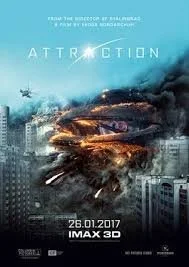
Six years later, the hit movie Attraction (2017) is a purely Russian production, directed by Fyodor Bondarchuk, transferring familiar blockbuster tropes to a Russian setting. An early scene of an alien craft crashing into the Chertanovo district of Moscow provides that particular thrill of urban architectural destruction familiar from such films as Independence Day. Aside from the visuals, one of the attractions of Attraction is that, like the best first contact movies, it seems to be about more than simply what we are seeing. The alien is benign, but the Muscovites who survived the consequences of his catastrophic landing are in no mood to greet him with the traditional bread and salt. Bondarchuk himself said the story was allegorical, with the extraterrestrial filling the general role of “Other,” while the screenwriters even went as far as saying they were inspired by the 2013 anti-migrant riots in the Moscow neighborhood of Biryulyovo. The political parallels are not exactly delivered with the lightest of touches (“You're from another galaxy? Well, we’re from Chertanovo!” shouts the mob as they go off in search of alien scum to pummel). It also doesn’t hurt that the alien visitor happens to look like he would be equally at home in either his spaceship or as the lead singer in a boy band. The main characters immediately find themselves in a love triangle that plays out like Romeo and Juliet, if Shakespeare had only though to include exoskeletons and death rays.[1]
The film's sequel, Attraction 2: Invasion (2020), ups the ante, as sequels usually do: now, for a variety of uninteresting reasons, the civilization that sent the alien heartthrob is now hellbent on destroying the planet. So far, so predictable: countless American movies have used the same scenario, with the United States as the default representative of the entire planet's interests and defense. Invasion simply Russia for America, with the occasional nod to contemporary geopolitics. The opening credits include news video clips from around the world, summarizing both the events of the first film and their consequences over the two years since, with a Russian reporter noting that, since Russia has refused to share the examples of alien technology salvaged in 2017, the West has instituted another round of economic sanctions. Meanwhile, Russia's newly-formed "Extraterrestrial Threat Prevention Unit" is doing its best to head off a repeat of the previous incursion, an endeavor that the film's very title shows is futile. Again, this is completely standard fare for the genre, but it can also be read as the SF extrapolation of the Putinist posture vis-a-vis an outside world that is considered hostile by default.
This is not to say that there is no threat; indeed, this being a sequel, the threat has doubled. Not only is Ra, the AI controlling the alien's spaceship, prepared to destroy the planet if it does not hear back from its master, but now Russia itself have been subverted by the aliens. Ra has taken over Russian media, broadcasting fake news about Yuliya, the heroine and love interest from the first film. She has been branded a terrorist who must be stopped at all cost. This is patently false, but what is true (and potentially disturbing to the status quo) is that, in the figure of Yuliya, alien influence has utterly transformed one of Russia's citizens. Thanks to the miracles of extraterrestrial technology, Yuliya has started to develop some of the same abilities as her alien heartthrob, Hekon (whom she calls Khariton). This, too, is an unsurprising plot point for an SF sequel/franchise: uplifting ordinary characters to superhumanity can function as anything from wish fulfillment to franchise building. Her status is complicated, because she is the main point of audience identification. But she is also an object lesson in the dangers of miscegenation and hybridization: when you sleep with the enemy, you become the enemy. At the same time, the speed with which the population believes the false information about Yuliya is bracing; still, by 2020, should the Russian audience truly be shocked by how easy it is to be declared an enemy of the people? In its own, small way, this film is playing with fire, as it implicitly encourages viewers to root for a "foreign agent."
Next: Invasion of the Capitalist Marketing Machine