Claremont was obliged to spend over three years tearing down the admittedly minimal work he had put into building Madelyne as a character, and put her on a path towards villainy. This could not have been easy, because the mandate to create X-Factor ironically made Madelyne truly sympathetic rather than just a cypher. Her husband's absence for most of her pregnancy might have been a red flag, but as she herself readily admits when she confides in Ororo in Uncanny X-Men 201, this was out of his control (he was brought back into the X-Men involuntarily). But when the end of the team's Asgardian adventures landed them in France, "Kitty phoned, you phoned, almost everyone called to see how I was. Except my husband." Soon after, Madelyne had to deliver her baby by herself, on the X-Men's kitchen floor. Upon his return, Scott is so alienated from his family that he duels Ororo for leadership of the X-Men when Madelyne wants him to return home with her and their newborn son. Madelyne still hopes he'll come back to them, but has few illusions about the scenario: "Why can't it be because he wants to, instead of because he has no other choice?" The very next month, Jean is back, X-Factor debuts, and Scott abandons Madelyne and the baby without a word of explanation. The next time the reader sees Madelyne, in Uncanny X-Men 206, she is lying on a stretcher in a San Francisco hospital, suffering from multiple gunshot wounds and unlikely to last the night.
Thus commences the next phase of Madelyne's haphazard life: as fugitive from a group of mutants called the Marauders, who inexplicably want her dead. The Marauders were the perpetrators of the Mutant Massacre (which crippled several X-Men and decimated the subterranean Morlock population). Their mastermind is the newly-introduced Mister Sinister, who at the time was a generic villain with under-explained motives. [1] After Madelyne wakes up from her coma in Uncanny X-Men 215 (having healed at a rate that surprises her doctors), she is once again targeted for murderer. One of the Marauders, Scalphunter, explains his mission to Madelyne in a manner that is surely metafictional: "You're a loose end."
And, indeed, for the next several issues, even as the X-Men become embroiled in a potentially reality-destroying conflict, Madelyne struggles to be something other than superfluous to requirement. Interestingly, she forms a bond with Havok, Scott's younger son Alex, who, now that his lover Polaris has been possessed by the evil spirit Malice, is also at a loss to find a place for himself. Though his current emotional turmoil is a result of recent events, there is a stronger reason that he and Madelyne become kindred spirits: Alex had always been the superfluous Summer brother (before other writers threw in a third and even a fourth years later). He and Madelyne have been secondary to Scott both in the X-Men franchise and in their own lives. For now, Madelyne's only solace is to turn her very superfluity into an asset, speaking to human reporters on the X-Men's behalf, and even volunteering to help Dazzler stay in the fight after the impalement of Destiny's mask onto head renders her blind ("I'll be her eyes!").
Once the X-Men are brought back to life and safely deposited in Australia by the goddess Roma, Madelyne makes herself useful to the team by managing all their technology, surveillance, and communications while the book bides its time for the next crossover event, Inferno. Madelyne herself is the spark for this particular conflagration (although she has help from Illyana and a demon or two): when she chances on television footage revealing that Jean Grey is alive, well, and very close to Cyclops, she undergoes a psychic and magical journey that finishes what the last three years of plots had started: as a character, she is completely dismantled, only to be built back up again. Her entire life so far is briefly recapitulated in fantasy form: first, she is an angel flying free in the bucolic countryside, on her way home to her beloved husband and child. Then her peace is shattered by the appearance of a naked, female figure utterly without features, who immediately steals her husband. Cyclops tears off Maddy's wings and gives them to this mannikin. Then he hands her the baby, followed by Madelyne's hair, mouth, and eyes, turning this intruder into the "original;" Jean Grey. Madelyne, Scott explains, is just a copy ("Dawn of Blood," Uncanny X-Men 233, by Claremont, Sylvestri and Green). It is now Madelyne who is featureless: "A nothing being./ In a nowhere place. /Abandoned..../...and alone."
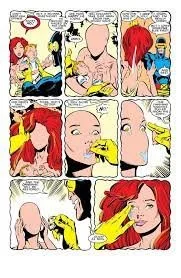
This vision of Madelyne's dismantling handily sums up her experience within the X-Men Franchise itself: she and Jean are in complementary distribution. As the title of the trade paperback collecting the stories in which Mastermind convinces the X-Men that Madelyne is actually Jean (From the Ashes), she is all that could be rescued from Phoenix's funeral pyre, until suddenly, she isn't. What could be a better sign of her secondary status than the cannibalization of every one of her features as part of a project to rebuild Jean Grey? She began as the embodied likeness of a character whose absence left a significant hole in the franchise, and now she has to give that likeness back.
In Madelyne's vision, the landscape resembles the comic's depiction of the Australian outback where the X-Men then resided, but as she moves through it, it first transforms her, and then is itself transformed. The heat bearing down on her "forges" her, "paring her down to her essence.../making her one with the land" ("Glory Day," Uncanny X-Men 234, By Claremont, Silvestri, and Rubinstein). Her featureless surface melts away, leaving her once again looking like Madelyne. But why say that she is "one with the land"? And why is she greeted by S'ym, the demon who once served the monstrous Belasco, and until recently was bound to Illyana Rasputin?
In her transformation into the "Goblin Queen" (effected by S'ym this issue), she is on her way to ruling the domain of Limbo and overrunning our world. It is an odd turn for Madelyne, who previously had no connection either to magic or to Illyana's realm, but it is more than just an unmotivated plot twist. Madelyne can rule Limbo because she has been stuck in limbo, both metaphorically (since the decision to return Jean Grey to life) and literally (when she wanders through an empty waste land). No wonder she becomes "one with the land;" as a character who has become surplus to requirement, "limbo" defines her entire existence. This, in turn, justifies a crossover that hinges on both Madelyne and Illyana (whose entire backstory and recent plotlines are all based on her childhood exile to the Limbo that Claremont and Anderson introduced in Uncanny X-Men 160). Inferno is the story of two insanely powerful women whose fate is always about exile, suffering, loss, and superfluity.
Note
[1] Claremont's original plans for him was that he was a child's conception of a villain (hence the ridiculous name, and some of his dialogue). Subsequent work by many other creators took Mister Sinister in a very different direction.
Next: Burning Down the House