Jean Grey’s next resurrection is not particularly satisfying, a retcon establishing Jean and the "Phoenix Force" as separate entities means that the emotional roller coaster extending over 37 issues of the X-Men wasn't about Jean at all. The Phoenix Force also makes the Phoenix a portable entity that can attach itself to others, threatening to drain the Phoenix concept of anything that makes it unique. [1] Jean herself has been cloned (Madelyne Pryor), and both her clone and alternate future versions of her have produced now-adult offspring (Cable and Rachel Grey Summers). Only when Grant Morrison gets his chance to write her and ignore the worst aspects of the Phoenix Force retcon does Jean's fundamental connection to death and resurrection become a feature of her character that is recognized even within the X-Men storyworld.
Morrison pushes Jean out of her many, many ruts: her marriage to Scott Summers is ruined when he has a psychic affair with Emma Frost, but also her wishy-washy status as a non-quite Phoenix (she had previously reclaimed the name and even the costume, but not the powers). Now, possibly thanks to a clever plot device called "secondary mutation" Morrison introduces off-camera, Jean once again manifests the Phoenix raptor and even conjures up a Phoenix persona to talk to Professor Xavier, who is worried about the ramifications of the Phoenix's return:
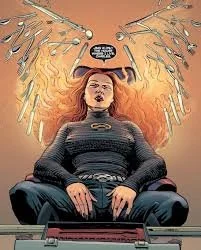
Technically, I think this makes her a haunted house.
Jean is just the house where I live, Charles.
I am born and consumed in blood and flame and sacrifice.
And return.
Always coming back. ("New Worlds," New X-Men vol 1, 128, by Morrison and Igor Kordey)
The Phoenix is no longer about the temptation to become "evil;" it is about "how it feels to be the last hope... and to know you'll win against the odds." Destruction is part of the Phoenix's job, and dying and coming back is her essential nature. Which means it is also Jean's.
Morrison's reestablishment of the Phoenix's cyclical nature is a perfect fit for their project on New X-Men: while Morrison non-stop innovation was a breath of fresh air for a franchise that had been treading water for years, they nonetheless leaned into the repetitive patterns of X-Men plots in order to foster the sense of novelty that characterized their years on the book. Morrison's run revisited all the hits of the Claremont/Cockrum/Byrne era: the Sentinels, a climactic battle with Magneto, struggles against reality-distorting villains (Proteus in the 1970s, Cassandra Nova and the denizens of the World in New X-Men), dystopian alternate futures ("Days of Future Past" vs. "Here Comes Tomorrow"), and, naturally, the death and rebirth of Jean Grey. But where Jean's suicide was an externally-imposed plot twist following several years of build-up towards her turn to the dark side, her death(s) in New X-Men were not the obvious outcome of internal plotting, but instead the understandable expression of Morrison's desire to reinterpret the X-Men's glory years. Morrison also ups the ante: while Jean's first death in New X-Men echoes her demise on the space shuttle (she and Wolverine are on a spaceship hurtling into the sun), what she rescues is not merely the team itself, but its future. In Morrison's concluding, dystopian storyline, Jean comes back to excise the dismal time line that resulted from her death and from Scott's turning his back on the team. She does not merely save the X-Men. She saves The X-Men.
As she explains to Logan right before her first death during the Morrison era, the Phoenix is not simply a creative or destructive force: "it's more like...it burns away what doesn't work." The Phoenix is all about "blood and flame and sacrifice;" it "burns and disinfects... and dies to return" ("Planet X (Part 3): Survivor Type," New X-Men volume 1, 148, by Morrison, Phil Jimenez, and Andy Lanning). As she is explaining all this, both she and Logan are close to burning to death, but they are also the two X-Men on whom death has the most tenuous grip (Logan's healing factor brings him back from nearly anything). In a reversal of her suicide at the end of the Dark Phoenix Saga, instead of killing herself before the man she loves, she dies from a mercy killing at the hands (or rather, claws) of the other man she loves. And, of course, she comes back, in time to save Logan, fight Magneto, and die yet again at his hands.
Jean will be (mostly) dead for the next fourteen years, but there could be little doubt that the situation was temporary. More than that, it would no longer be a cheat: Morrison establishes death and resurrection as Jean's superpower, an essential part of her character. She is Phoenix; it's in the name.
The next decade and a half will prove this point, with both Jean and the Phoenix brought back in a wide array of largely uninteresting iterations. The 2005 miniseries X-Men: Phoenix - Endsong (by Greg Pak, Greg Land, and Matt Ryan) spends five issues literally robbing Jean's grave. The Phoenix Force tries to reunited with its favorite host, but Jean protests that it is "too early," resulting in five issues of Jean as Phoenix coming back to life and dying repeatedly, before her body returns to the ground and her spirit returns to the White Hot Room (where Phoenixes go to die). In 2012, the Beast brings teenage versions of the original X-Men to the present, which means that a Jean Grey who never became the Phoenix will be on the scene for the next six years. Original Jean is finally revived by the Phoenix Force in 2018 but refuses to merge with it, and teen Jean is sent back to the past.
It is worth noting, however, that Jean's 2018 resurrection also allows Cyclops to be brought back from the dead (another long story). By this point, Jean's connection to death and rebirth has been taken for granted both by her teammates and by her readers, but the comics had yet to acknowledge that resurrection was no longer simply about Jean Grey. The original Phoenix Saga made the death of a beloved character a key story beat for the X-Men franchise, at the same time that it served as reminder of death's impermanence in the Marvel universe in general and for the X-Men in particular. By the time of the X-Men's line-wide reboot in September 2019, nearly all the characters had died and come back at least once: Colossus, Storm, Rogue, Wolverine, Professor Xavier, Archangel, Jubilee, Psylocke, Havok, Cable, Polaris, Dazzler, Cannonball, Cypher, Northstar, Emma Frost, Magik, Warlock, Blink, Monet, Strong Guy, Jamie Madrox, and, after holding out against death the longest, Nightcrawler.
This reboot, spearheaded by Jonathan Hickman, was the most radical change in the X-Men's status quo since Wolverine and co. joined the team. But it was also built out of a set of ready-mades--the defining tropes of the X-Men franchise. This sounds like what Morrison did on New X-Men, but Hickman upped the ante. Morrison's revision of the X-Men involved reprising well-known story beats and putting their own particular spin on them. Hickman appears to have gone through the entire history of the X-Men franchise in order to isolate the features that were fundamental to the X-Men, though not all of them were immediately obvious. And the key to Hickman's interpretation of the X-Men? Death and resurrection.
Note
[1] As of 2026, the Phoenix has been hosted by Jean Grey, Madeline Pryor (partially), Rachel Grey Summers, Quentin Quire, Hope Summers, the Phoenix Five (Namor the Sub-Mariner, Magik, Colossus, Emma Frost, and Cyclops), Wolverine, Echo, Charles Xavier, a few of the Stepford Cuckoos, She-Hulk, Luke Cage, Moon Knight, Shanna the She-Devil, Reno Carlotta, the Black Panther, the Black Knight, Dr. Doom, and Shang-Chi. And that's only on the primary Marvel Earth (616).
Next: The Island of Misfit Mutants