Nobody dies quite like Jean Grey. Introduced as Marvel Girl in the very first issue of X-Men ("X-Men," Vol 1 #1, by Lee, Kirby and Paul Reinman, September 1963), she was, as her name suggested, the only "girl" on a team of "boys." As such, she was an object of romantic interest on the part of many of them (including, at one disturbing moment, their middle-aged teacher, Professor Charles Xavier), a frequent damsel in distress, and a typical Stan Lee heroine whose powers (in this case, telekinesis) required her to point, strain herself, and faint into the waiting arms of one of her teammates. Soon she added telepathy to her power set, but her role throughout the entire first run of X-Men (1-66, September. 1963-March 1970) was circumscribed, first by Lee's retrograde approach to female characters, then by Lee's legacy once he left the book. Had she actually died during this initial run, her demise would probably have served merely to advance the character arc of her boyfriend, Scott Summers (Cyclops); but such fridging wouldn't really start until Gwen Stacey's death three years after the X-Men's book was canceled.
When the X-Men was revived as multiethnic, international team of mutants in Giant-Size X-Men 1 ("Deadly Genesis!" by Len Wein, Dave Cockrum, and Peter Iro, May 1975), Jean, like all of the original X-Men save Cyclops, was about to be set aside in favor of their replacements. But Wein left the book, and when Chris Claremont took over, he was not done with Jean. Even though she was no longer on the team, she was still in a relationship with Scott, which meant she was with him when the mutant-hunting robot Sentinels attacked them on Christmas Eve ("Merry Christmas, X-Men - The Sentinels Have Returned!", X-Men vol 1, #98, by Claremont, Cockrum, and Sam Grainger, April 1976). Two issues later, the X-Men (plus Jean) are escaping a ruined space-station in a shuttle lacking the shielding to protect them from a solar flare. Jean uses her telepathy to gain the knowledge necessary to pilot the shuttle and knock Scott out to keep him from stopping her. Ordering the X-Men to take shelter in the one part of the shuttle that still has shielding, she guides them through the solar flare, her telekineses initially protecting her from the radiation before she succumbs and dies. The ship crash lands in Jamaica Bay. The end.
Well, not quite. As the rest of the X-Men are swimming to the surface, Jean suddenly shoots into the sky, wearing a striking new costume and sporting fabulous hair, shouting, "Hear me, X-Men! No longer am I the woman you once knew! I am Fire and Life incarnate! Now and forever--I am PHOENIX!" ("Like a Phoenix, from the Ashes, X-Men Volume 1, 101, by Claremont, Cockrum, and Frank Chiaramonte, October 1976). She immediately faints like Marvel Girl, but this time she has an excuse: not only has she saved the entire team, but she has died and come back to life.
Initially, her resurrection serves as a new origin for a new version of an old character ("Bitten by a radioactive phoenix, young Jean Grey.."). With Jean recuperating in the hospital and shunted to the sidelines for the next four issues, her death might seem to be merely a vehicle for her reinvention as a cosmic powerhouse, although Jean herself makes clear that there is something more going on, asking a friend, "how would you feel if you'd ..died, then brought yourself back to life?" ("Who Will Stop the Juggernaut?" X-Men Volume 1, 102, by Claremont, Cockrum, and Springer, December 1976). As her new superhero name suggests, Jean is now linked to the fundamental forces of life and death; and, even though Claremont and Cockrum may not have intended it, her name also indicates that death and resurrection may not be a one-time deal. Just a few issues later, she comes close to single-handedly saving the universe from blinking into non-existence, but finds she needs the life-energy of her teammates to seal the deal (giving her a brief, and disturbing, sensation of vampiric pleasure). As she knits reality back together, she has a vision of herself and the X-Men as the Tree of Life from the Kabbalah.
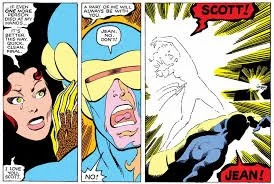
I actually remember where I was when I first read this comic
For the rest of this particular incarnation on the mortal plane, Jean/Phoenix will continue to be caught up in cycles of life and death. Just six issues after she stops the universe from falling apart, the X-Men battle Magneto inside a volcano; Jean and Hank McCoy escape to the surface thanks to her godlike powers, while the rest of the X-Men tunnel their way to the Savage Land. For the next year's worth of comics, the X-Men think Jean has perished, and Jean thinks the same of them. This facilitates the ongoing subplot of Jean's seduction to the dark side, when Mastermind convinces her that she is traveling back in time and reliving key moments in the life of a highly immoral ancestress. By the time she and the X-Men are reunited, it is too late: in just a few more months, she will first dress like a mutant dominatrix and become the Black Queen of the Hellfire Club, then descend into madness as Dark Phoenix. Dark Phoenix defeats the X-Men, travels into space, and consumes an entire star to fuel her growing need for power, resulting in the deaths of billions of sentient beings. Brought back under control by Professor X and Scott, she is nonetheless pursued by the Shi'ar Empire, and kills herself rather than succumb to Dark Phoenix again. Editor-in-Chief Jim Shooter insisted that this was the only reasonable punishment for the genocide of the alien D'Bari, overruling the original plans by Claremont and Byrne, who soon came around to the notion that the story was much more powerful with Jean's death. They were, in fact, resolute on the question: Jean must not be brought back. In real time, she would remain dead for five and a half years.
Next: Death Becomes Her