Fresh off a ground-breaking run on Captain Marvel that introduced the death-loving Thanos into the Marvel Universe, Jim Starlin revamps Warlock again. [1] No longer is Warlock a kind of Space Hippie Jesus; now he is at the center of a cosmic drama that encompasses every aspect of existence. Warlock must fight the Magus, the god of the Universal Church of Truth, who turns out to be a future version of Adam himself. The fact that Adam is aided by Thanos of all people is not just evidence that Starlin wants to take his favorite characters with him, but a sign of the direction in which Warlock the hero and Warlock the series were going: Adam Warlock, who had already died and been resurrected once, and whose cocoons ensure the possibility of repeated rebirth, would become a vehicle for death-focused storytelling. It is Thanos who convinces Adam that the only way to stop the Magus is to commit "cosmic suicide." In a particularly trippy sequence, Adam jumps ahead a few months to his own future, encounters his embittered, dying self, and kills him, absorbing his soul into the Soul Gem. Then, a year or so later, he replays the same scene again, this time as the dying self who cannot wait for it all to be over. Even then, Warlock's soul was not extinguished, but rather living on in the Soul Gem along with all the gem's other victims. Adam is recalled to reality one last time to kill Thanos, and then goes back to his supposedly eternal reward.
This was not the end for Adam Warlock, of course, but Marvel did let him stay (mostly) dead until Starlin returned to Marvel with a plan. Once he is revived for the Infinity Gauntlet crossover, Adam will endure repeated cycles of death, cocoon, and rebirth, each time coming back somewhat altered. Starlin would come and go, and eventually, Warlock would find himself in the hands of other creative teams. But even in Starlin's absence, Warlock is defined by his repeated deaths and resurrections, continuing to serve as a narrative engine for the preoccupations Starlin introduced. Starlin, after all, is the author of the aforementioned Death of Captain Marvel graphic novel, as well as a miniseries in which Thanos kills off the entire Marvel Universe (obviously, that didn't last), and also was responsible for killing off Jason Todd at DC. And, not to put to fine a point of it, his signature creation is Thanos, the death-worshipping Titan whose name is a shortened version of the Greek word for death. Starlin single-handedly did more for the centrality of death to the superhero genre than the rest of the Seventies Marvel bullpen combined (and since that bullpen included Chris Claremont, this is a real achievement).
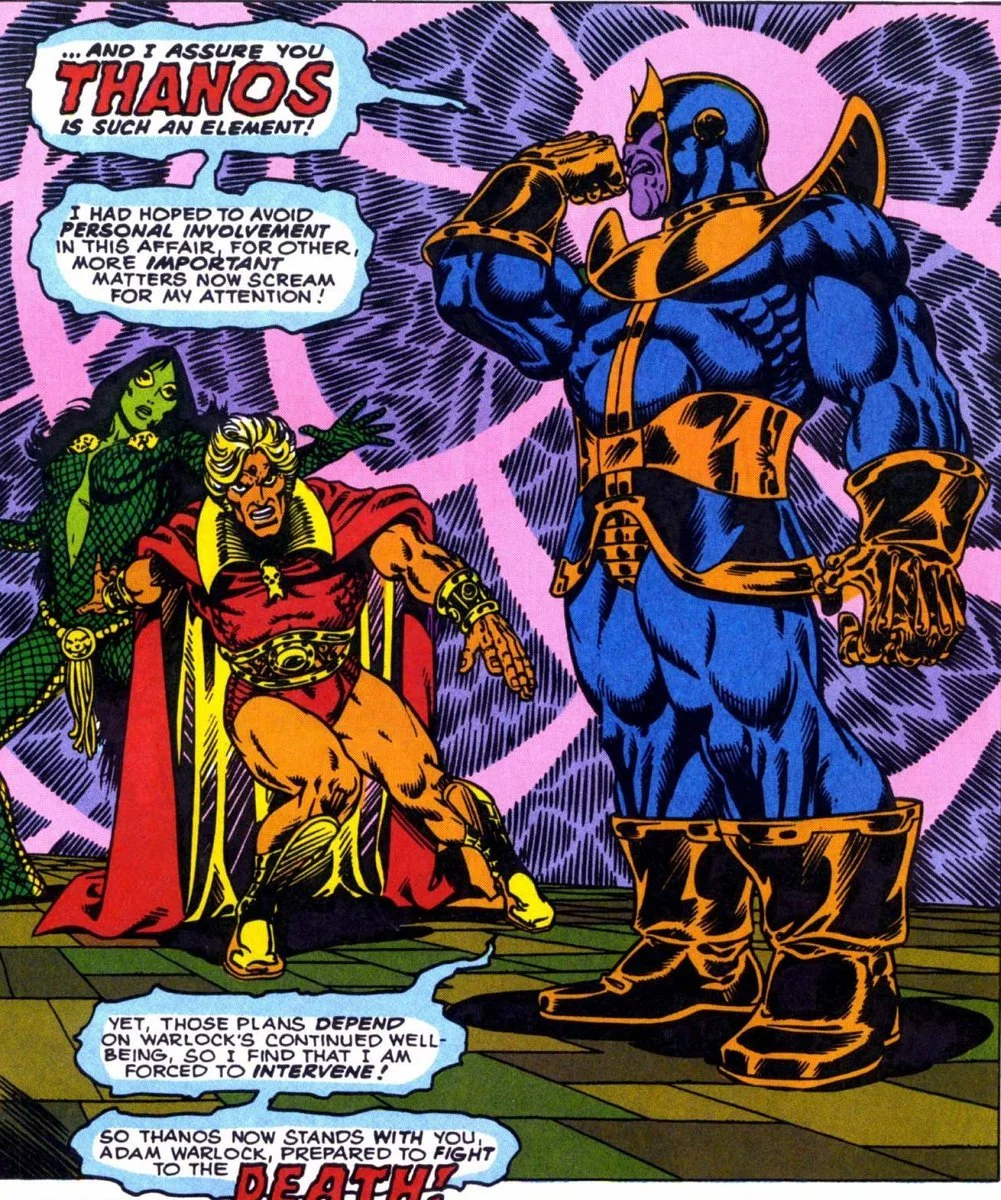
Gotta give it to Thanos: the man can monologue with the best of them
Thanks to Starlin, Thanos has become the signature Marvel cosmic threat. There are other villains who have had name recognition for longer: the Green Goblin, Doctor Octopus, Doctor Doom. None of them match Thanos in power and scope. The one who comes closest is Galactus, introduced by Lee and Kirby in the 1960s Fantastic Four. Before Thanos, Galactus seemed to be at the top of the cosmic food chain: the survivor of a now dead universe with an insatiable hunger for biospheres, Galactus consumes entire planets. In the 1980s, John Byrne would establish Galactus as a fundamental principle of our universe, sister to Death herself. But Thanos, death's spurned lover, wants to annihilate the entire universe (or sometimes just half) as a token of his love. Starlin took Thanos's name not simply from the Greek word, but from Freud's opposition between Eros (the life drive) and Thanatos (the death drive), as the artist made abundantly clear by giving Thanos a brother who is actually named Eros. Starlin loves metaphysical dichotomies, including Chaos and Order (borrowed from Michael Moorcock and turned into abstract entities that structure our cosmos) along with life and death. His heroes are forces for life; his primary villain is the champion of death.
Starlin's Marvel work is strongly connected to Warlock, Captain Marvel, and the Silver Surfer, all of whom have dedicated fanbases, yet none of them has had the staying power of Thanos. Thanos has even had his own series several times (first by Starlin, then written and drawn by others); he is not the only villain to claim this honor, but it is certainly telling. In putting Thanos at the center of so many stories in both the Marvel Universe and the Marvel Cinematic Universe, the company has tacitly embraced Starlin's life/death dichotomy. In doing so, it has also accepted the centrality of (serialized, reversible) death to its storytelling.
The fact that Thanos has died and come back several times is not in and of itself remarkable; the rules for villains have always been more lax than for heroes. The villain's death is often deployed as the logical end to a conflict with a powerful, often homicidal foe; sometimes, we find out how the villain actually survived; sometimes the villain is actually resurrected, and sometimes no explanation is given or needed. A hero's death and return might be structurally homologous to that of a villain, but there is a different affective dimension. The readers are invited to invest emotionally in the hero and mourn the loss in a manner that is only sometimes associated with the villain (and usually in cases where the villain has been humanized and allowed to dominate the spotlight). If the hero dies and quickly comes back, the pathos prompted by the hero's death can become retroactively pointless after the hero's resurrection.
Hence the disdain behind the term "revolving door of death." It is easy to be disappointed in the frequency with which heroes die and return, but the past three decades have seen a transformation in the function of repeated resurrections, as creators lean into the transitory nature of comic book death for productive effect. The revolving door of death, once recognized and accepted, has become a narrative opportunity. It is also a clear sign that corporate superhero comics have entered their decadent phase, embracing excess as a defining aesthetic and philosophical feature.
Note
[1] Technically, Thanos appeared a few months earlier, but it was all part of Starlin's Captain Marvel-centered ongoing saga.
The Many Deaths of Jean Grey