Death, Disability and the Superhero is the most comprehensive study of superhero mortality, but Alaniz's primary focus is the story of actual, irrevocable death (as in his chapter on Strikeforce: Morituri and his reading of Jim Starlin's 1982 graphic novelThe Death of Captain Marvel. The one exception is his chapter on The Death of Superman, DC's most thanotropic superhero event. Superman's death at the hands of the monstrous Doomsday in 1993 brought the character more media attention than he had received in recent memory while he was still alive, and played a key role in the speculator boom that severely damaged the entire industry. At the time, I remember being nonplussed by the media coverage, which seemed to take his "death" at face value: surely, no seasoned comics reader (not to mention anyone who could read a balance sheet) actually believed that he wasn't coming back? Alaniz uses the nearly year-long storyline as a chance to study one of the rare cases in which everyone in an entire superhero universe was coping with the loss of one of its central characters. Sustained mourning was not typically a comic book selling point.
Of course, we all know (and Alaniz certainly knows), Superman came back. Just as Wonder Woman has come back from at least five deaths in the post-Crisis era, Batman from three, and Marvel's Jean Grey from too many to count. This is a phenomenon that the anonymous Quarter Bin blogger memorably names "The Revolving Door of Death," and which Alaniz himself discusses at some length. The term has gone on to have great currency in the comics world; like fridging, everyone seems to know about it and understand its role in superhero storytelling. Quarter Bin began their "Revolving Door of Death" series of posts in 2002, by which point the phenomenon was already well-known, if not named (Superman himself had only been back from the dead less than a decade). In the more than two decades that have past, the Revolving Door of Death has ceased to be simply an element of comics debated by creators and fans; now it is often part of a more self-aware corporate superhero storytelling. Where once it could be dismissed as simply a cliché, now it is a fundamental instrument in the storyteller's toolbox. The Revolving Door of Death, it turns out, is not a bug, but a feature.
Certainly, a character's death and resurrection can be a mere stunt or narrative feint. Wonder Woman dies during the 1991 War of the Gods crossover, but is brought back the very next issue after a brief stint in the underworld. John Byrne kills her again in "Ascension" (Wonder Woman vol 2 127, November 1997), but barely: her soul is immediately brought to Olympus, where she become Goddess of Truth. Even dead, she is still part of the story, and her death was merely a pretext for her mother's assumption of the mantle (and for sending her back in time to World War II so that DC had a Golden Age Wonder Woman again). She dies again in the Death Metal crossover, once again ascending to divinity before returning to Earth. The common feature to all these deaths and resurrections is that Wonder Woman is left unchanged by the experience. Far from existential, these are plot-advancing deaths. They can be referenced and subsequent issues, but they are no more meaningful than past storylines in which she lost the Wonder Woman title, or traveled into space.
There are, however, many other temporary deaths that are vehicles for character growth. Particularly in the 1970s, heroes would die and return in something resembling a rite of passage or a shamanic journey, returning with new wisdom or new capabilities. When Steve Englehart and Frank Brunner kill Dr. Strange at the end of his fourth issue ("...Where Bound'ries..Decay," Volume 2, Issue 4 with inks by Dick Giordano and Bob Wiacek, October 1974), there is little to no suspense involved. In order to escape the realm of fantasy in which he is trapped, he must embrace death completely. His death barely lasts a page; before returning to the land of the living, he has a brief conversation with his (dead) mentor and realizes that he has gained enlightenment from the experience (now his forehead bears an ankh symbol that will appear whenever death is near). The reader did not have to wait a month (or, in this case, two) to find out if Strange was ever going to come back, because that was not the point.
Dr. Strange was just one example of transcending to another realm of consciousness by transcending death itself. In the 1970s, this was common enough to become close to a cliché, extending to the most unlikely an obscure properties, such as David Micheline's and Don Newton's all-but-forgotten Star Hunters. A seven-issue series abruptly cancelled after its seventh issue during the famous "DC Implosion" of 1978, Star Hunters featured a rag-tag team of misfits exiled from Earth by the evil Corporation (its actual name). Its leader was a solider of fortune named Donovan Flint, a muscular, hairy-chested rogue straight out of Seventies central casting, yet even he gets the opportunity to commune with an omniscient, mysterious entity (called "the Entity") after briefly dying at the end of the third issue. He returns superficially unchanged, but with a new sense of purpose that he finally explains to his comrades just a few pages before cancellation.
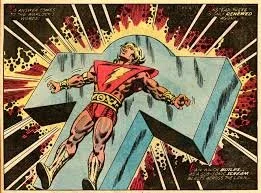
If death and resurrection sound at all familiar, there is a reason for that, one made crystal clear by one of the earliest such cases in Seventies Marvel: the first death of Adam Warlock. Created as the mysterious "Him" by Lee and Kirby in a storyline in Fantastic Four, Adam is given his name (and a mysterious Soul Gem) by the High Evolutionary, a godlike scientist who also transcended humanity through a kind of death. The High Evolutionary had just created Counter-Earth, a copy of our planet but obscured to us by its position on the other side of the sun. He had intended it to be a utopia, but the interference of his evil creation the Man-Beast unleashed evil on the Counter Evolutionary's experiment. The High Evolutionary asked Adam to go to Counter-Earth and try to teach humanity a better way.
Something about this scenario is familiar, but it’s too subtle for me to figure out
If we recall that the High Evolutionary basically adopted Adam, we see a very familiar scenario: the creator of the Earth has sent his son down to redeem it. Over the course of his short-lived series, Adam gathers followers (or disciples), and is eventually betrayed into the hands of his enemies. What happens next is therefore not a surprise, except for the fact that it involves the Incredible Hulk (whose comic was used to wrap up the story after Warlock's cancellation). Warlock is bound to a cross and publicly executed; in his last moments, he forms a cocoon around himself (Warlock was born from a cocoon, and retreats into cocoons at crucial moments). Hulk and the disciples take him to a cave; three days later, he burst free of the cocoon, defeats his enemies, and takes his leave of Counter-Earth to explore the stars.
This is when Jim Starlin gets his hands on Adam Warlock.
Next: More Death, Please