Chapter 4:
Crisis and Event, or, Punching Reality in the Face
Crossing Over
Something strange happened to the superhero comic in its middle age. The depredations of midlife were not as obvious on the comics as they were on the readers of roughly the same vintage; comics are blessedly immune to paunches, hair loss, and all varieties of sagging. For stereotypical straight men, midlife crisis means having an affair or buying a sports car. For DC comics, it meant a Crisis of Infinite Earths, while Marvel opted to skip right to second childhood, hooking up with a toy company and playing with all its action figures in Marvel Superheroes Secret Wars (more commonly referred to as just "Secret Wars").
The Eighties inaugurated what looks to be a never-ending cycle of comics crossovers that rope some or all of a company's titles into servicing a plot that usually manages to disappoint before the story is over. Starting with Crisis on Infinite Earths, DC would lean into continuity-shuffling crossovers, sometimes including reboots, while Marvel, with one notable exception, generally avoids turning its own continuity into the subject of drama. Instead, and with no particular connection to the original Secret Wars event, Marvel would become preoccupied with its own potential, in the form of alternate futures that left the present mostly intact.
"Crossover" has turned out to be too bland a term for most of the stories we are talking about; after all, comics had been crossing over with each other for years, with a story starting in one character's title and concluding in another. Such crossovers (which still happen) are fairly self-contained. They are a slightly more convoluted variation on business as usual. The line-wide crossover (involving either an entire company, such as DC, or a recognizable set of related books, such as all of Marvel's mutant titles or all of DC's Bat titles) has come to be called an event.
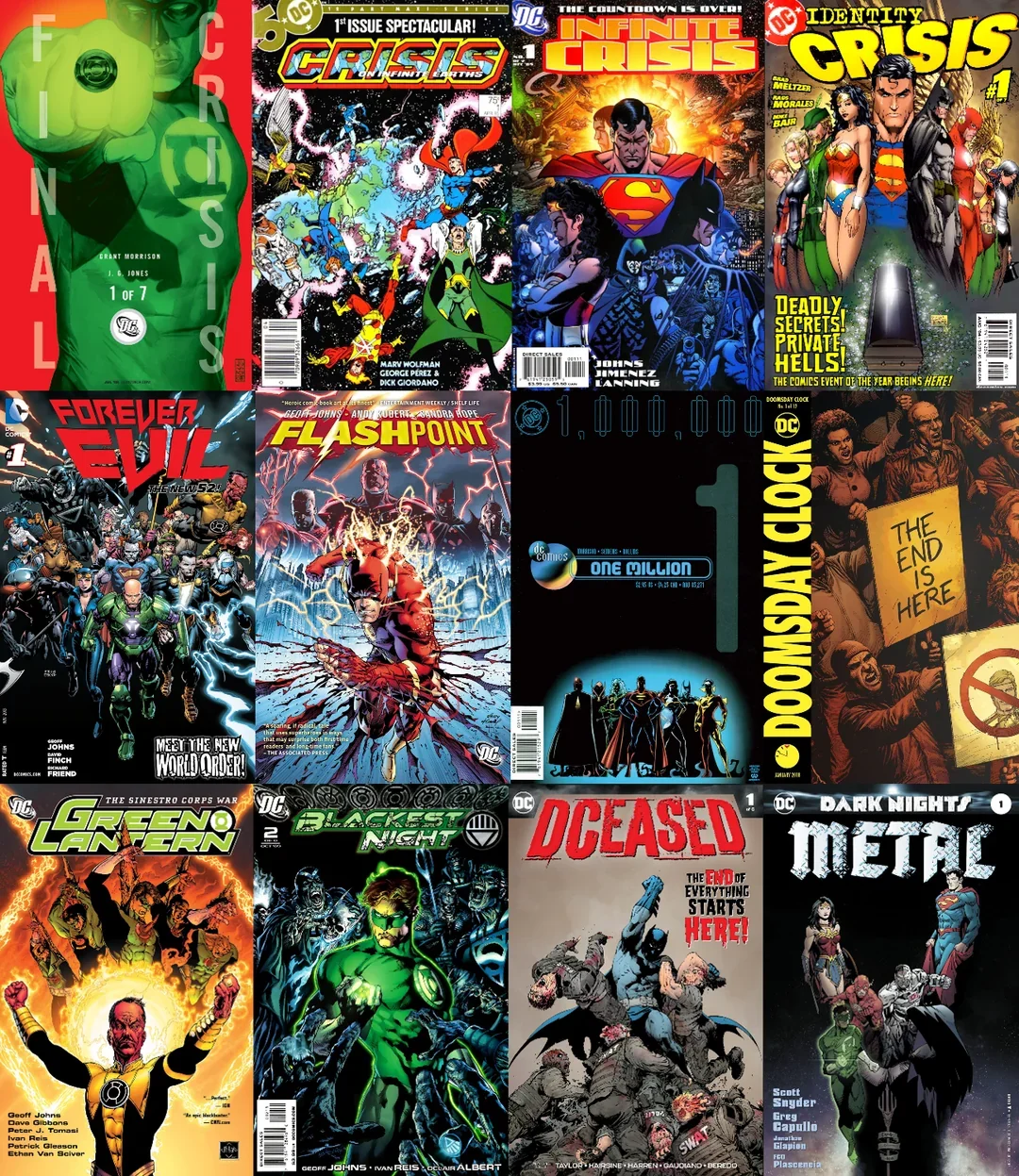
Yes, I’ve read all of these. Sigh.
For individual comics titles, events can be unwelcome interruptions in the ongoing plots that might have little to do with the crossover. They are in the service of the larger story. But events do more than simply develop a grand plot involving most of a company's characters; they define the company's comics for months or even years to come, articulating the comics' overall mission (sometimes well, sometimes poorly). They also establish or reconfigure the relationship between the comics, their creators, and their readers. These events model the interpretive behavior of "good" and "bad" readers, often through characters who function not as figures of reader identification, but as representations of the act of reading itself. Crossover events are a more mainstream iteration of what is otherwise an avant-garde approach to comics--comics as metafiction that does not demand a great deal of philosophical engagement on the reader's part. The modern comics event, particularly as exemplified by DC's multiple "Crisis" crossovers, is predicated on a great deal of reflexivity and self-referentiality masked as superhero plots. The promise is that a given comics universe will be changed irrevocably, but it is a change that is also to be experience by the reader, of whom the event demands a realignment of perspective.
Crossover events, and, in particular, DC's Crises, are typically overstuffed with protagonists and plot; there has yet to be a line-wide event that could in any way be called "minimalist." The scale is the point, and the aesthetics are usually monumental, if not bombastic. But that is the thing about excess: there can never be too much of it. Or rather, there can appear to be too much of it from the point of view of aesthetics or reader satisfaction, but not because of any inherent value in restraint. The end of this chapter introduces what might be called the decadent phase of the DC Crisis, when the self-reflexive concerns of continuity combined with the demands for greater spectacle and scope lead to comic that revel in their capaciousness, high-concept, and increasingly baroque world-building.
Next: Events and Their Horizons