"Event" is a word that holds a promise: what happens in these pages will be significant. In the case of a crisis, that significance is self-referential, turning onto the very premise of the company's storyworld. But no matter the scale, an event promises change. Secret Wars delivered on that promise immediately, but superficially: For a while, Spider-Man had a new costume (one which would literally take on a life of its own, as half of the antihero Venom), She-Hulk replaced the Thing on the Fantastic Four, Colossus broke up with Kitty Pryde, and Marvel got its second in what would prove to be a long line of Spider-Women. Crisis on Infinite Earths resulted not just in change, but in change on a metextual level: continuity-threatening disasters became one of the company's most recognizable genres.
Calling a story an "event" is first and foremost a question of marketing, one that, with enough repetition, becomes a question of genre: what constitutes a comics "event"? Readers' and critics' reactions take into account more than just the quality of the storytelling; fans want to know if an event truly matters, and for how long. As a thought experiment in an imaginary (and therefore controllable) universe, superhero comics events have philosophical ramifications, not just about the apparently unstable nature of (fictional) reality, but also about the very nature of an event as a concept. In addition to the metaphysical questions, these events also raise concerns about ethics, returning us to the the themes raised in this book's introduction: do I dare disturb the universe? Who gets to intervene, and when?
Addressing these questions turns out to be a job for...French philosopher Alain Badiou. This is not to suggest that Badiou, a towering figure in the study of ontology, has ever turned his attention to the ins and outs of DC's Sinestro Corps War, or investigated the status of being in Marvel's Avengers vs. X-Men. Instead, Badiou has had to content himself with the much less flashy pleasures of trying to make peace between the implacable enemies known as continental philosophy and analytic philosophy. One of his most important works, Being and Event, came out in 1988, coincidentally just a few years into the comics industry's love affair with the crossover event. By no means do I wish to suggest that this coincidence is, in itself, significant, nor do I want to bring in Badiou just because he wrote a book with "event" in its title. [1] Badiou is useful here because his approach to the event is based on multiplicity, rupture, intervention, and ethics.
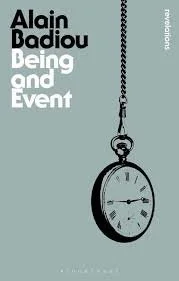
Come on, Alain, admit you’re a fanboy at heart
In writing about the Event, Badiou targets the usually unquestioned dominance of a sociopolitical system (and its often invisible ideology) at a point when the illusion of its permanence or inevitability is dispelled. Badiou's model of the event is the revolution, when that which has been denied or excluded by the dominant paradigm erupts onto the scene. But this is not Marx's revolution; rather than being the inevitable product of the logic of history, an Event is radically contingent. It could just as easily happen at the moment it occurs as at many other possible moments. Events disrupt the old order and begin the construction of the new.
His four examples of such historical Events (the Paris Commune, the Russian Revolution, the Maoist Revolution, and May 1968) are undeniable momentous (although 1968 looks likely to recede in historical importance along with the generation that drove it). Certainly, nothing in corporate comics could be commensurate with these undeniable sociopolitical upheavals. And yet...
Badiou's Events are momentous and portentious at the same time, promising an irrevocable break with the reigning order. At the time of an Event, it may seem to be part of the current situation, rather than the thing that will bring that situation to an end. Part of the "eventness" of the Event come with the moment of recognition, or decision: naming the Event as an Event, declaring its import through nomenclature. The Event is the public recognition of the finitude of the current order, with an entirely new model emerging from the rupture. Reality as we know it is reorganized.
Badiou, of course, is talking about the social order, ideology, and socioeconomic systems, even if he he is using language more suggestive of metaphysics. The laws of nature (however we define them) remain untouched, while the laws of the social are rewritten. The Event in comics resonates with Badiou on the level of rhetoric and of consequence. Badiou writes as if he is talking about the cosmos, but is actually describing the sociopolitical. The ComIcs Event literalizes Badiou's rhetoric: the world itself (that is, the comics storyworld) is put in jeopardy, transformed, and even superseded by the new order that the Event creates. The Event in comics replaces the social with the cosmological, effecting a rupture that is both more spectacular and more total than anything that could take place in a brief time outside of fiction. Where Badiou's Event reveals "hidden multiplicities" and brings forth that which has been "excluded," the comics Event often, though not always, confronts the inconsistencies and flaws that the storyworld has tried, and ultimately failed, to conceal. Superhero comics, with their flexible continuity and lack of real-world consequence, are close to the Platonic ideal of the Event: their creators (and marketers) can boldly claim that "nothing will ever be the same again." This claim is correct in the affirmation of radical change, but is also suspect within the skeptical framework that sees revolution and reaction as cyclical: yesterday's rejected status quo will come back after the next Event or two.
Note
[1] Actually, he wrote three, including Logics of Worlds (2006) and The Immanence of Truth (2018), which are subtitled Being and Event 2 and 3, respectively. But only the first is relevant to the present study.
Next: Crisis Management