Crisis Management
In comics, the Event raises expectations and doubt at the same time: will this event really follow through on its implicit promise to shatter the status quo? In other words, will it be worthy of the designation "Event" with a capital "E"? Marvel's Civil War II, for example, labored under the burden of its derivative status from the moment it was announced, and nearly all its consequences proved inconsequential: Miles Morales did not end up killing Captain America, as prophesied; War Machine's death and She-Hulk's incapacitation did not last long; and the entire predictive justice apparatus that was at the heart of the conflict disappeared not long after the storyline's Inhuman Maguffin, the clairvoyant Ulysses, conveniently left the mortal plane. Others, like DC's Convergence, are so incoherent that they end with the promise of enormous consequences (undoing Crisis on Infinite Earths) that are immediately ignored upon the series' conclusion.
The relationship between the Event and the comics that spawn them is paradoxical-- both antagonistic and parasitic. In his 1972 essay 'The Myth of Superman," Umberto Eco famously described the world of the superhero comic as an "oneiric climate" set in a "continuous present," allowing time to pass in a strange, untrackable way: events would happen, information would accrue, but the narrative of Superman would never "consume itself" by heading towards its inevitable ending. Eco's assessment was more or less accurate for the comics of his time, especially those published by DC. But less than fifteen years later, the Event comic, more specifically, the DC "Crisis," would reestablish the conditions of a continuous present first by disrupting its flow.
The publishing rationale behind Crisis on Infinite Earths is a well-known, often-recounted story. In the nearly three decades since the reinvention of The Flash launched the Silver Age of Comics, DC had established and developed a mechanism for explaining the simultaneous existence of multiple versions of the same character, as well as, eventually, contextualizing a publishing line that included stories and characters that could not possibly take place in the same world as Hal Jordan or the Justice League of America. The very first appearance of Barry Allen, the Silver Age Flash, acknowledged the existence of his Golden Age predecessor as a comic book character. Barry had read the adventures of Jay Garrick as a child. Just five years after Barry's introduction to readers in Showcase 4, "Flash of Two Worlds" (Flash 123, by Gardner Fox, Carmine Infantino, and Joe Giella, September 1961) revealed that Jay was just as "real" as Barry. Jay (and, by extension, all the other Golden Age National/DC heroes) lived on Earth-Two, located in a parallel universe that vibrated at a difference frequency from Barry's (Earth-One). Just two years later the Earth One Justice League would meet the Earth Two Justice Society in "Crisis on Earth One"(Justice League of America 21, by Fox, Mike Seowsky, and Bernie Sachs, August 1963).
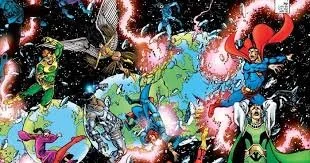
Calm down, it’s only the end of the world(s)
Soon the two teams would meet on a semi-regular basis, and their Earths were joined by a growing collection of variations on the familiar DC status quo: Earth-Three (where the evil counterparts to the JLA formed the Crime Syndicate of America), Earth C (populated by talking animals, such as Captain Carrot and the Zoo Crew), and, in a winking metafictional touch, Earth Prime, "our" world where the DC team produced all the comics about the rest of the multiverse. This allowed for the inclusion of Carey Bates and other DC staffers in the comics themselves, a trick that Marvel had been doing from the beginning as a throwaway gag, without the need to establish a different Marvel earth. The inclusion of Earth Prime was also a nod in the direction of the utility of the DC multiverse for DC as a corporation. When DC acquired the characters formerly owned by Fawcett, Quality, and Charlton, they were initially settled on Earths S, X, and Four, respectively.
The architects of Crisis on Infinite Earths were looking for the opportunity to modernize the staid, underwhelming DC Universe, jettisoning the ballast that had accumulated over the previous decades and opening up the possibility for more contemporary storytelling approaches. But they also repeatedly justified their project as one of simplification: DC's multiple Earths had become too confusing for new readers to follow. This was an assertion that always seemed questionable: after all, the average DC comic that featured more than one Earth was at great pains to explain the premise to readers old and new. Certainly, with the multiverse now on everyone's lips thanks to its deployment in the MCU, the success of Everything Everywhere All at Once, and the persistent fandom of Rick & Morty, it is difficult to see why DC's cosmos might be considered confusing. But even without an anachronistic backward glance, there were reasons to wonder just how confusing the DC multiverse actually was.
At the same time that DC was "simplifying" its storyworld, Marvel was busy adding increasing layers of complexity to its own. The X-Men's Days of Future Passedstoryline began a years-long infatuation with multiple timelines and conflicting futures, eventually featuring characters who would turn out to be the unborn (and even impossible) adult offspring of long-established Marvel stalwarts. Even before the X-Men made the alternate future a commonplace, Marvel in the 1970s had used alternate timelines to powerful effect (Jim Starlin's Warlock, for example). And Marvel was a sales juggernaut. Was confusion really such a problem?
If it was, then Crisis was a poor solution. Rather than rebooting all of DC continuity (as Wolfman would have preferred), the follow-through to Crisis was inconsistent: Wonder Woman was completely rebooted almost immediately; Superman limped along for half a year before doing the same. Jason Todd, the second Robin, was revamped over a year after Crisis ended, and the removal of Superboy from DC continuity was close to fatal for the Legion of Super-Heroes [2]. But complaining about these continuity problems is to fall into the same interpretive habits used to justify Crisis in the first place: why should continuity be the metric for judging the success or pleasure of a given corporate superhero comic?
Next: What Crisis Did Well