What Crisis Did Well
By virtually every metric except the one dictated by its original remit (simplifying DC continuity), Crisis on Infinite Earths was a triumph. True, parts of it aged poorly; twenty-first century readers tend to have less tolerance for expository dialogue, and for the continual reintroduction of characters to each other and to the reader. But George Perez's art is as stunning now as it was then, while the scope and ambition of Wolfman's script were unprecedented. The sales figures speak for themselves, as does DC's repeated return to both the events of Crisis on Infinite Earths and the paradigm it helped establish. For DC fans, Crisis was a must read, not necessarily because they were invested in making the DC universe "simpler," but because they desperately wanted to know what was going to happen to the characters they knew (who, for once, were actually at risk of permanent, or at least long-term death}, and needed to know what the DCU was going to look like in the event's wake.
Crisis on Infinite Earths was a shocking rupture in the conventional flow of DC storytelling, and not just because its creators had so successfully brought a Marvel feel to the company's biggest competitor (a process begun with their work on The New Teen Titans). Its very status as an event was important because of how un-eventful DC had been. It was only in the four years leading up to Crisis that the stories had started to matter even after they were finished, thanks to the flood of Marvel refugees DC had been hiring, as well as the very beginnings of the "British Invasion" (in the figure of Alan Moore).
In creating the DC Event, Crisis managed to be both restorative and archeological at the same time that it destroyed the DC Multiverse as readers knew it. Wolfman and Perez brought a sense of lasting, serious consequence to a cosmos that lacked it while identifying the pre-existing elements of DC's cosmology that could be drafted into the service of meaning-making. The multiverse itself appeared to be the epitome of randomness: an infinite number of worlds existed with an infinite number of differences, even if the ones the comics visited tended to be the ones with the greatest dramatic potential (such as Earth X, where the Axis won World War II). But the only reason for the multiverse's existence was its publishing rationale: DC could continue to exploit IP that might otherwise contradict itself. As far as the heroes themselves were concerned, the alternate earths may as well have been the hidden kingdoms, distant planets, and secret societies they encountered as a matter of course. Only in the last years of the DC multiverse did the characters contemplate the significance of their own doppelgangers' existence (such as the Earth-1 Batman's emotional confusion upon learning that his Earth-2 counterpart had died).
Wolfman and Perez made the multiverse intrinsically important by linking it to an obscure Silver Age team-up between the Green Lanterns of Earth-1 and Earth-2 ("Secret Origin of the Guardians!" by John Broome, Gil Kane and Side Greene, Green Lantern vol 2, 40). This is where we first learn that, ten billion years ago, one of the ancestors of the Guardians of the Universe broke one of his society's fundamental laws, using technology to look back at the formation of the universe. When he sees a giant hand cradling a cluster of stars, he is struck by lightning. Krona survives, but evil is loosed into the world.
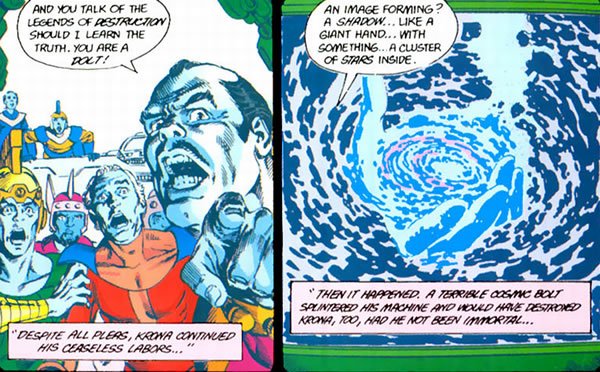
Yes, it’s blue, but it’s not Dr. Manhattan’s hand (thankfully)
In revisiting the story, Wolfman and Perez play down the simplistic morality tale in favor of a myth of gnostic rupture: Krona's crime broke the universe. The evil it unleashed was connected to the creation of the anti-matter universe of Qward (also a pre-existing, Silver Age concept). At the same time, Krona's actions gave rise to the positive-matter multiverse currently endangered by the Anti-Monitor, who is himself (like his counterpart, the Monitor) the direct result of Krona's interference.
Given the scope, it's an economical origin story, binding together ready-made bits of DC lore in a manner that was intrinsically rewarding to hardcore readers, whose deep knowledge of the DCU was yielding a real narrative payoff. But this was only the most visible of Wolfman and Perez's clever, if perhaps not always deliberate, constructions made out of DC universe ready-mades. Even before Crisis, Krona's tale of cosmological hubris had distinct Biblical overtones; his experiment is the sci-fi equivalent of both eating of the Tree of Knowledge and building the Tower of Babel. But Crisis adds to its significance by repeating it, this time with the scientist who would eventually be known as Pariah. He, too, is warned by his people not to try to discover the origins of the universe, and he, too, ignores their pleas. But rather than creating a multiverse, his actions start the process of destroying it: his experiment releases the Monitor and the Anti-Monitor from a hibernation that had lasted billions of years.
Reading what is essentially the same scenario twice reveals precisely how unoriginal this premise is, at the same time reminding us that it is (appropriately enough for a search for cosmological origins) generative. In twice telling us the story of disastrous attempts to discover the beginnings of the DC multiverse, it uses the story that would (retroactively) serve as the origin of DC comics as we know it. Indeed, it is a story that is replicated in a third variation at the very beginning of the series, when the Lex Luthor of Earth-3 sends his son to another Earth to avoid the Anti-Monitor's destruction of their home universe. It is the story of Superman’s father, Jor-El.
Next: The Cassandras of Infinite Earths