The Cassandras of Infinite Earths
Jor-El was Cassandra as Silver Age scientist: his repeated warnings that Krypton was doomed fell on deaf ears; of the planet's entire population, the only person he could save was his infant son. Like Krona, Jor-El lives and dies in a story heavy with Biblical parallels. The difference, of course, is that, where both Jor-El and Krona's detractors accuse them of hubris, it is only Krona who is truly guilty as charged. Jor-El cares more about his son than he does about himself, rocketing his baby off into space like Moses in his basket on the Nile.
Both Krona and Jor-El are doubled in Crisis: Jor-El by the selfless Alexander Luthor of Earth-3, who sends his infant son to another Earth before his is consumed by anti-matter (thus handing the heroes the eventual key to victory), and Krona by Pariah, a scientist on yet another alternate Earth who tried to replicate Krona's experiment. In his own words, Pariah was vain and overly ambitious, ignoring all his colleague's warnings about the danger of his actions. Naturally, his experiment is a disaster, but, unlike Krona's (which did not lead to any direct body count) or Jor-El's (which saved his child), Pariah's destroys his entire world, leaving him (rather than a baby) as the sole survivor.
All four of these characters can be defined in terms of their relationship with both the ongoing narrative and the particular cataclysmic event that sets the narrative in motion. Alexander Luthor, Sr. and Jor-El are fundamentally paternal, fathers both to their sons and to the story. In each case, they "father" in the traditional sense of the verb: that is, they engage in a one time action that forms the entirety of their role (as opposed to "mothering," which is understood as an ongoing process). They embody a deist model of creation, ceasing their involvement with the narrative process immediately after initiating it.
Krona and Pariah are a different story, a twist on Marvel's Uatu archetype: they intervene in events simply by watching them. The taboo on viewing the origin of the universe (in Krona's case) or the multiverse (in Pariah's) turns observation into an intervention, with devastating consequences: creating and then awakening the Anti-Monitor and Monitor, thereby setting the Crisis on Infinite Earths in motion. Krona's punishment by his fellow Oans is discorporation (the opposite of his inadvertent act of creation), while Pariah's is condemned (by karma?) to an eternal, fruitless witnessing. Each of them is reenacting the Freudian Primal Scene on a cosmic scale: no one should see the act (or repetition of the act) that led to their own creation.
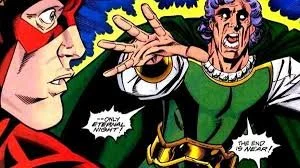
Remind me not to invite Pariah to my next party
Also like Uatu, when Krona and Pariah observe the unfolding events, the reader, in turn, observes Krona and Pariah in the act of observation (as they had also been doing with the Monitor's cameos in every DC series in the months leading up to Crisis). They may not be the best models of observation one could ask for; Krona and Pariah are like the casual reader who, when given a copy of a precious comic book by a fan, fold back the spine, rip the cover, and leave a mess in their wake. Or perhaps like Frederic Wertham's Innocent adolescent, seduced and driven mad by something they would have been better off not not seeing.
Diegetic and semi-diegetic witnessing is nothing new to narrative entertainment. Pariah functions as a Greek chorus, albeit one that is whiny and guilt-ridden. North American comics are no stranger to personalized narrators, from EC Cryptkeeper to DC's Phantom Stranger to Uatu the Watcher himself. These narrators exist as both a storytelling device and a style, taking the opportunity afforded by skaz to develop a sense of immediacy.
But just as the various Earths infinitely multiply (before their eradication by the Anti-Monitor), so too does the faculty of witnessing and narrating in Crisis on Infinite Earths. Crisis moves from event to event, killing characters and destroying worlds while confronting the heroes with personal and ethical dilemmas. One might imagine that the sheer novelty of the plot would be enough, but Crisis demands each act of destruction be doubly witnessed: in prose, via Wolfman's dialogue, and in the art, via Perez's repeated focus on the eyes of the characters doing the witnessing. The pattern is established in stunning two-page spread following the very first page of issue 1: an earth is gradually erased by the white wall of anti-matter in the top panels, parallelled by a series of panels immediately below them featuring a series of increasingly close shots of Pariah, ending with the image of a tear flowing out of one wide-open eye. Pariah's monologue, which begins in this row, continues over the next two: "So much longer must I suffer for my sins.../ before I may be spared the witnessing of these horrors?..../I'm disappearing again.../Another earth is to be swallowed by the dark..."
Pariah's incessant verbalization of the tragedies unfolding before him could be dismissed as mere exposition. Certainly, the mainstream superhero comics of the previous two decades have no shortage of characters explaining what the readers can already see and filling in the details on what they can't. Crisis is a comic with a cast of thousands, and clumsy exposition was inevitable. But there is much more at work here. The characters in Crisis appear to be under an injunction to endlessly report. In the second issue, Earth-1's Batman and the Joker are confronted by a vision of a dying Flash (Barry Allen), who speaks of a reality they cannot yet see ("Please...can't you see the world?/ I-it's dying all around me") while Batman helplessly describes what both he and the readers see: "The Flash.../ ....disintegrating before my eyes!"). Here the Flash is a ghost from the future--we finally see what he is talking about seven issues later. Traveling through time, he can foreshadow like no other, ensuring in advance that the upcoming event will accrue significance. Batman's words are less explicable: who, after all, is he talking to? The Joker?
As is the case with most clumsy exposition, he is speaking to the reader. And while the reader may not need the details of these particular panels explained, it is the act of verbally registering the event that is crucial. It is not so much that Wolfman does not trust his reader to pare what is happening on the page; he does not necessarily trust his reader to appreciate the importance of what is depicted. Despite the grandeur of George Perez's art, what is depicted must be turned into language in recognition of the very immensity Perez handles so well.
Next: Crisis: The Play-by-Play