Consider the death of Supergirl: only the demise of the Flash (Barry Allen) rivals it in significance for the plot, emotional resonance, and sheer novelty. Wolfman uses Supergirl's dialogue (or, more often than not, monologue) to simultaneously increase her importance (giving her more characterization in a single issue than she had shown in the past decade) and emphasize the secondary nature of her character (she willingly gives up her own life to ensure that her more powerful, and more marketable cousin survives). Meanwhile, the new Dr. Light (a Japanese woman who obtained the classic villain's powers and costume earlier in the series), not only describes Supergirl's death, but also relates how it affects her:
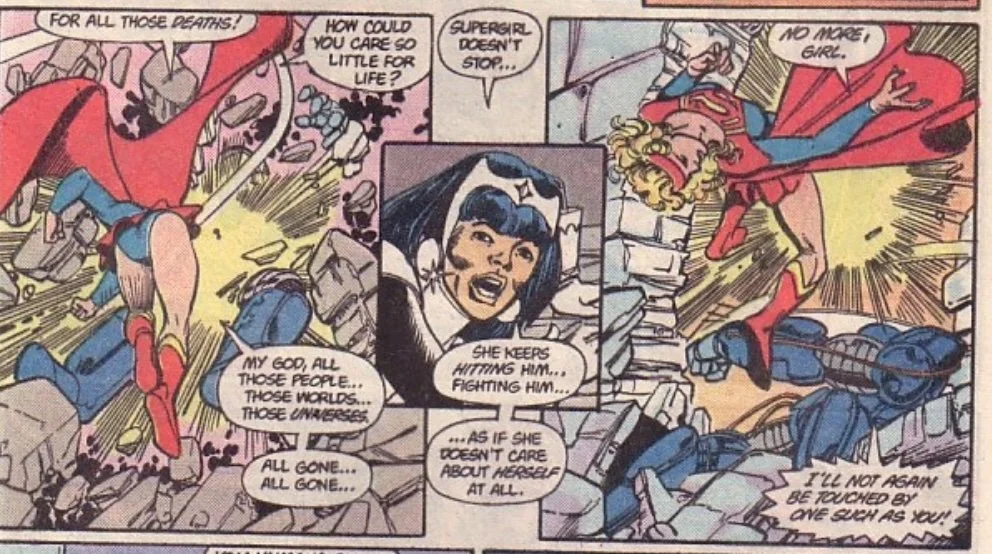
"Supergirl doesn't stop.../She keeps hitting him...fighting him.../ ....as if she doesn't care about herself at all."
"Sh-she is a hero...totally selfless and concerned only with others.
While I have wasted away my life with selfishness."
"No more, Supergirl--no more! Whatever happens here, you've shown me the truth!"
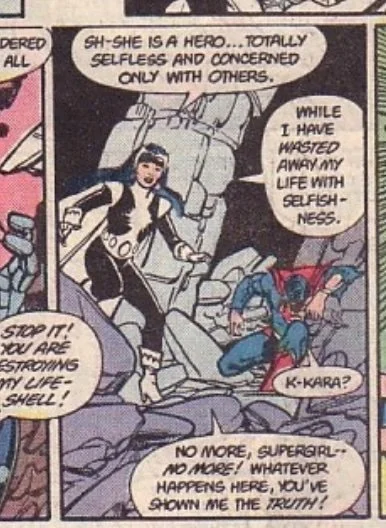
Dr. Light functions as the ideal hybrid of reader and hero. As a reader/observer, she cannot help but be inspired by Supergirl's heroism. Contrary to all the handwringing during the 1950s moral panic over the malign influence of comic books, Dr. Light becomes a better person before our very eyes. At the same time, both she and her narration are a part of the action. In the last moments of the battle with the Anti-Monitor, Dr. Light shouts:
"By the stars! They're locked in combat!
"He is killing her!
"I have to help!"
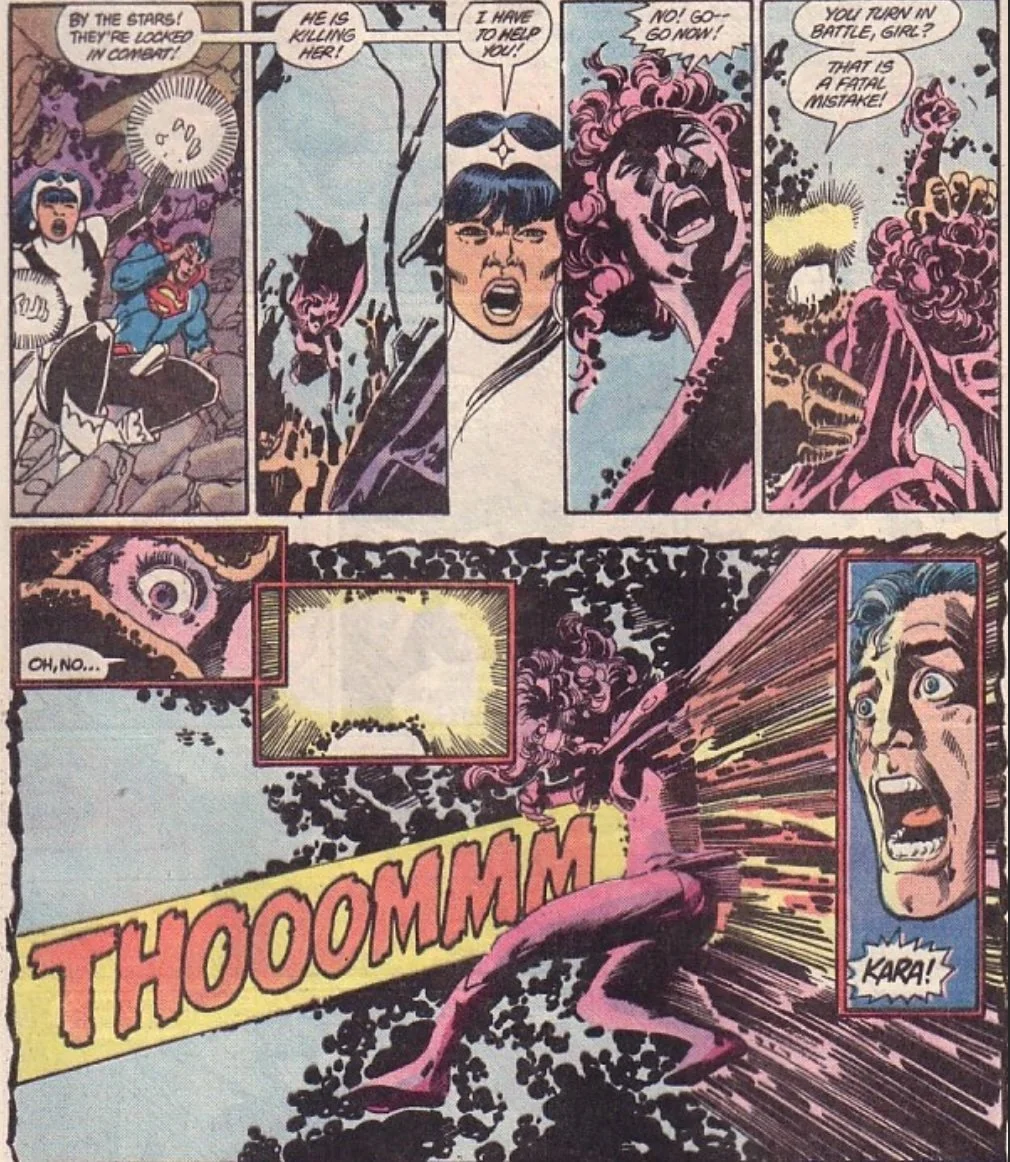
Supergirl turns around telling her to go (and bring an injured Superman to safety), which the Anti-Monitor calls a "fatal mistake" before landing his killing blow. Now Dr. Light, the product of DC's line-wide plot machinations, has an origin worthy of Spider-Man: guilty over her role in Supergirl's death, she resolves to use her great power with great responsibility. [1]
Dr. Light exemplifies Wolfman's clever approach to in-story narration. A project on the scale of Crisis was always going to require huge, frequent infodumps, which, if done improperly, could bring the action to a standstill. But Wolfman elevates the technique by wedding it to affect: the characters narrate and emote at the same time. In so doing, they also help avoid another potential pitfall that would become familiar once large-scale crossovers became the norm. When the cosmos is threatened in a story with a huge cast, the twists and turns of the plot can come at the expense of characterization and emotional resonance. Crisis is a master class in balancing events and emotion. As in their work on The New Teen Titans, Wolfman's and Perez's characters never stop feeling.
No wonder, then, that the Psycho-Pirate, a minor, half-forgotten villain, maintains a notable supporting role throughout the series. Roger Hayden, the second owner of the emotion-manipulating medusa mask, was initially recruited by the Monitor before being abducted by the Anti-Monitor in order to control a set of alternate earths. Yet his persistent presence in the already-overstuffed Crisis is difficult to explain in terms of plot alone; nearly ever intervention he makes could have been dispensed with rather easily. Instead, his importance is thematic: the heroes' feelings are integral to the series' impact. At the same time, his abilities are also a cheat, since he induces affective states with virtually no effort. Were he responsible for all the emotions felt by the characters, he could stand in for lazy writing. But instead, closer examination shows him to be an imperfect fan. All he wants is to collect a world that he can have to himself, using it as a playground for his emotional fantasies. By the end of the series, he is not just one of the few (perhaps the only) characters to remember the multiverse before the Crisis, he suffers from a nostalgia that verges on psychosis. Straightjacketed in Arkham Asylum, he cannot stop talking about the way the DC Universe used to be:
"You see, I like to remember the past because those were better times than now.
"I mean, I'd rather live in the past than now, wouldn't you?
"I mean, nothing's ever certain anymore...nothing's ever predictable like it used to be."
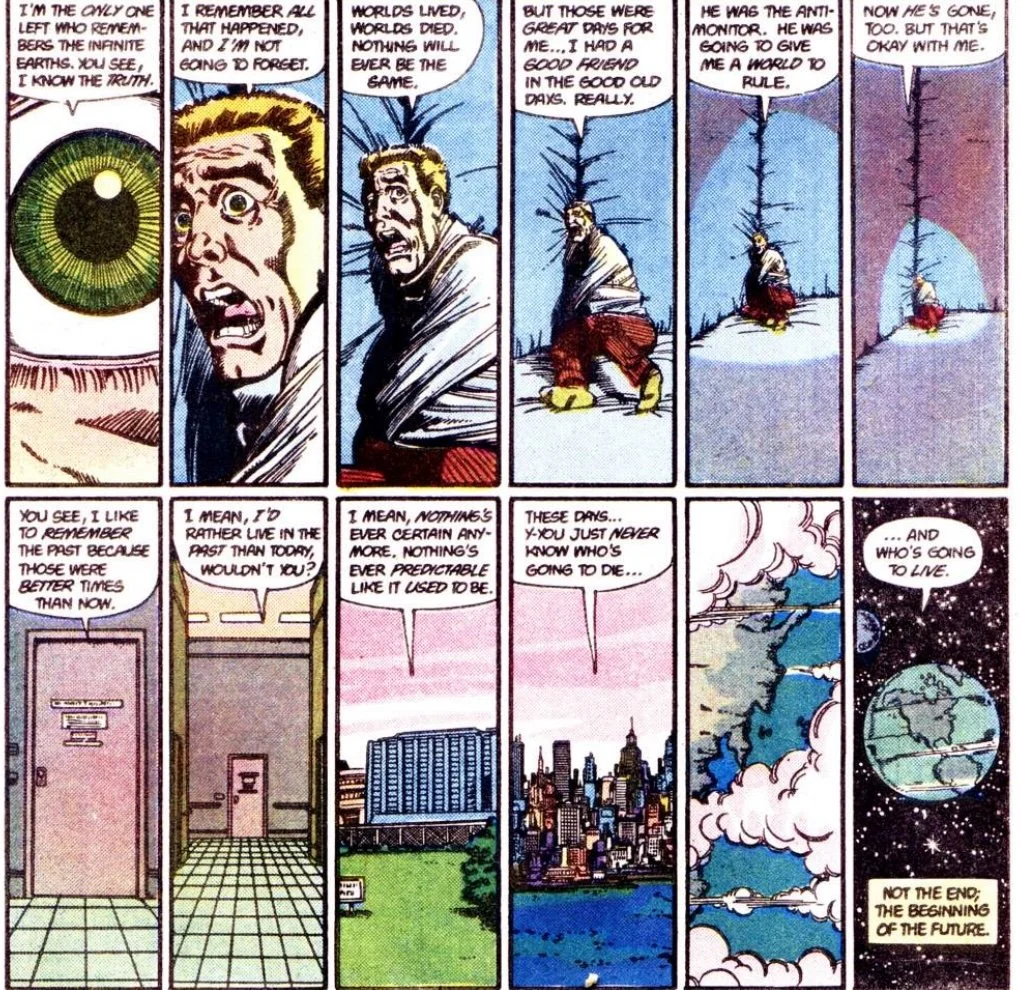
Wolfman stacks the deck by choosing the Psycho-Pirate as a vehicle for what is essentially a negative judgment on everything that happened in the twelve-issue series. Not only is his mind fractured, but Hayden has been confined to a cell giving him virtually no sensory input. He has nothing to watch, nothing to read, and is hardly in a position to asses whether things are better than they "used to be." The Psycho-Pirate is a figure we have seen again and again, and one that will become a regular player in DC Events: he is the bad fan.
Crisis on Infinite Earths, after all, was as much about habits of reading as it was about multiversal annihilation. The Monitor gave his life trying to preserve his comics collection, while the Anti-Monitor threatened the entire medium with destruction. Wolfman and Perez's resolution (streamlining all of DC into a single continuity that promised to be consistent) was supposed to give the casual consumer an easier comics reading experience, but it ultimately reinforced a tendency in the opposite direction, threatening to eliminate the casual reader as if they were some alternate earth slated for destruction. Continuity became king.
Note
[1] Later she learns that Kara was near death already, and that this last killing blow mercifully prevented extended suffering.
Continuity as Obsesive Compulsion