Four decades later, Crisis need no longer be judged according to its original remit, especially since so much of its most significant plot points have been subsequently reversed: the DC multiverse is back (albeit in a different form), Barry Allen, the second Flash, is alive again, and even if the rebooted Supergirl currently published by DC has no memory of her pre-Crisis incarnation, she is once again Kara Zor-El (after numerous "new" Supergirls with different origins). Crisis has proven to be the inaugural work in a particular genre of comics, a genre that shares its name: "Crisis" comics. Primarily a DC phenomenon (though Hickman's Secret Wars, Steve Orlando and Davide Tinto's Commanders in Crisis, and Deniz Camp and Eric Zawadzki's Assorted Crisis Events also fit the bill), this genre puts the destruction and recreation of the storyworld front and center. A DC Crisis is a pure event, with the rupture and reconfiguration of reality as the entire raison d'etre. Yet at the same time, the iterative nature of the subsequent crises (Infinite Crisis, Final Crisis, Zero Hour: Crisis in Time, Dark Crisis on Infinite Earths) drains them of import.
This does not mean that subsequent Crises lack character drama: heroes must always die, and new heroes are always born. But the heroes are no longer the protagonists of the Crisis; the protagonist is continuity itself. The reason to read Zero Hour, or Infinite Crisis, or Convergence, is to see what happens to the DC universe.
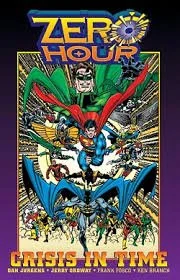
As it repeated the noteworthy story beats of Crisis (the apparent death and disappearance of The Flash, the gathering of the heroes by a cosmic force for good), Zero Hour: Crisis in Time set a dismal pattern for subsequent reality-altering DC events: huge chunks of exposition to clarify cosmic changes the art does not, or cannot convey, and a clunky, metafictional agenda whose primary goal is to clean up after the messes left behind by previous crises and poor editorial decisions.
In the eight years since Crisis on Infinite Earths, DC's continuity problems (and their various solutions) had once again rendered the storyworld needlessly complex, but with diminishing returns. DC's Legion of Super-Heroes, initially rooted in Silver Age Superman stories, had its history revised twice in response to the Man of Steel's post-Crisis reboot, eventually drifting fatally from its originally premise: first Earth's moon, then the Earth itself were destroyed, while the adult Legion discovered an entire set of teenage versions of themselves whose origins were as murky as the storytelling. Meanwhile, Hawkman had become the poster child for bad continuity, with a history so convoluted that the ability to explain it could serve as a shibboleth for the hardcore fan. And, most recently, Hal Jordan, the original Silver Age Green Lantern, had been driven mad by the destruction of his beloved Coast City, even going as far as destroying the Guardians of the Universe and the entire Green Lantern Corps. Zero Hour was an attempt to fix some of these problems (Hawkman, the Legion) while doubling down on others (Hal Jordan).
Zero Hour is not, however, a complete failure. Or rather, the very elements that seem to argue against its aesthetic success are the foundation of an ideological triumph, however inadvertent. Zero Hour has a message about continuity and fannish desire, and its very plot and form recapitulate that message precisely by being so unsatisfying. Like Crisis, Zero Hour presents an allegorical clash between the sensibility of the editor and affective attachments of the fan, but with a different outcome. Where Crisis sided emotionally with fans (the tragic deaths of beloved heroes and the mourning over the loss of infinite earths), the resolution of its plot was just a few steps short of achieving the dreams of the story's villain (the Anti-Monitor) through the destruction of the multiverse. Zero Hour is a multipart indictment of the fan's desire for the familiar and nostalgia for the past by turning it into the villain's motivation. Witness the fate of the surviving original members of the Justice Society of America: Extant (the villain who seems to be behind all the heroes' woes, before the revelation that he was Hal Jordan's pawn) has reversed the various spells and time paradoxes that had kept them young. Suddenly old and frail, they solemnly walk off stage when the story is only half over. (Zero Hour 2). By the end of the series, the message is clear: some of our beloved toys are past their prime, and it is time to put them away. This is no guarantee that their replacements will be an improvement (on the contrary, their replacements are DC's largely dismal mid-1990s output), but, even as it repeats Crisis beat for beat, it is a rejection of the very backwards-looking, fannish ethos it spends five issues entertaining.
Next: Zero Hour: Why, Exactly?