The remit for Crisis on Infinite Earths was to fix something that was not broken (the DC multiverse) in the interest of clarity and consistency. Zero Hour's goals are more mixed: on the one hand, it had to clean up the worst messes of DC post-crisis continuity that had gotten to the point of being barely functional (the Legion, Hawkman), but on the other, it tantalized readers with the prospect of reversing every editorial decision to change the status quo in the years since Crisis: could Batgirl regain the use of her legs? Could Jason Todd still be alive? Could Hal Jordan redeem himself, and the destruction of Coast City be reversed? The answer to all of these questions (at least as of the end of Zero Hour) was no. [1]
The inclusion of a Batgirl from a parallel timeline is particularly troubling, and not just because of her paper-thin characterization ("Look, I just stop crooks. Most of this so...well, it's beyond me" (Zero Hour 1). Her self-sacrifice in the final issue is presumably supposed to echo the death of Supergirl (whom Batgirl even eulogizes at the end of Crisis), but it is undercut by the fact that, in the main universe, Barbara Gordon is alive and well and operating in her new identity as Oracle, an information broker and uber hacker working with and for the superhuman community. She is also paralyzed from the waist down, and the presence of Batgirl in Zero Hour all but equates her disability with death. The Joker's assault on Barbara Gordon in The Killing Joke is a prime example of the violent excesses of 1980s superhero comics, a bloody, gratuitous maiming with overtones of sexual assault. Alan Moore, who wrote the story, apparently had not thought it would become part of DC continuity. But her subsequent career as Oracle transformed a questionable editorial decision into a mature, adult take on an underused character. By comparison to Oracle, Jurgens' Batgirl is the one-dimensional embodiment of naivete. Decades later, DC would, in fact, restore Barbara's mobility and Batgirl identity, but without erasing her years of disability or scaling back her character development.
Batgirl's role in Zero Hour is to be a one-woman, waffling Greek chorus ruminating over the actions of Hal Jordan. Could Hal be right? But is this how a hero behaves? The last decision of her life will be to oppose Hal's plans, but always in the least subtle formulations imaginable ("This is wrong!"). When she sacrifices herself to save Damage (and the entire universe) from Hal, she is a casually fridged Little Nell, emoting helplessly: "Only...wanted...to live..."
In accidentally killing Batgirl, Hal proves that he is on the wrong side of the metaphysical debate that stands in for Zero Hour's plot by reminding the reader of the emotional stakes. The clumsy, rushed three-issue sequence of Hal's descent into villainy in his former comic (Green Lantern 48-50) had only one thing going for it: a focus on Hal's affective state. His home city annihilated, Hal Jordan is driven by grief and rage to rebel against the Guardians of the Universe, who refused to help him undo Coast City's destruction. Hal's readiness to casually wipe out the entire Green Lantern Corps and destroy the Guardians' home planet of Oa is, to put it mildly, out of character, but at least the readers cannot doubt that they are watching the actions of a man who, initially selected to wear the Green Lantern ring for his absence of fear, has completely lost control of his emotions.
Now calling himself Parallax, the Hal Jordan of Zero Hour makes the case for rebooting reality with all the passion of a jaded real estate broker shilling for a proposed new subdivision: "Watch all these fledging globules of plasma energy--/--will soon solidify and become planets filled with life" (Zero Hour 0). Indeed, despite the occasional fights and explosions that punctuate the issue, the final chapter of this crossover is basically a series of Power Point presentations, first by Hal, then by Waverider (a superhero charged with maintaining the integrity of the the timeline). Waverider and his allies succeed in their goal, but only after a massive failure: Parallax's actions have necessitated a massive reboot of the DC Universe, but not on Hal Jordan's terms. Waverider explains: "We defeated Parallax and Extant, restarting time by initiating our own Big Bang--/--letting nature guide it, not someone like Parallax." "Nature," of course, is a stand-in for "DC Editorial," with Parallax's defeat putting the "Bad Fan" in his proper place.
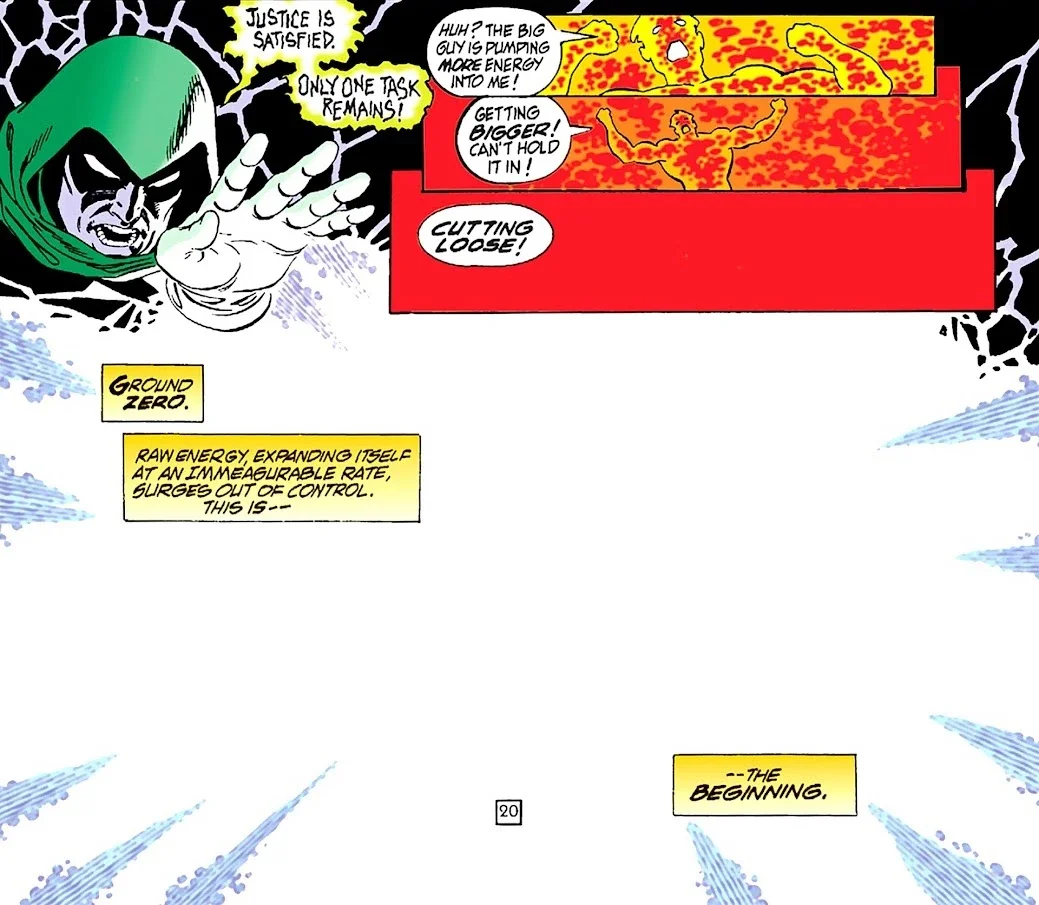
Damage, narrating the origin of the universe as if he were in a porn video
Parallax was the result of Hal Jordan's descent into insanity (or at least that is how it was understood before a twenty-first century retcon exonerated Jordan of all responsibility for Parallax's actions). But it was an insanity based on a particular mental state: melancholy. Hal could not move on from the destruction of Central City (fair enough; he was given no time to process the event), projecting his inability to properly mourn his losses onto the entire DC cosmos (starting with his mentors, the Guardians of the Universe, whom he casually slaughters). What began as grief becomes the generalized rejection of forward-looking change as such; Parallax was engaging in nostalgia on a cosmic scale. Some of the changes in the DCU resulting from the new Big Bang did constitute a move forward (sidelining the ancient Justice Society in favor of characters such as Jack Knight, the new Starman; turning Batman into a Gotham "urban legend" rather than a known hero), but most of them were simply attempts to clean up the incomprehensible messes that Hawkman and the Legion of Superheroes had become. This may look like what was accomplished in Crisis on Infinite Earths, but Wolfman and Perez had created a story with high stakes and drama whose eventual result may have been a streamlined continuity, but could stand on its own as a dramatic event. Zero Hour brought in its cosmic custodians, interrupted or relaunched existing series with a special zero issue, and then promptly faded into the background.
Note
[1] Inevitably, with the passage of (real) time, the answer to all these questions would eventually become "yes" after all.
Next: Crisis of Infinite Geoffs