Zero Hour unintentionally highlighted the limitations of the Crisis Event in only the second iteration of genre: when the cosmic continuity and the characters' affect are not aligned, the results are unlikely to satisfy. Curiously, the DC writer who was best able to resolve these contradictions would also eventually be responsible for the disastrous misfire of Flashpoint: Geoff Johns.
In his first years at DC (staring with his 1999 Golden Age legacy series, Stars and S.T.R.I.P.E), Johns made a name for himself through his ability to mine the company's past for something greater than mere nostalgia and for his ingenious solutions to the storytelling dead-ends perpetrated by previous creative and editorial teams. It was Johns who used clever, well-thought out retcons rather than reboots to rescue two of the characters most damaged by the Post-Crisis era: Hal Jordan and Hawkman.
Instead of sweeping the past under the rug or claiming a crucial plot point never happened, Johns developed stories that insulated the characters from the worst decisions of their recent past by leaning into narrative complexity. Hal Jordan did not simply go insane with grief; he was possessed by the Fear Entity that powered Sinestro's ring and was responsible for the Green Lanterns' vulnerability to the color yellow. That entity was called Parallax, which is why Hal chose this word as his villain name. Not only did this allow for the reset and resurrection of Jordan (who had given his life in an intervening, minor line-wide event called Final Night and even taken on the mantle of the Spectre), but it opened up a whole range of storytelling possibilities for the now-revived Green Lantern franchise (the multiple, different-colored Corps, each with its own supernatural entity as a power source).
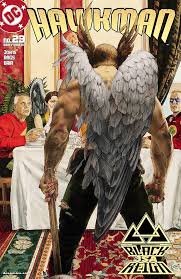
Dear God, please don’t ask me to explain Hawkman
As for Hawkman, Johns decided that every iteration of the Hawkman story was essentially true. Using the framework of the Golden Age Hawkman's backstory as a resurrected Egyptian prince, Johns "revealed" that Hawkman and Hawkwoman (Hawkgirl) had been resurrected numerous times throughout the ages, and even the Thanagarian versions from Silver Age were iterations of the same characters. Johns accomplished all of these feats of franchise redemption with amazing dexterity, deploying all of the fanboy wonkiness of a Mark Gruenwald or Peter Sanderson in the service of elegant storytelling.
At the same time, we should be recognize what this is not: the importation of an arthouse/indy/British invasion sensibility into corporate comics. Johns' reconstructive approach would prove to be quintessential 21st century DC storytelling. In form and ingenuity, Johns weaves the disparate strands of past comics in a manner that recalls the accomplishments of Alan Moore and Neil Gaiman, both of whom excelled at reviving moribund intellectual property. In Moore's case, this was largely through pioneering the now familiar trick "Everything You Thought You Knew About this Character is Wrong," which managed to radically transform existing characters at little cost to their established continuity. [1] But in doing so, Moore would also establish connections between previously-unrelated characters (Swamp Thing, Cain and Abel, the Demon, the Spectre) and thereby start the process of rebuilding the supernatural corner of DC's fictional universe.
Here and elsewhere, Gaiman followed in Moore's footsteps, but with a much greater enthusiasm for worldbuilding. He followed through on Moore's reinterpretation of Cain and Abel to reinforce the role of his newly-created Lord of Dreams, Morpheus, as the shaper of stories. Surely, as he developed Morpheus's connection with Greek myth, it was a felicitous realization on his part that one of the previous Sandmen (Hank Hall) had married and impregnated Lyta Trevor Hall, who had previously fought supervillans as a member of Infinity, Inc. under the name "Fury." The result was a 75-issue series that achieved the unheard-of feat of employing the mechanisms of tragedy in a best-selling and critically acclaimed suphero-adjacent comic book.
This is decidedly not what Geoff Johns did with Hawkman, Green Lantern, and the Justice Society of America. Instead, he used the tools of Moore and Gaiman to make better superhero comics, full-stop.[2] Who better, then, to commemorate the twentieth anniversary of Crisis on Infinite Earths than Geoff Johns? Fresh off his successes with these previously moribund properties, Johns became the driving force behind Infinite Crisis.
Notes
[1] Moore's revelation that Swamp Thing was never actually the biochemist Alec Holland, but rather a creature made of vegetable matter infected by the scientist's consciousness who mistakenly believed he was Alec Holland, invalidates a few prior stories in which Swamp Thing reverts back to human form, but these were minor entires in a poorly-selling series that could eventually be explained away through the general handwaving following Crisis on Infinite Earths (should anyone care enough).
[6] Johns' debt to Alan Moore is too vexed question to treat here. Much of his Green Lantern work is based on turning Moore's throwaway ideas from various eight-page "Tales of the Green Lantern Corps" into multi-part storylines (Sodam Yat, Mogo the Green Lantern Planet, the Darkest Night), while his Doomsday Clock does a great deal of damage to Watchmen and its characters while replicating the book's most distinctive formal innovations.
Next: Crisis of Infinite Memberberries