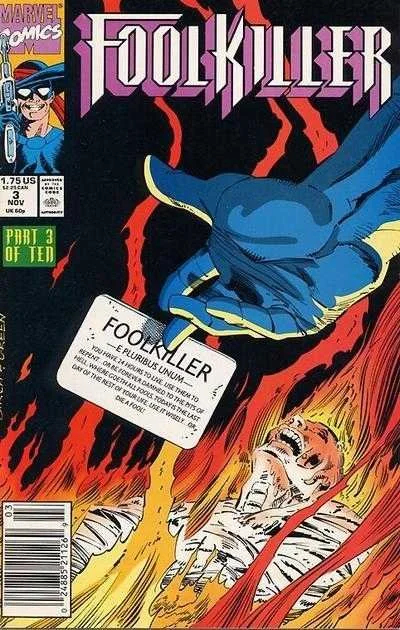
By 1990, interrogating vigilantism is no longer new to superhero comics, a fact of which Gerber must have been perfectly aware. He had, in fact, been a bit ahead of the curve with his first two incarnations of the Foolkiller. Returning to the character after the developments of 1980s comics could well have been redundant. But Gerber was not haunted by the anxiety of influence. He embraced this redundancy by doing what he had always done: bringing his comics into dialogue with their predecessors.
Though the artistic style, series format, and tone are completely different, Foolkiller proves to be an ironic recapitulation of Miller's Batman: The Dark Knight Returns. The commonalities are glaring once you start to look for them. The vigilante (or a version of the vigilante) reappears after an extended absence. The urban environment has bred an amoral, criminal youth underclass that the vigilante must address. The vigilante's actions are continually commented upon by television media personalities, with each side of the debate given weight by the narrative itself. Psychaitric interventions into the problem of criminality prove ineffectual and ridiculous. The Foolkiller, like the Joker, appears on a popular television program, though the resulting body count is lower. The comics are driven by a first-person narrative that, while central to the book, is occasionally absent in favor of featuring other characters. The vigilante transcends partisan politics, but ultimately becomes public enemy number one, and fakes his own death.
The only convincing argument against seeing Foolkiller as a response to The Dark Knight Returns is that this would be an unusually subtle response on Gerber's part. From his early Howard the Duck days in the 1970s through his brief return to the character in a 2001 miniseries, Gerber's critique of other comics was usually packaged as part of a very broad parody. In the 1970s, the targets included Killraven and Shang-Chi; thirty years later, it was Warren Ellis's Transmetropolitan and the grotesquely oversexualized heroines published by Image Comics. Fookiller, though broad an blunt in its caricature of late twentieth-century excess, never actually becomes a superhero parody. This is fortunate, and there are a few plausible explanations. At this point, the Foolkiller is a legacy character, even if that legacy is primarily the creation of Gerber and his collaborators; he was not designed to parody a specific character, but rather to critique a set of attitudes. Certainly, by the time Gerber revived him for the 1990 series, the Foolkiller was a concept that could stand alone, with no particular antecedent as the target. Instead, the Foolkiller is a walking, murdering critique of an entire set of societal trends that Gerber saw as toxic.
It is entirely possible that Gerber was not conscious of his repetition of so many of Miller's story beats, but was simply stepping into a space that Miller had held open. Certainly, the two men (who respected each other enough to have pitched their own revamp over Superman before John Byrne got the job) were using similar motifs to make different arguments. As writer and penciler, Miller had the advantage of near-complete control of the material, while Gerber always had to rely on an artistic collaborator. Each of them insisted on considering the vigilante character within the context of the broader media ecosystem that conditions our understanding of law, criminality, and deviance. Ultimately, even as it points in the direction of fascism, Miller's vision is more optimistic. The lone vigilante can inspire entire groups of people to take justice in their own hands when institutions fail them.
Kids, don’t try this at home
For adherents to liberal democracy, it is a frightening vision, but to those who can see themselves in both Batman and his followers, it can look like a better alternative. Gerber also allows for the Foolkiller to act as a kind of social contagion (after all, Kurt is the third man to use the name), one facilitated by old media (television) and new (the modems that Greg and Kurt learn to use in the early issues). But even as his dismissal of partisan politics and potentially sincere ideological differences could potentially be instrumentalized by cynical authoritarians, Gerber never approaches fascism, if only because of an innate distrust of groups of any kind. In his commitment to an individualistic, atomized understanding of the self and society, Gerber refrains from gesturing in any practical political direction. Even as he demonstrates the violence and contradiction inherent to the superhero comic, Gerber's Foolkiller remains committed to the the individualism that spawned the superhero. Were he ever asked, this Foolkiller would not for a moment considering joining Justice League or the Avengers. HIs only path is to go it alone.
Despite the structural connections to Miller's now classic Batman story, the Foolkiller's vigilantism is truly one of a kind. Most vigilantes we have seen so far have, when confronted with the choice between law and justice, choose justice as an abstract ideal that cannot be brought about by the law alone. Some of them, like Daredevil, grapple with the implications of their choices; others like Batman, seem completely untroubled by doubt. The three iterations of the Foolkiller move from religion (a received framework for justice seen as its own law), aesthetics (an artistic judgment that becomes a proxy for morality) to....what, exactly? Kurt Gerhard is certainly flouting the law, but justice does not appear to be his goal. Nor is he motivated by Greg Salinger's "poetic" sensibility. Though Kurt kills people he thinks are a plague on society, there is no evidence that he is trying to build a better world. His killings are the manifestation of his fundamental objection to the behavior of the people around him. Kurt is not trying to actually accomplish anything other than homicide. If Gerber is continuing the critique of vigilantism that was apparent in the first Foolkiller and implied in the second, it is only to show the vigilante as entirely directionless. Ultimately, the Fookiller's actions become a kind of reflex. The resulting comic does not constitute a coherent argument against the Foolkiller, even as it does not make a persuasive case for him. Gerber's satirical target is the same as the Foolkiller's actual target: the people whose actions and behavior make the world a worse and more ridiculous place. No amount of vigilantism can solve these problems; the vigilante merely uses the conventions of the superhero genre to draw our attention to them before slipping away to continue his ideologically motivated, but practically fruitless, actions in another story.
Next: The Underground (Super)Man