The Cultural Logic of Misanthropy
Fookiller is a conundrum of a comic book. It is a perfect fit for its time, not only because of the very contemporary objects of its satire, but because its grim outlook and excess violence make it the missing link between Miller's exploration of vigilante violence in Batman: The Dark Knight Returns and the Grand Gruignol of 1990s Image comics. In 1992, Image would give the world Shadowhawk, who, after mobsters infect him with HIV-positive blood, becomes a vigilante whose signature move is breaking criminals' spines.
But Foolkiller is also very much an outlier. It may well be the most pessimistic comic Marvel ever published. This is not a Campbell-inflected hero's journey; no one is enlightened, and the world is not a better place in the last issue than it was in the first. Instead, Foolkiller is the story of Kurt Gerhard's increasing alienation and cynicism, framed in a critique that offers no indication of any possibility for positive change. Kurt's extrapolation from is own suffering deadens his sympathy for others rather than developing empathy; wherever he goes, he sees new variations on the "Fool." A self-described Reagan-voter who was a happy cog in the system until it failed him, he makes political decisions that he sees as apolitical. The fault with society is that people no longer make any real effort, chasing simple pleasures and blindly following demagogs. Gerber tries to make Kurt look like an equal-opportunity slaughterer of fools, someone who is above everyday politics.
The comic takes a remarkable, almost certainly unplanned turn in issue 8, which is devoted in its entirety to the run-up to Operation Desert Storm. To my knowledge, this was the only Marvel comic to respond to these events in close to real time, and it was an opportunity for very pointed political commentary. Instead, Gerber doubled-down on a politics that pretends to rise above partisanship, calling down a plague on both houses. The morning after war breaks out, "the peaceniks and the warniks have taken to the streets." Both sides feature idiots who spout "the wisdom of the bumper sticker" ("You don't deserve to live in this country!" ("Why? 'Cause I don't think the troops should die for oil company profits?!") A disguised Foolkiller confronts two protesters mid-scuffle:
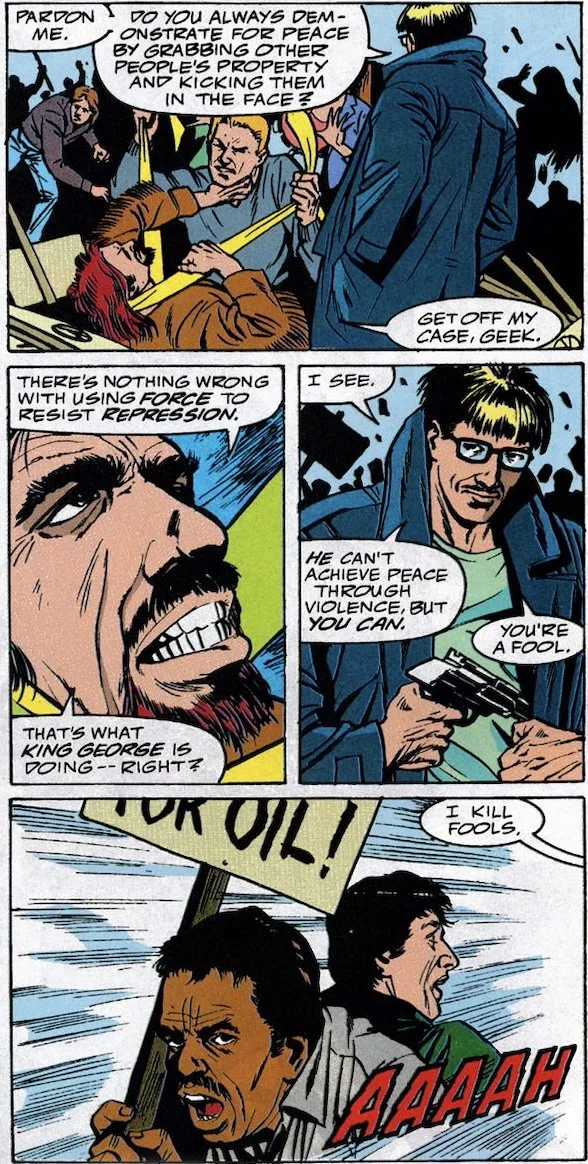
Foolkiller Pardon me. Do you always demonstrate for peace by grabibing other people's property and kicking them in the face?
Hippie: Get off my case. Geek.
There's nothing wrong with using force to resist repression. That's what King George is doing--right?
Foolkiler: I see.
He can't achieve peace through violence, but you can.
You're a fool.
I kill fools.
He disintegrates the hippie, leaving the warmonger speechless:
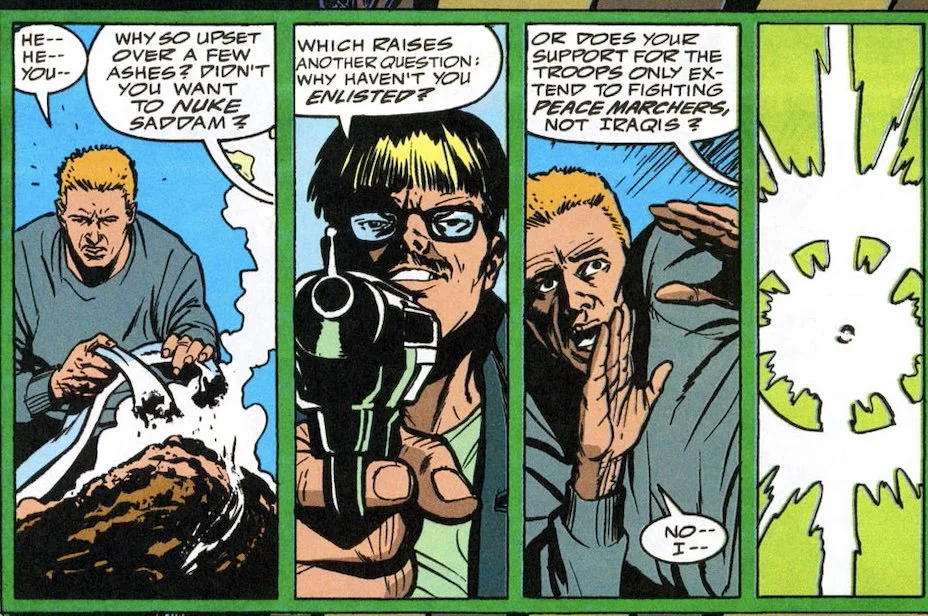
Foolkiller: Why so upset over a few ashes? Didn't you want to nuke Saddam?
Which raises another question: Why haven't you enlisted?
Or does your support for the troops only extend to fighting peace marchers, not Iraqis?
Whereupon the Foolkiller fires again. By this point in the narrative, homicide no longer bothers him. He walks away, thinking to himself that "liberals suffer from vicarious compassion, " while conservatives "are afflicted with vicarious courage."
In case the reader misses the message, Kurt also slaughters a man selling "Support Our Troops" flags at $5 a pop, and an anti-war protester encouraging his audience to destroy war toys because "the toy companies are to blame for the war in the Gulf!" Kurt has particularly harsh words in this case: "In China, the protesters have to stand in front of realtanks....Real people are dying, and you're protesting toys. You're a toy protester."
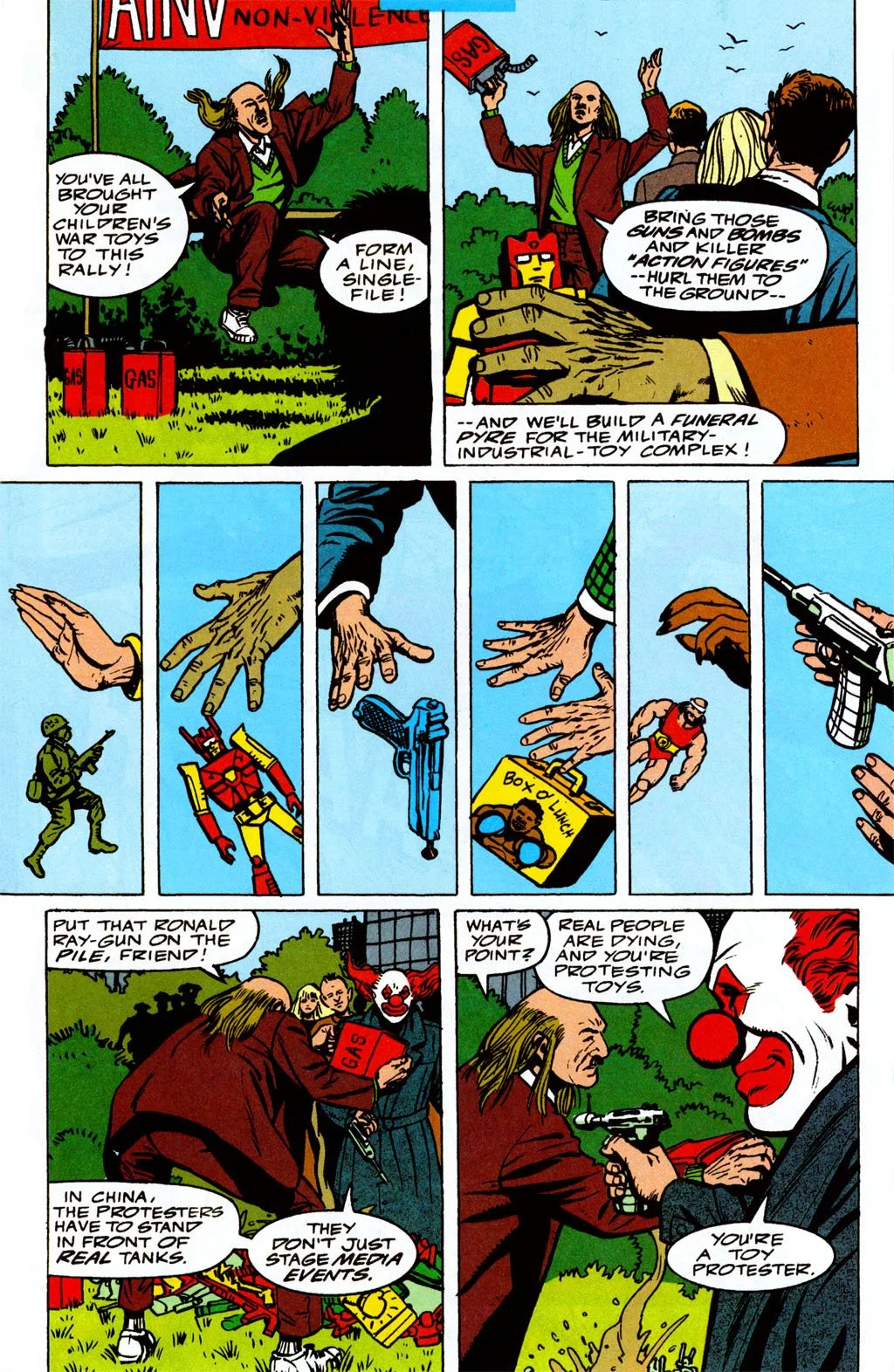
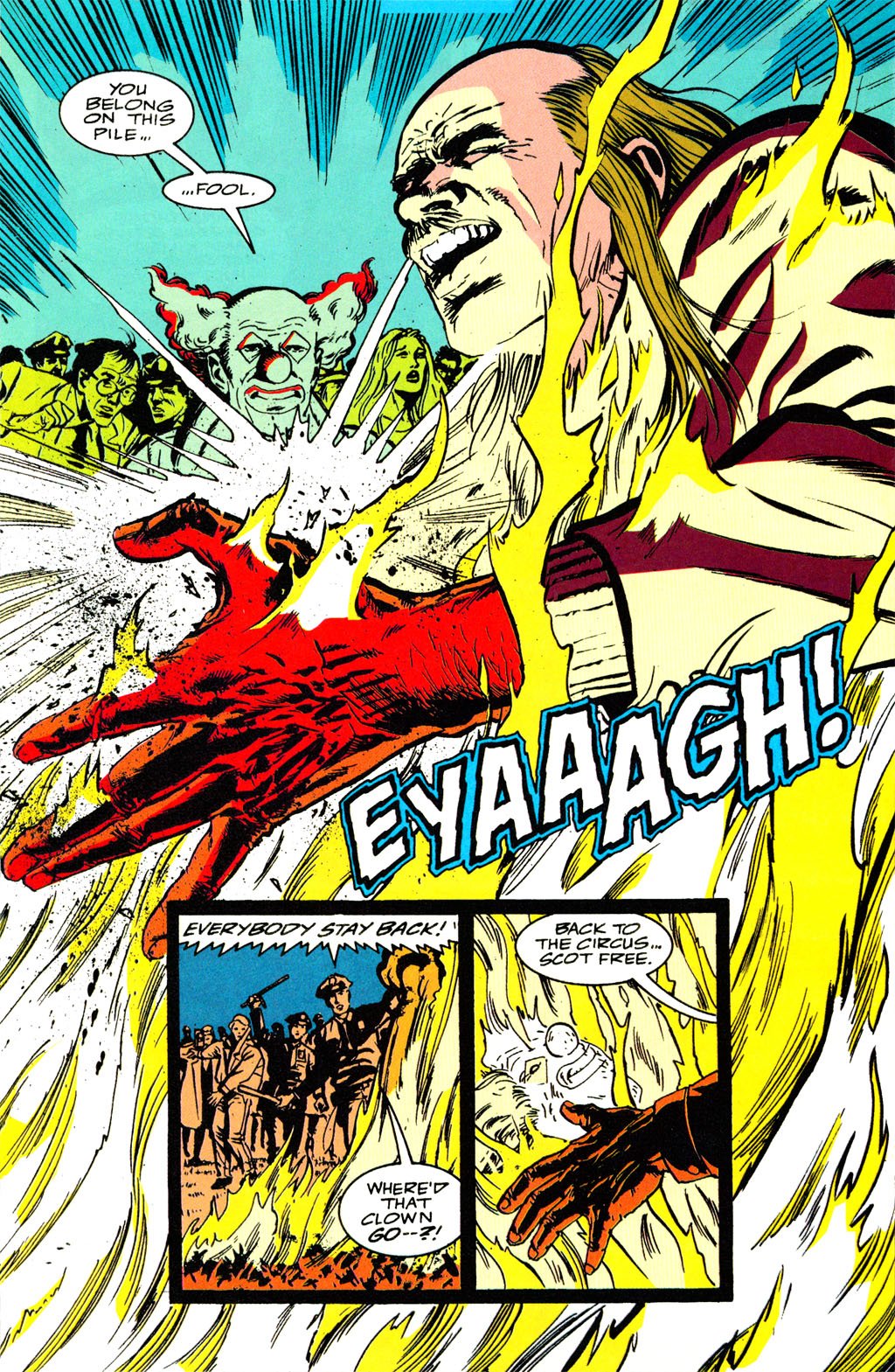
Two important points emerge from these particular killings: first, that Kurt (and, by extension, Gerber) is completely uninterested in engaging in the substance of these political disputes. He is so outraged by the conduct of the "fools" he targets that the actual ideas that ostensibly motivate them are irrelevant. This indirectly links him to his predecessor, Greg Salinger, whose targets lacked "poetry." The Foolkiller's objections are based on distaste and disgust. He, too, is guided by his aesthetic judgments in order to make conclusions about morality and worth. This, combined with his refusal to address politics, underscores the essential misanthropy of the Foolkiller concept. There are simply too many people who are a worthless waste of space.
The other point is also about the confluence of aeshetics and morality. The "toy protester" embodies a longtime Gerber bete noire: critics and "concerned parents" with a naive, simplistic understanding of texts and audiences that falls in line with the mid-twentieth-century "Media Effects" school. This approach assumed that audiences are helpless before media inputs, incorporating messages exactly as they are intended and imitating the actions they see on television or read in comics. Gerber, as always, is arguing for personal responsibility, as well as for a different understanding of media. He opposed all forms of censorship, particularly the insistence on non-naturalistic representations of violence. His earlier mouthpiece, Howard the Duck, argued that violence should be depicted in as much bloody and unpleasant detail as possible in order to avoid romanticizing it. This is where Birch's matches Gerber's violent aesthetic: Kurt's victims have their flesh stripped from their bones; at one point, the purity gun accidentally chops a child in half. Kurt rolls around in garbage to inure himself against his own disgust, but the Foolkiller comic insists on exposing the reader to grotesque depictions of violence in order to wake the reader up.
Next: Foolkiller: The Dark Nutcase Returns