The Foolkiller vs the Culture
In 1990, Gerber revives the character in a surprising ten-issue miniseries. Why surprising? First, the mere fact that Marvel was committing to this project with a writer whose history with the company was tumultuous (he sued Marvel throughout the 1980s over ownership of Howard the Duck. Second, it is a safe bet that fans were not bombarding Marvel with letters asking for a Foolkiller series. There is little evidence to suggest that the character had a significant fan following, and, in any case, his infrequent and uninspired appearances since Gerber's departure were unlikely to have helped lay the groundwork for a ten-issue commitment.
But the biggest surprises were contained within the comic itself. Certainly, Gerber's familiar irony, facility with narration, and complex characterization were evident and expected. The series' violence and high body count also had ample precedent by this point, not only thanks to the various Punisher series, but also because of the "grim and gritty" trend that had begun to dominate the mainstream since Batman: The Dark Knight Returns and Watchmen. [1] Marvel's willingness to let Gerber sustain such a dark critique not only of contemporary culture, but contemporary vigilante comics was rather startling. Gerber's new Foolkiller combined Bernie Goetz, the antiheroes of the Great Recession, and the Punisher in a compelling pathology that was unlike anything the company had ever published.
This does not mean that the series is fondly remembered as a classic. Despite being self-contained, the Foolkiller series had little hope of becoming the next Watchmen. Gerber bears some of the responsibility: the series lacked subtlety and left itself open to accusations of racial stereotyping. The art may also have been a barrier. J.J. Birch's angular, grim pencils certainly fit the book's themes, and his subsequent work on Mileston's Xombi shows an impressive imaginative range. But Birch's largely realist art, rather than reinforcing Gerber's prose, pushed the grimness to unintentional self-parody: the scenes of an underwear-clad Kurt Gerhard exercising while surrounding himself with garbage are difficult to take seriously, at least as visuals, while the Foolkiller's redesigned costume (all leather, with an open zipper baring his chest and a gimp mask covering his face, is laughable enough, but when that cover of issue seven is a close up of the Foolkiller shedding tears through the leather masks eyeholes illustrating the phrase "Tears of Torment!" we are veering into camp territory. One can appreciate the boldness with which Birch embodies Gerber's longstanding attitude towards the depiction of violence (it must be explicit, graphic, and disgusting enough not to seem admirable), but this is not art that is likely to draw the reader in. In hindsight, Gerber's grim satire might have been better matched with art that was more deliberately cartoony (in the mode of Mike Allred).
Nonetheless, the Foolkiller series has much to recommend it. Even more than Batman: The Dark Knight Returns, it reflects a very specific historical moment. While this moment certainly involves violent crime and urban blight, the driving force is economic: serialized in 1990 and 1991, Fookiller unfolds in the aftermath of the 1987 stock market crash (and its smaller 1989 echo). Appropriately enough for a vigilante story, Kurt Gerhardt's transformation from low-level savings-and-loan officer to multiple murderer is tied to the collapse of most of the institutions that propped up his life. First, his father is killed by muggers disappointed that their haul consists of the six dollars he carried in his wallet; then he is fired from his job. Kurt explodes when his wife gently suggests that he might have been in some way at fault, a scene that manages to convey both Kurt's own instability and the pernicious neoliberal ethos that ignores structural flaws in favor of personal responsibility. Reduced to working the counter at Burger Clown, his attempt to stop the fast food restaurant's robbery only earns him a concussion.
But Kurt's transformation would not have been possible without a parallel set of institutional failures. The first issue ("Mad...as in Angry" by Gerber, Birch, and Tony Dezuniga, October 1999) begins not with Kurt but with Greg Salinger, the previous Foolkiller, who is well into the process of duping his psychiatrist at the Central Indiana State Medical Institution. Greg has written a short manifesto about the fools responsible for the sorry state of the world, and is quickly mastering the modern technology that will allow his words to go viral. First he learns to use the mail merge function on the hospital computer, and then realizes his best bet is to get the attention of Runyan Moody, the shock jock host of a tv talk show that recalls the heyday of Jerry Springer. Greg has inadvertently discovered the vulnerabilities in the (then-contemporary media ecosystem. The issue ends as Kurt, recently abandoned by his wife, turns on the tv:
"Tonight--live from Indiana--is this the collapse of Western Civilization?
Are liberals and criminals destroying our way of life?
Runyan Moody asks---
--the Foolkiller!"
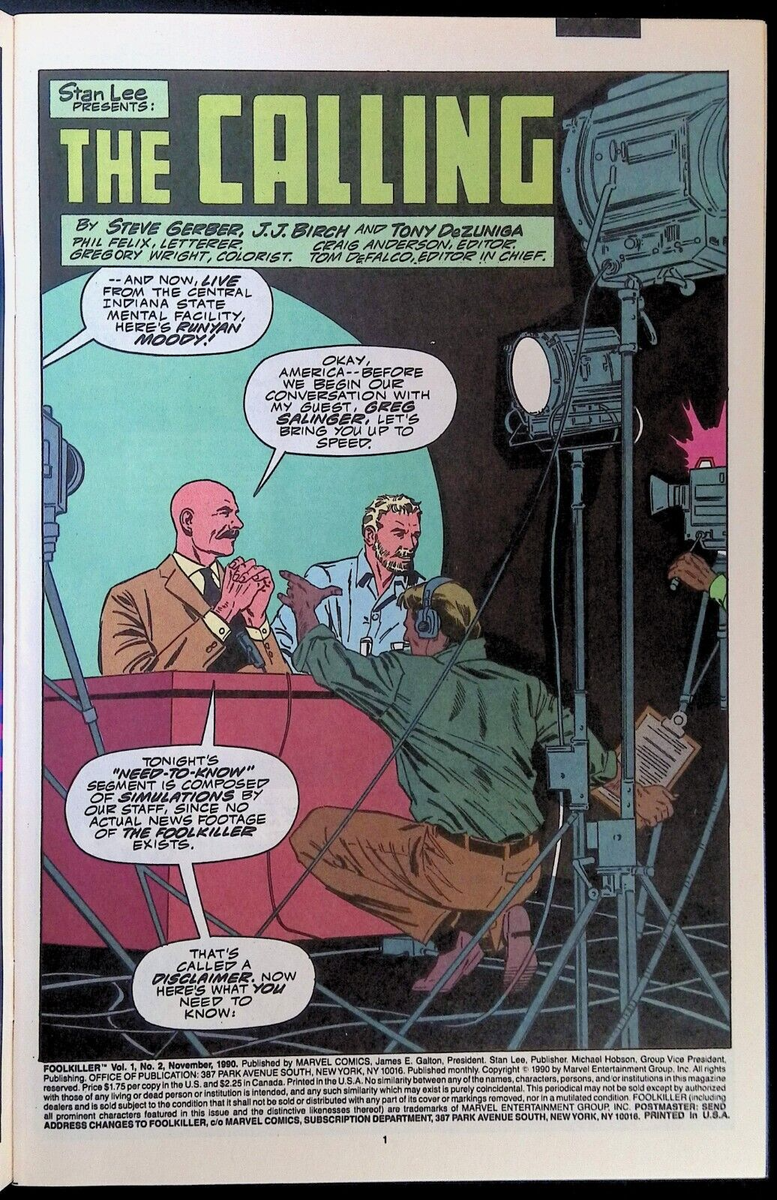
To be fair, this goes better than when the Joker went on Letterman
This first issue efficiently introduces the characters and establishes just how damaged their world is, setting the stage for a rethinking of the Foolkiller concept. The first two Foolkillers, however different their moral frameworks might have been, were limited by the very individualism that so often defines vigilantes. The Foolkillers look for specific fools, and kill them, as if targeted assassination could solve any important problem. But Kurt's story immediately moves into more complicated territory, particularly when he rejects his wife's implication that he is somehow responsible for what happened to him. Kurt is a passive aggressive sad sack, certainly, but he did not fire himself. A casualty of a devastating recession, Kurt knows that he has been failed by a system (a system that we might now call neoliberalism). Neither of the previous Foolkillers had a developed sense of the political, at least in their earlier appearances; Salinger seems to have spent his years of compulsory psychiatric hospitalization on his own education (perhaps he had more sophisticated interlocutors than Richard Rory in his prison days). Now Kurt will encounter Salinger as that now painfully familiar phenomenon, the disembodied, ranting voice on the Internet. Together with Runyan Moody, one of the most incendiary voices in an inflammatory old media genre, they give Kurt intellectual mentorship and a public platform as he embarks on his career as the third Foolkiller.
Kurt will rack up a disturbingly high body count over the course of his ten issues, establishing one of the intellectual and ethical conflicts that will animate the series: what is the role of individual retribution in the struggle against an entire system?
Note
[1] Still, this was only a few years after the graphic violence in Gerber and Val Mayerik's abortive Void Indigo series outraged retailers throughout North America (and another few years before Garth Ennis and Steve Dillon would go much, much further in DC/Vertigo's Preacher.
Next: The Cultural Logic of Misanthropy