Gerber wrote three different incarnations of the Foolkiller: the religious fanatic who briefly fought Man-Thing; the ex-con social crusader against urban blight who just as briefly appeared in Omega the Unknown before being brought into the wider Marvel universe by subsequent writers, and the former corporate shark brought low by predatory capitalism in Gerber's 1990s Foolkiller series. In the Foolkiller, Gerber uncovered a formula that was useful in its generality: anyone could become the Fookiller if he (and it was always he) had been kicked around enough by contemporary life, and anyone could be labeled a fool as each iteration of the character adopted a new definition of foolishness. The Foolkiller, then, was just the sort of device that Gerber needed for his more personal storytelling: he was a universal machine for satire.
This was not the only way that the Foolkiller was an anomaly in the serialized Marvel Universe. Linked primarily to his creator until just before Gerber's death in 2008, the Foolkiller came and went along with Gerber. The first two incarnations were from the writer's longest stint at Marvel (1972-1978), while the third was part of Gerber's intermittent freelancing with the company from 1983 to 1991. When Gerber and co-creator Mary Skrenes introduced the second Foolkiller in Omega the Unknown, they weren't just brining a new incarnation of an old character to Gerber's latest (and strangest) Marvel book; They were importing the character to Hell's Kitchen, where the story was set. Gerber had been living in Hell's Kitchen, which at the time was a notorious site of urban blight. [1] Now he is Greg Salinger, former cellmate to longtime Gerber supporting character Richard Rory, who has just arrived in Hell's Kitchen to share an apartment with the book's main characters. Rory has just received one of the Fookiller's calling cards, convinced that Everbest has somehow miraculously survived ("See? Same cheap paper--same pedestrian design--same clumsy syntax--!" (Gerber & Skrenes, and Jim Mooney, "Fightin' Fools!," Omega the Unknown 9, July 1977). Rory is initially relieved, though quickly unsettled, to discover that this new Foolkiller was inspired by his jail-time storytelling:
"I know, Rich--the original Foolkiller was insane, but I realized I could carry out his mission correctly--by secularizingit! [.] --but my criteria differ somewhat. You see...I'm a poet."
Rory is convinced that Greg has lost his mind, but James-Michael Starling, the primary viewpoint character in Omega the Unknown, imparts the wisdom that he has gathered since his arrival in the neighborhood seven issue ago: "I think you may be judging your friend too harshly, Mr. Rory...an' too hastily. / You're...new to Hell's Kitchen." Where the first Foolkiller was a one-note religious fanatic, the broad satire of a phenomenon Gerber clearly despised, and where Conway established the Punisher as the embodiment of a reactionary vigilante impulse that deserved condemnation, the second Foolkiller presents a greater challenge to both readerly and authorial sensibilities. If, to paraphrase Irving Kristol, the conservative is "a liberal who has been mugged by reality," Gerber's characters (James-Michael included) have lost their patience with procedural liberalism because they have been mugged by actual muggers.

The rest of this issue drives the point home. When the Foolkiller disintegrates two young men engaging in a knife fight, Omega's friend Gramps voices his approval of "blasting the human vermin." Two issues previously, Omega (who shares a mysterious psychic link with young James-Michael) had fought a criminal called Blockbuster, whose explanation that he robbed banks in order to provide for his son was enough to convince Omega to let him go (much to the consternation of the crowd). Now he has had a chance to reconsider, as now he is the one who needs to get money to protect his "son," James-Michael. When he sees Blockbuster robbing a jewelry store, he is only motivated to fight by the owner's offer of a thousand dollars--his morality has become depressingly transactional. But the Foolkiller disintegrates Blockbuster before Omega can claim any reward, a move that appears consistent with "blasting the human vermin." Gerber holds out the possibility that the Foolkiller, if not exactly right, is not exactly wrong, either.
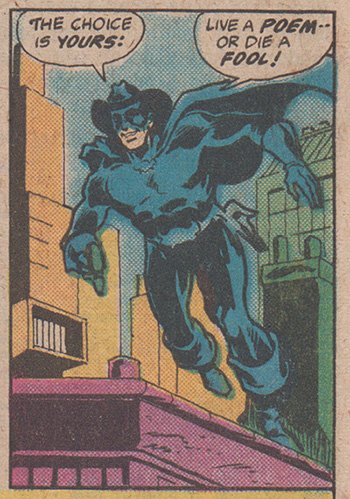
Oh, sure. No pressure or anything
There is, however, a mismatch between the Foolkiller as exterminator of pests to the urban ecosystem, and the Foolkiller's own conception of his mission. Yes, he targets criminals, but lawbreaking is not the only criterion. The Foolkiller dismisses Blockbuster on aesthetic grounds ("never a poetic thought or word or deed--!"). It is a strange combination, one that is difficult to justify without a broader familiarity with Gerber's work. Every the disenchanted satirist, Gerber, particularly in Howard the Duck, filters everything through a sensibility consisting of a profound moral disappointment that often expresses itself through a judgment somewhere between the aesthetic and the philosophical. Gerber's characters cannot stand bullies or villains, but they have just as little tolerance for frauds, posers, and the followers of the day's trends. The targets of Gerber's ire tend to exhibits failure in not just morality, but imagination. At the end of the second story arc of Matt Wagner's Grendel (also about a murderous antihero/villain), the narrator describes Hunter Rose (the titular Grender) as "the demon of society's mediocrity"). To the say the same of Greg Salinger, the second Foolkiller, during his earliest appearances would be to overestimate him; "the demon of society's mediocrity" is what this Foolkiller aspires to be.
Note
[1] And so it remains to this day in both the Marvel Comics and Marvel Cinematic Universes, despite the fact that in real life, it has been gentrified for decades.
Next: The Foolkiller vs. the Culture