God's Executioner
The first Foolkiller, retroactively named Ross G. Everbest when Roger Stern included the second Foolkiller in Amazing Spider-Man, was a religious fanatic who died in his second (and final) appearance in a Marvel comic. [7] As a young boy, Everbest was cured of paralysis by a faith healer named Mike, joining his savior in a new career as an evangelist. After catching a drunken Mike with his arm around a woman, Everbest killed him and became the Foolkiller. Targeting particularly egregious "fools" (such as the rapacious industrialist F.A. Schist and Ted Sallis, whose research inadvertently turned him into the monstrous Man-Thing), Everbest warned his victims with a card one day before attaching them:
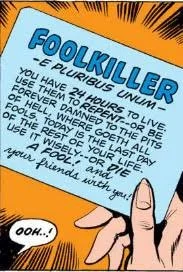
And well you might “Ooh!”
Foolkiller
- e pluribus unum-
You have 24 hours to live. Use them to repent or be forever damned to the pits of hell where goeth all fools. Today is the last day of the rest of your life. Use it wisely or die a fool!
Everbest is not exaggerating: somehow, this former child evangelist gained access to a great deal of mad scientist tech, from the stasis tube preserving Mike's dead body to his weapon of choice: a white-light-emitting laser that instantaneously reduces its target to ashes. Naturally, he calls it his "Purification Gun."
In his original incarnation, the Foolkiller satirizes the world that created him more than he does the genre in which he functions. True, he wears a form-fitting costume, but he is not trying to right wrongs or rid the world of crime. The fool, unlike the criminal, is not a legal or civic category; for Everbest, the fool's failings are moral. At this early moment in Gerber's career, the Foolkiller was one of the first example's of the writer's broadsides against religious fanaticism and moral superiority; just a year later, the Man-Thing would be helpless against the onslaught of book-burning provincial fundamentalists who aligned themselves with a murderous "Mad Viking" on a crusade to restore true American "manhood."
What makes the Foolkiller different from Gerber's other moralists is that he is not entirely wrong; all of his initial chosen targets are fools of one kind or another (more on this in the next post). The problem is that offenders in so elastic a category are subject to only one punishment: disintegration. Here the Foolkiller partakes of the same maximalist logic as the Punisher, one that can implicitly critique vigilantism with a story that celebrates it. The tools at their disposal are as limited and lacking in nuance as is the moral imagination of those who wield them. Superhero comics tend to deploy these vigilantes as foils for the conventional superhero in order to put the hero in a better light. But really, such vigilantes are only the superhero reduced to his most absurd avatar. With few exceptions, superheroes are equipped to solve every problem with violence; if violence is not the solution, then the problem remains invisible. Recall how laughable it was that Superboy Prime changed continuity by literally punching the walls of reality in Infinite Crisis; for this to work, reality itself had to be reorganized into something susceptible to punching. Had the Foolkiller or the Punisher been in Superboy Prime's place, they would have shot reality into submission.
Next: Live a Poem, Die a Fool