What a Fool Believes
Well before Miller's revitalization of Daredevil and Batman, Marvel Comics was already interrogating the status of the four-color vigilante. In a curious coincidence, the company introduced The Punisher, a character who would become the most successful fictional murderous vigilante in the medium just one month before the first appearance of The Foolkiller, who functioned as an unintentional parody of what appeared to be a one-off character. The Punisher made his debut in The Amazing Spider-Man 129 (by Gerry Conway, John Romita Sr, and Ross Andru) (February 1974), right before The Foolkiller in Man-Thing 3 (by Steve Gerber, Val Mayerik, and Jack Abel) (March 1974). As usually happens with corporate-owned characters, their psychological development, ideological framework, and even biographies would veer far away from their creators' original intent. When Mort Weisinger and George Papp created Green Arrow in 1941, he was a generic, square-jawed, blond variation on Batman. Nothing in Oliver Queen original appearances (or even those of the early Silver Age version) would have suggested that he would turn into an anticapitalist hippie in the 1970s, a mayor of his hometown in the twenty-first century, or, for that matter, a serial philanderer whose infidelities would continue to complicate one of DC most enduring love stories.
Nonetheless, Oliver Queen followed a path that is familiar to longtime superhero comics readers: initially a blank slate, Green Arrow would have to be given some measure of complexity for him to function as the genre matured. If anything, his leftward turn demonstrates just how malleable these characters can be when confronted with changing times. [1] But the Punisher and the Foolkiller are different, because each was, to widely varying degrees, initially rooted in social commentary. Each character would, like Oliver Queen, change with the times, but these changes would reflect reader reactions and the evolution of popular attitudes about crime and justice. Both the Foolkiller and the Punisher frequently blur the lines between satire and sincerity years before the slippage between irony and political extremism would wreak havoc with America's political culture.
The basic contours of the Punisher's evolution are well-known: a response to the vigilantism of Dirty Harry, the urban decay featured in the daily news, and Don Pendleton's popular paperback hero The Executioner, the Punisher was introduced as a new Spider-Man antagonist with no anticipation that the character would ever achieve anything remotely like the popularity he has enjoyed for nearly five decades. The following year, Conway gave the Punisher his canonical origin in Marvel Preview 2 ("Death Sentence," with Tony DeZuniga on art): Vietnam veteran Frank Castle takes justice into his own hands after his wife and children are murdered by the mob. As Kent Worcester so skillfully demonstrates in A Cultural History of the Punisher, Castle becomes both a right-wing symbol and an object of left-wing parody, each interpretation somehow coexisting with the other. Worcester's readings of the Punisher are brilliant, and have minimized the need for discussing the Punisher at great length here.
Though much less consequential as a pop cultural figure, the Foolkiller stands out for being less a cultural barometer than the outward manifestation of a particular writer's evolving sensibilities. Before his departure from Marvel, Steve Gerber was virtually the only writer to script Fookiller stories, probably because he was the only one who had any interest in doing so. The character was briefly mangled by Steve Grant as part of an assignment to wrap up Gerber's dangling Omega the Unknown plot threads in a few issues of Defenders, and then again by Roger Stern in a forgettable issue of The Amazing Spider-Man (#225, "Fools ...like us!" by Stern, John Romita, Jr. and Bob Wiaceck), before Gerber's return to the company in 1990. After Gerber, the Foolkiller would make occasional appearances before Greg Hurtwtiz 2007 and Max Bemis' 2017 revamps of the character in successive adult-oriented miniseries.
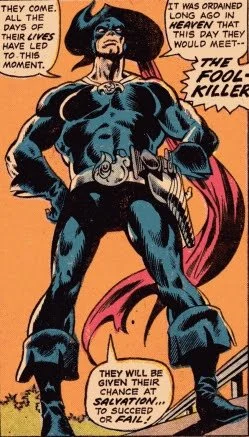
The Foolkiller’s first victim really should have been his tailor
The Foolkiller and the Punisher are both killers with a code; the difference lies within the code itself. As an exaggerated response to popular panic over crime and urban decay, the Punisher is an extralegal remedy for ills that are clearly defined by his country's laws. The Punisher may be judge, jury, and executioner, but what he is not is a legislator: just as the traditional superhero is inevitably committed to upholding the (capitalist, legal) status quo, so too is the Punisher unconcerned with the nature of crime. Crime is an essentialized phenomenon that exists before the Punisher ever appears on the scene.
The Foolkiller, on the other hand, is interested in a different category of social ill, as his name suggests: fools. Being a fool is not a crime; indeed, the entirely legal authority held by many a fool spurs the Foolkiller on to increasingly spectacular executions. Nor is there a commonly accepted definition of a fool that would allow a citizen (or a reader) to predict who might be the Foolkiller's next target. Other versions of the Punisher have popped up now and then, whether in different timelines, alternate dimensions, or even as a short-term replacement of the main continuity's character. None of these have had the resonance of Frank Castle, because it is Frank's history, character, and perspective that define this particular variation on the vigilante theme. The Foolkiller, however, is a more malleable concept, and the multiple iterations of the character each rests upon his own understanding of what constitutes a fool.
Note
[1] Green Arrow is also an example of a successful revamp that fundamentally defines perceptions of the character from that day forward. When Geoff Johns and the DC editorial staff were laboring to undo the mistakes of the New 52 (which, in Oliver Queen's case, rendered him nearly unrecognizable to comics fans even as he was more closely alligned with the hero of the CW's hit show, Arrow), he engaged his colleagues in a group exercise to define the basic features common to virtually every successful version of a DC character. For Green Arrow, that was his van dyke beard, his abrasiveness, his politics, and his relationship with Black Canary.
Next: God's Executioner