Who, after all, are the Mutants? In addition to being a comics industry in-joke, the name also reminds us of the metaphorical power that Marvel's mutants have always had: as a non-existent minority, they can stand in for any marginalized population. Of course, Marvel's early approach to this question was typical: the X-Men and other mutants were open to metaphorical interpretation precisely because they were white. Without any of the baggage of a real, existing ethnic group, they were a means for the white reader to cosplay oppression. Miller's mutants are something else entirely: not white, not Black, Latino or Asian, but strangely almost beige.
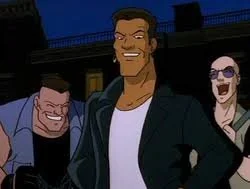
Street gang racial harmony, brought to you by Disney
It's an interesting, if unsatisfying, solution to a longstanding representational problem: my elementary school books in the 1970s featured children with an astounding range of skin colors (blue, orange, maroon), but none found in nature, while the 1990s hit adventure cartoon Gargoyles featured multiracial street gangs that resembled a downscale Benetton ad or a human resources dream team (one Black, one white, and one Latino gang member joining in harmony to threaten passersby). Miller's approach was to drain all the gang members of color, and yet give them a slang that was heavily inflected by African American Vernacular English. It's a clever dodge: Miller can gesture towards blackness, but any assertion that the Mutants are meant to be Black must be made by the reader, not the author.
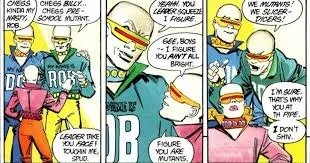
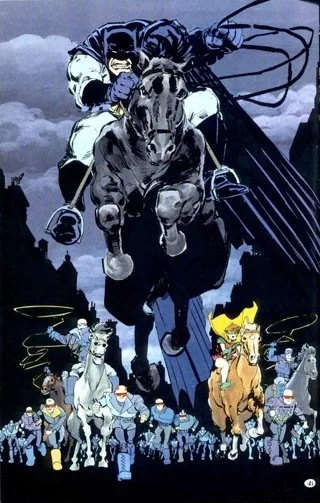
It also avoids the cringe-inducing visual of a giant white man (Batman) leading an army of young men of color. Once the Mutants cosplay as the Sons of the Batman, they blend in with his color palette. The result is a literalization of the theory that young men go feral without a father figure: no racial diversity will call Batman's paternity into question. Meanwhile, decades of discomfort and cultural criticism about Batman and his relationship to the young boy(s) who follow him are put to rest. First, he has a new, female Robin, with whom his dynamic is obviously paternal. Second, Batman's closeness with young Dick Grayson or any of his successors facilitated Wertham's thesis that Batman and Robin were a "homosexual fantasy" (as do numerous hilarious old comics panels frequently shared online), but Batman in charge of an army of young men looks completely different. His is both father and general, the central figure in a network of homosocial group bonding. As a positive male role model, Batman lifts the Mutants up. In the words of the military recruitment slogan that was ubiquitous when Miller published the book, Batman inspires his "sons" to be all that they can be.
Iconography? What iconography?
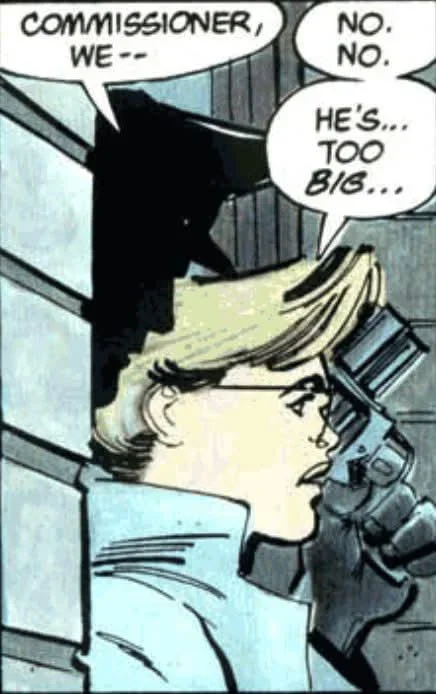
How does Miller get both his skeptical characters and potentially skeptical readers to support this particular model of Batman(hood)? The same way zombie movies require their viewers to (temporarily) approve of widely available firearms, or 24 establishes ticking-clock scenarios in which torture is justifiable and effective: developing a plot that becomes a fascist Batman's natural habitat. No matter how dystopian Gotham City may have become, it is still a place where the virtues and vices of vigilantism are up for debate. But after an electromagnetic pulse disables all of Gotham's technology, the city is reduced to the Hobbesian nightmare that has always lurked just beneath the surface. The only force for order left is Batman and his teenage army. Miller draws a two-page spread of Batman and the former Mutants literally riding into town on horseback to save the city, recapitulating a cowboy trope that lies deep within American mass culture. The appropriate response is modeled by the chief Batman skeptic in law enforcement: Ellen Yindel, Jim Gordon's replacement as police commissioner. Asked by a cop if they should fire at him, an awestruck Yindel reponds: "No...he's too big" (check).
Phrasing!
Batman is, indeed, too big: larger than life, he is also larger than any of the city's now totally dysfunctional institutions. This is where vigilantism and fascism meet: institutions are fundamentally inadequate for solving social problems. Only a big man (and his followers) can save the day. Batman further proves his point by fighting Superman to a virtual standstill, before interrupting the fight by faking his own death. In The Dark Knight Returns, Superman ("the big blue boyscout") is both the embodiment of a romantic heroic ideal (he even comes with his own idyllic scenery when he meets Bruce in his secret identity) and a government stooge. The president (somehow Ronald Reagan is still alive and in office) is addled and under-informed, but Superman, being Superman, follows his orders. When he is nearly killed by the electromagnetic pulse, he restores his vitality by absorbing the life force of the natural world around him; Batman powers his exoskeleton to fight Superman by syphoning off most of the remaining electricity from Gotham's power grid. Batman's natural environment is the city, but without much respect for its institutions. He drains the very infrastructure to get his way.
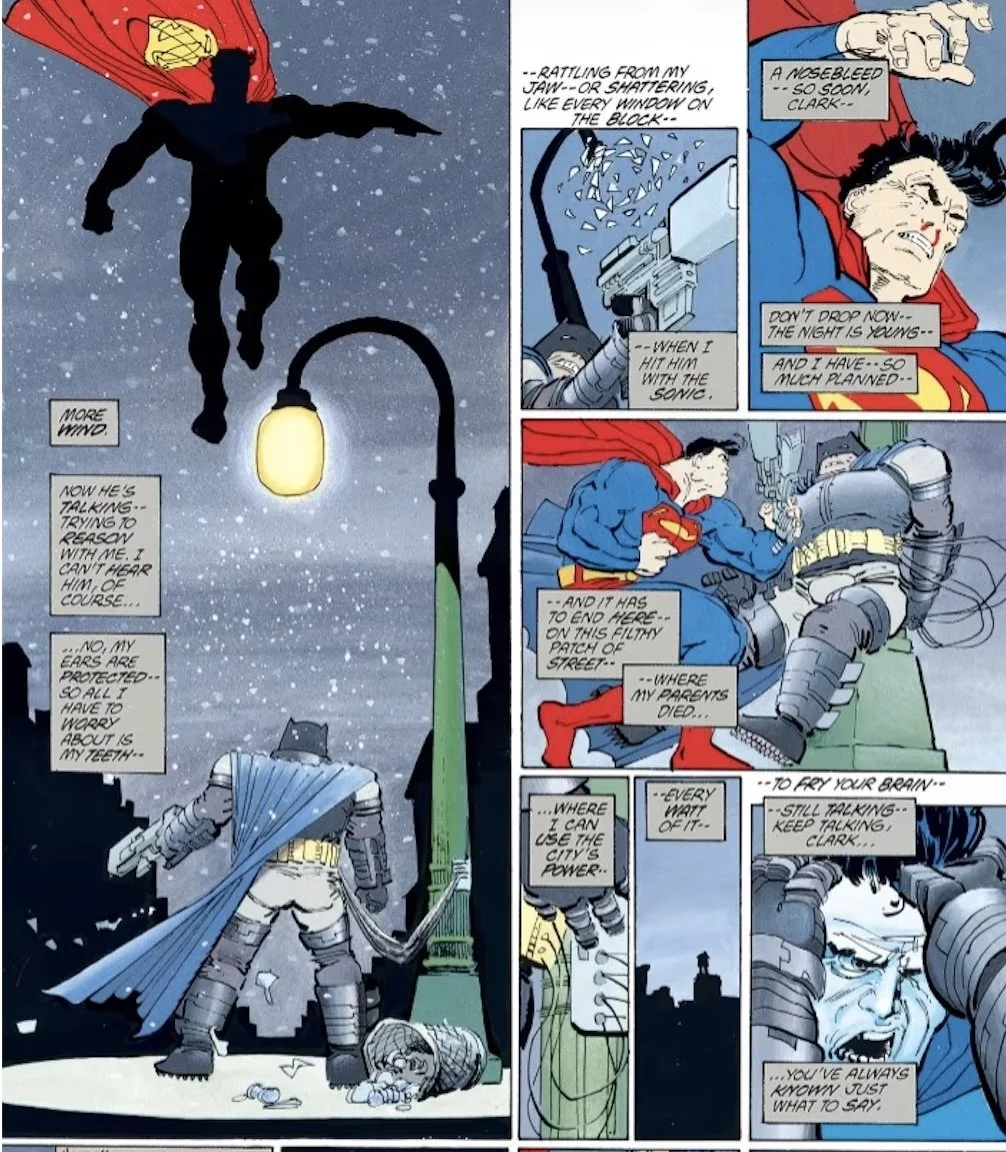
News alert! Rich white guy privatizes power grid
Despite his apparent death, the book gives Bruce Wayne a perfectly Batman happy ending: with all the trappings of his civilian life destroyed, he and the Sons of the Batman can retreat deep within the batcaves, near the city but not of it. To borrow Agamben's terms, Batman has ended his civil life (zoe) in favor of what, for him, is the sheer, unrestrainable power of bare life (bios). He and his sons (and Carrie) have opted out of civilization, in a home base from which they can work to make Gotham better. Batman has abandoned government in favor of a militia.
Next: What a Fool Believes