Batman and Sons
The Sons of the Batman, whose unspoken acronym, "SoB," is both a slur and a signal of toughness, are only the most obvious example of The Dark Knight Return's embrace of the cult of masculinity, in all its fascist implications. Manliness has always been central to modern fascism, whether it be the Mannerbunde who paved the way for Nazism or the Nazis' own preoccupation with male group cohesion and the perfect male, athletic body. The Dark Knight Returns is full of rugged, muscular male heroes, which in and of itself is not unusual for the superhero genre.
Indeed, the ubiquity of the perfect male superhero physique is part of the point. The Dark Knight Returns shares a common fascist disinterest in traditional femininity in favor of a female androgyny that borders on the butch. Both Ellen Yindell, the anti-Batman commissioner who succeeds Gordon, and Carrie herself sport short hairstyles that lend some ambiguity to their gender presentation. And, just as Batman has foils like Two-Face, who reflect back some of his salient traits in exagerrated form, one of the few women Batman every fights appears at the very beginning of Book Three, in a liquor store hold up accompanied by a news broadcast informing us that Yindel is taking over as commissioner that very evening. The sheer volume of androgyny and cross-gendered presentation in this single scene is astonishing. Batman is in disguise as an obese Black bag lady, while the robbers are a splinter group of ex-Mutants who, rather than joining the Sons of Batman, have cut to the chase and become Nazis. Granted, their Nazism has a strong whiff of the same cosplay in what Batman is engaging: the two men wear identical green uniforms that, while inspired by the Third Reich, end up looking a bit like the guise of some futuristic henchmen from a bad 1950s sci-fi adventure. They sport the same blond buzz cut as their leader, Bruno, a tall, shirtless muscular figure with tattoos on their bare buttocks and breasts. Bruno can be read either as a transwoman (based on the shopkeeper's comment about her body ("Nice work, too. Can barely see the stretch marks," and his addressing them as "boys), as a very butch woman (the same shopkeeper refers to Bruno as "her," which, in the time and situation, strikes me as an unlikely courtesy on his part if she is trans). Either way, she and Batman are opposing visions of a feminine grotesque: the manly physique that frames a huge pair of breasts (Bruno) and the sheer excess of the fat Black female body that Batman pretends to inhabit.
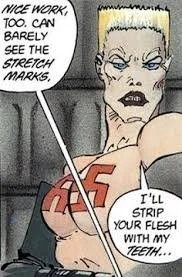
This patently ridiculous fight between a bare-breasted androgynous Nazi and Batman the Black Bag Lady lampshades the most obvious omission in Miller's reproduction of Eighties-era panic over "urban" youth crime: it is one of the few moments in the entire book when racial difference is rendered explicit. Any representation of Gotham's juvenile delinquents could not help but be racially fraught. Portraying them as, partially or primarily, people of color not only opens up Miller to charges of racism, it would create a visual dynamic to Batman's fights that would be open to racist appropriation regardless of authorial intent. On the other hand, making them all white would be to whitewash American history, to deny the legacy of centuries of economic oppression, from slavery to quotas to redlining, that confined people of color to urban ghettos, widespread unemployment, excessive policing, and few options besides crime. The racist stereotype of Batman's disguise as incoherent, obese unhoused woman is safety valve for the pressures of racial contradictions that are just underneath the surface of the book.
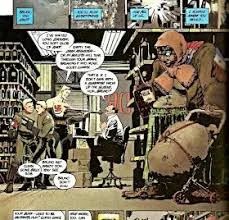
Where’s Batman? Disguised as an obese unhoused woman, of course
Next: Too Big to Fail