While there is something satisfying about calling violent criminals "mutants" during a time when Marvel's X-Men were in their ascendency, the Mutants are not simply a nod in the direction of the Marvel/DC rivalry. When ordinary denizens of the Marvel universe hate and fear the X-Men, their prejudice is unfounded; Miller's Mutants, though not literally the result of genetic drift, embody an older generation's fears of an incomprehensible, horrifying youth that have come to take their place. By the 1980s, decades of moral panic about teenagers had intensified to such an extent that the 1950s depictions of "juvenile delinquents" looked tame, if not positively adorable. In a decade scarred by the Reagan Era War on Drugs, the institution of mandated sentencing, fear-mongering over the crack epidemic and "crack babies," and a highly racialized media frenzy about violent, drug-related street crime, urban youth of color were framed as prone to violence, a problem allegedly exacerbated by the absence of father figures in their lives.
If anything, Miller's portrayal of violent youth gangs is not just reflective of the anxieties of his times, but borderline prophetic: three years after Batman: The Dark Knight Returns was published, the vicious gang rape of a white woman in New York's Central Park would take the discourse of racialized crime to frightening new heights. The five Black and Latino teens wrongfully convicted of the crime were said to have been engaging in an activity called "wilding", which consisted of random acts of violence against total strangers. Wilding (which turned not not to be a real phenomenon) was to be a key element in the rising moral panic over urban crime.
The primary antagonist in Book Two is ostensibly the adult leader of the Mutants, but the main focus of the story is on the children and teens who follow him. "The Dark Knight Triumphant" is a mini-novel of, if not education, than mis-education by the media, failing social institutions, and deadbeat parents. As is often the case in this graphic novel, the chapter approaches the primary moral questions by alternating conflicting examples: bad teens inspired by the Mutant Leader and the incipient heroism of the new, self-declared Robin. Carrie Kelly was introduced in the previous installment, in which Batman saves her from a Mutant attack. Now, while the news announcer reports on an anti-Batman petition "citing him as a harmful influence on the children of Gotham," Carrie puts on her new Robin costume for the first time. While the announcer reports that Jim Gordon has just shot and killed a 17-year-old Mutant who had attacked him in the chapter's first pages, Carrie makes her way out the window and onto the ledge. Her parents, never actually seen on panel, lament what they see as another in a long line of instances of police brutality. They are ex-hippies who watch TV and reminisce about Woodstock and Chicago, only occasionally remembering that they have a child. When Carrie nearly dies in her attempt to climb down the building, who is to blame? Her stoned, irresponsible parents? Batman, for inspiring her? Like all the teens in Batman: The Dark Knight Returns, she is not just choosing her own adventure; she is choosing her own father figure, and the pickings are slim.
In one of the many television broadcasts punctuating the chapter, Harvey Dent's psychiatrist, Dr. Bartholomew Wolper, explains that Batman is himself responsible for all the crimes he fights, thanks to his anti-social actions being popularized by the media. Wolper (who, among other things, is an obvious parody of anti-comics crusader Dr. Frederic Wertham), is a proponent of the outdated "media effects" theory, which presumes passivity and vulnerability on the part of the media consumer:
Just as Harvey Dent--who's recovering steadily, thanks for asking--assumed the role of ideological doppelganger to the Batman, so a whole new generation, confused and angry...
--will be bent to the matrix of Batman's pathological self-delusion. Batman is, in this context--and pardon the term--a social disease...
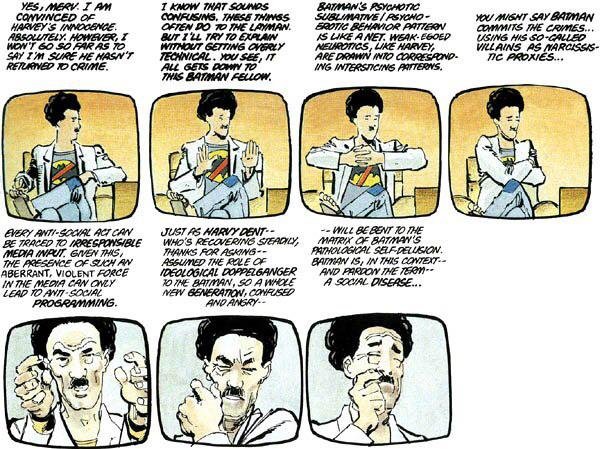
Like Wertham, even as he draws spurious conclusions, Wolper is nevertheless on to something. His interpretation of Harvey Dent, while not exhaustive, is far from incompatible to Batman's own assessment of their relationship ("A reflection, Harvey"), while Batman: The Dark Knight Returns clearly supports the premise that Batman is having an influence, pernicious or otherwise. Yet, here, too, the argument is stacked in Batman's favor. The Mutants are not just needlessly violent predators; their crimes show them to be nihilists whose worldview leaves no room for the future. One Mutant randomly kills a subway rider by planting a bomb in her purse after feigning to steal; the Mutant responsible is not a character at all, but simply a function, while the woman, Margaret Corcoran, gets an entire page of narration putting the reader in her head. She is an overworked, impoverished mother who has just found ten dollars that she intends to use for her son's art supplies rather than medication for her own pain. Now her children are orphans. In another scene, a group of Mutants is holding a baby for ransom; one holds a gun to the children's head telling Batman "I'll kill the kid--/believe me, man, I will--" before Batman takes him down. Batman may be fighting the youth of Gotham, but it is to protect an even younger, more innocent generation.
The chapter ends with a bloody, gruesome battle between Batman and the Mutant leader in a mud pit, complete with the over-the-top violence for which Miller has become famous:
Batman: You don't ...get it, boy...
This isn't a mudhole...
It's an operating table.
And I'm the surgeon.
[He breaks the mutant leader's leg]
Caption: Something tells me to stop with the leg.
I don't listen to it.
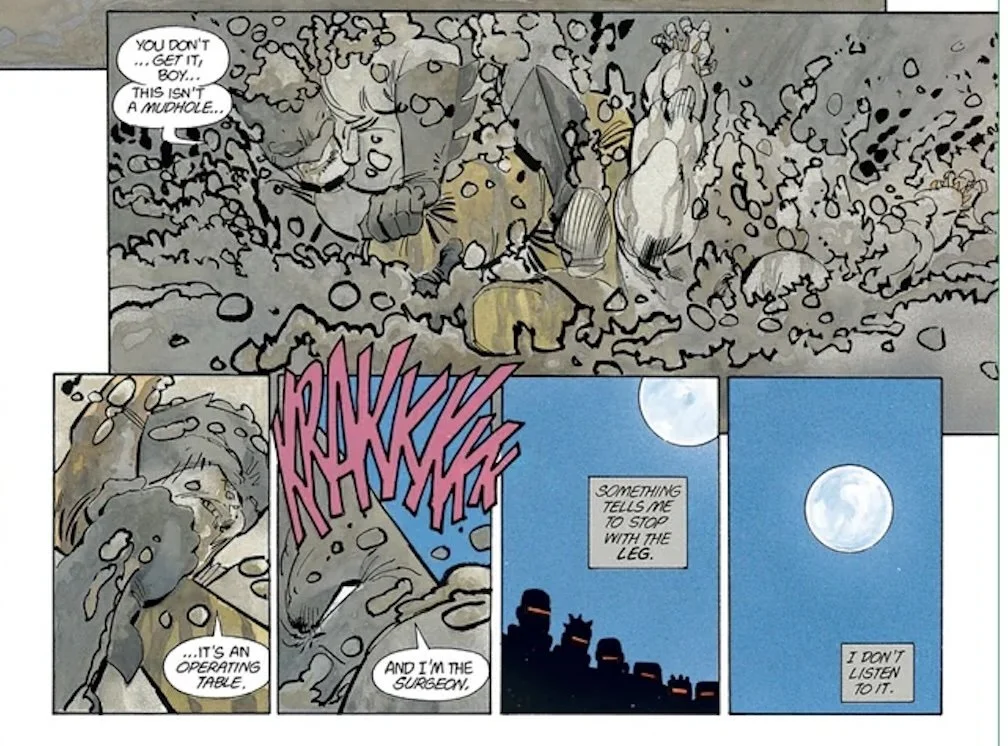
It's a case of terribly overwrought dialogue that would be perfectly at home in a B-grade action movie, but the metaphor clarifies Batman's purpose: his physical fight stands in for his attempt to cure the Gotham body politic. In fighting the Mutant leader, Batman is showing his impressionable young (Mutant) audience who is the better father figure, and who is most deserving of emulation. He has already won over young Carrie without even trying, and in any case, as a law-abiding teen (and a girl, to boot), she was never part of the demographic most linked with the panic over urban youth crime. The Mutants, on the other hand, are almost exclusively male, and their submission to an alpha male leader fits the classic late twentieth-century paradigm of feral young men desperate for a father figure. The scene of Batman kneeling over the Mutant leader's prone body is juxtaposed by one of the book's ubiquitous television screens, this time with a young man who appears to have Batman's symbol tattooed onto his face:
The Mutants are dead---mutants are history. This is the mark of the future. Gotham City belongs to the Batman.
[...]
Do not expect any further statements. The Sons of the Batman do not talk. We act. Let Gotham's criminals beware.They are about to enter hell.
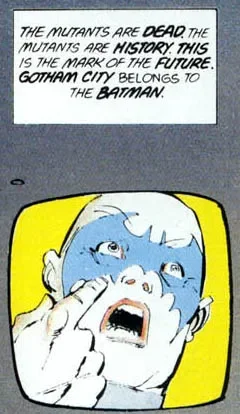
Wolper immediately cites this speech as evidence that he was right all along:
Just as I predicted--the Batman has infected the youth of Gotham--poisoned them with an insidious excuse for the most violent anti-social behavior.
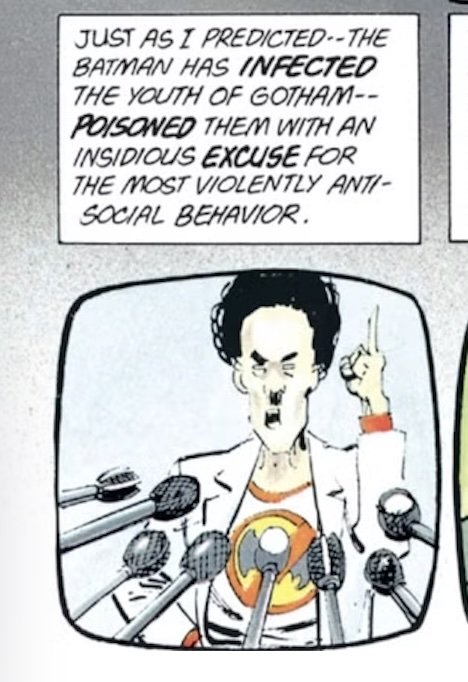
If we strip Wolper's words of their value judgments, he is right: Batman has "infected" Gotham's youth. Their switch of allegiance to Batman validate's both Wolper's media effects model (passive viewers are transformed by what they see) and the absent-father paradigm for gangs. The Mutants/Sons of the Batman have no values or evaluative capacities of their own, and will follow the strongest man to win their attention. Their very name indicates the centrality of masculinity to their group formation: there do not appear to be any Daughters of the Batman.
Next: Batman and Sons