Appropriately enough, Batman's reemergence is paralleled not just by the return of his greatest foes (Two-Face, the Joker), but also by an ongoing debate on the possibility of rehabilitation. Indeed, it is the initial focus on Two-Face that helps establish the impression of a full-fledged ethical dialogue about superheroes and supervillains; if anyone is well-poised to bring up two sides of an issue, it is the scarred and schizoid Harvey Dent. In a brilliant page that starts whose very composition emphasizes duality, Two-Face is reintroduced in a complex grid: the first row consists of four panels, while the second row has five, because the last panel showing the door to Two-Face's room is bifurcated down the middle. When we actually see a completely bandaged Harvey, the same bifurcation splits his body into two separate panels, with his surgeon at his right shoulder and his psychiatrist at his left. Two different medical discourses have come together to cure him in body and mind, culminating in a series of three more sets of bifurcated images focusing on his face, before his face at last fits in a single, final panel, obscured by the mirror in which he sees his post-surgical image. The panels themselves convey Harvey's putative cure and reassumption of a singular self.
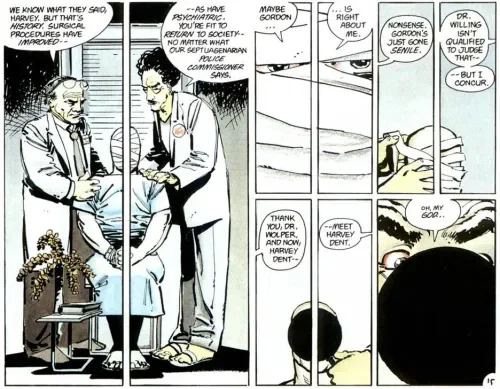
The media reaction to Two-Face's cure is, naturally, divided, with Commissioner Gordon expressing skepticism about the end of Harvey Dent's criminal career, and Bruce Wayne, who sponsored the treatment, arguing for the virtues of medical and psychiatric intervention and, above all, a second chance. Here Batman's dual identity mirrors Harvey's own: as Batman, he fights and imprisons Two-Face, and as Bruce, he tries to rehabilitate him. But Batman's very return to the public stage causes the Joker to wake up from his decade-long catatonia, a fact that implicitly supports the view of Harvey's psychiatrist, who insists that Batman provokes the manias and obsessions of the members of his rogue's gallery.
Both Batman's supporters and detractors clearly recognize that his return is, at the very least, an incitement to debate. In the first of several excerpts from a Gotham television stations regular on-camera debates between two pundits (one is a man named Morrie, while the other is an obese Lana Lang from the Superman comics--Lana was a journalist in pre-Crisis DC continuity), Morrie calls Batman a "social fascist," to which Lana responds:
Then why do you call him psychotic? Because you like to use that word for any motive that is too big for your little mind? Because he fights crime instead of perpetrating it?
Morrie: You don't call excessive force a crime? How about assault, fat lady? Or breaking and entering? Huh?
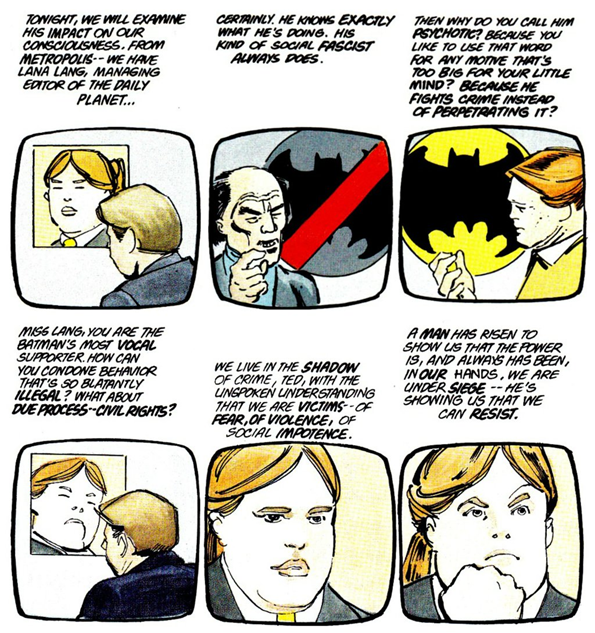
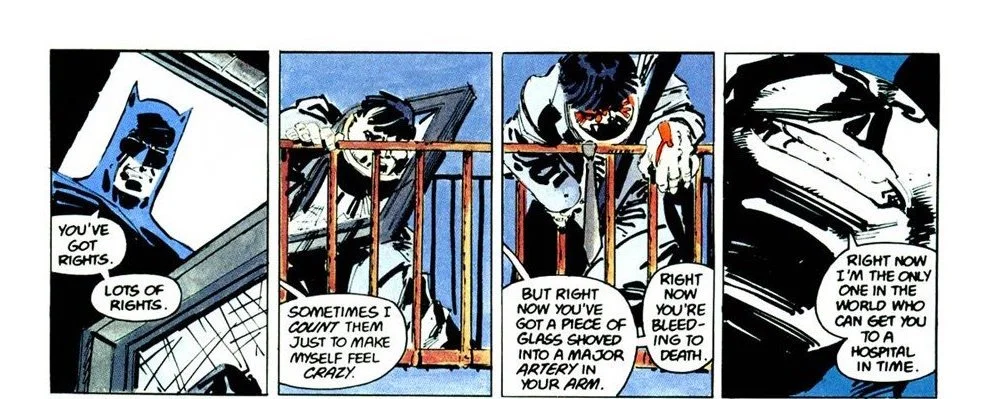
The set up is a parody of the long-running Sixty Minutes segment "Point Counterpoint" (as well as an homage to Saturday Night Live's own hilarious parody), so the animosity might be expected. But Lana is the cooler head here, as Morrie's name-calling ("fat lady") indicates. Their debate launches a four-page examination of Batman's violent methods and their repercussions, with an ambulance-chasing lawyer insisting that Gordon release his client, who he insists is not a criminal, but a victim of Batman's "criminal assault" on his person. We know (and Gordon certainly knows) that the man is guilty, but Batman, in ignoring procedure, has left Gordon no other choice but to let him go. This only gives Batman access to the criminal once again. The man crashes through a window trying to avoid Batman, shouting "I got rights." Batman's response is that of the classic vigilante who knows that the system does not work:
You've got rights
Lots of rights.
Sometimes I count them just to make myself feel crazy.
But right now you've got a piece of glass shoved into a major artery in your arm.
Right now you're bleeding to death.
Right now I'm the only one in the world who can get you to a hospital in time.
Miller immediately follows this monologue with another "both sides" response to Batman: first from a supporter, who hopes that he "goes after the homos next," and then from a detractor, who calls for the rehabilitation of criminals before admitting he would "never live in the city." While the book's thrills most obviously come from Batman's extreme actions, the first issue still appears relatively even-handed in its depiction of the pro- and anti-Batman debate. But the issue's conclusion metaphorically previews the resolution of the debate. With Harvey Dent as the antagonist, the entire installment has focused on dualities, from Bruce's and Harvey's dual identities to the opposing views on superhero vigilantism. Early on, the book seems to promise that the dichotomy between good and evil can be resolved in favor of the good, with Harvey's surgery restoring his face to its previous, unblemished form. But in the end, we learn that Harvey sees the exact opposite when he looks in the mirror: a monstrous face that no longer includes a scar-free half. The beauty of Two-Face as a villain rests in the promise that a dichotomy can be momentarily resolved (by flipping a coin), but endlessly deferred (as represented by Harvey's divided face). By contrast, both Harvey's surgical cure and his delusion augur an ultimate end to dualism: one side is going to win. By the same token, Batman: The Dark Knight Returns will play with dualism over the course of four chapters, but in the end, will come down firmly on one side of the coin.
But beating Two-Face has limited utility in determining Batman's value to society after a decade's absence. The first and third chapter are replays of Batman's greatest hits: fighting Two-Face and the Joker. The Joker in particular only returns because Batman did, leaving open the possibility that the hero's only significant role in his declining years is to clean up the messes that survived along with him. They are baroque, fanciful villains from a bygone age, with costumes, a gimmick, and little resemblance to how crime was portrayed at the time Miller made The Dark Knight Returns. The even-numbered books highlight a new kind of menace, one that resonated with the anxieties of the 1980s: the ultraviolent youth known as the Mutants.
Next: Who's Your Daddy?