If, as Rick Hudson argues, Watchmen is the "exemplary Menippean and dialogic text with the graphic novel" medium (that is, using the characters and the plots in which they find themselves as a testing ground for trying out competing ideas), Batman: The Dark Knight returns is something different. The multiple points of views, examples, and arguments are not so much in dialogue with each other as they are like motifs in a symphony: recurring, evolving, and combining and recombining as point and counterpoint in the service of the larger overall theme. The titles of the four books that make up the collected edition sketch an arc that, while formally accurate, is deceptive on the level of theme and ideology. The odd-numbered books have titles whose relevance is indisputable: "The Dark Knight Returns" and "Hunt the Dark Knight, " respectively. They are descriptive rather than evaluative; both the returning and the hunting are definitely happening. But the even-numbered books are another matter: "The Dark Knight Triumphant" and "The Dark Knight Falls." In terms of both the actual events and their ideological ramifications, these titles could just as well be swapped: In book two, Batman both falls (to be rescued by his new Robin) and triumphs (he beats the Mutant leader), while in the last book, he "falls" (throwing the fight against Superman and faking his own death) and triumphs (living to carry on his crusade outside the unrelenting media glare). By the end, Batman has also both lost and won the larger questions about the appropriateness of vigilantism as an alternative to failed institutions: he has lost, in that, in the face of state persecution, he has been forced to abandon the life he built for himself over the course of four decades, and he has won, in that the book ultimately reinforces his world view.
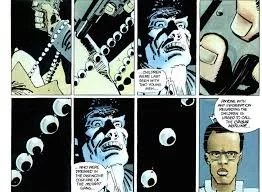
Rereading The Dark Knight Returns from the beginning, but decades after its first release, reveals both the source of the book's reputation for a relatively even-handed presentation of the morality of vigilantism and the heavy thumb Miller puts on Batman's side of the scale. Before TDKR, Batman had never been presented as quite so broken. On the very first page, he miraculously survives a race car accident in a scene whose narration stresses Bruce's insistence on flirting with death, while his dream about falling into the Batcave when he was still a little boy demonstrates a history of trauma that actually predates his parents' murder. The set piece is an iconic sequence that intersperses the slow-motion shooting of his parents that precedes multiple images of his mother's pearl necklace being pulled by the gunman until it snaps; the necklace is repeatedly interpolated with images of adult Bruce's horrified face and tight close-ups of TV news anchors reciting the latest urban atrocity. The visual metaphor is clear: Bruce, like the pearl necklace, is on the verge of snapping.
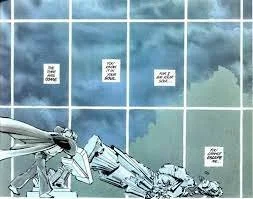
Visually, the entire first book conspires to show just how hemmed in Bruce is by his current life. During the race car scene, we only get a partial picture of various parts of his face. After turning off the television that inadvertently brought him back to the scene of his parents' death, Bruce knocks a statue off a pedestal while walking across a multi-panel grid showing the storm brewing outdoors. The statue crosses over four different panel boundaries, while Bruce himself, racing forward, is more than a single panel can contain. When he does finally don the Batman costume for the first time in a decade, Miller continues to play with the contrast between confining panels and Batman's body, but where before, the emphasis was on constraint, now we have the first inkling that Batman is "too big" for the panels that tell his story. When Miller at last shows us Batman's entire body in a full-page spread, the hero again exceeds his borders--larger than life, he dwarfs the television screens that appear along the right side of the page.
The point is that, while the first book does a remarkable job reminding the reader that Bruce is essentially damaged goods, it is in the service of ultimately reinforcing the legend. Many of the best superhero comics of the 1980s have been labeled "deconstructionist," usually alluding to a misunderstanding of what Deriddean deconstruction was all about. The assumption is that "deconstruction" is a synonym for "destruction," and "reconstruction" is the opposite. Deconstruction works in contrast to mere destruction: it breaks things down, shows their internal contradictions, but builds them back up again while incorporating an awareness of the shaky foundations on which it is built. Deconstruction incorporates reconstruction, but with a critical difference. This is what Miller does with Batman. The process always leads to a reaffirmation of Batman's greatness.
Next: Fighting Crime or Curing Crime?