Nonetheless, one need not read The Dark Knight Returns anachronistically to conclude that the book does, in fact, come down on the side of a politics that at least flirts with fascism. In and of itself, this would be an interesting finding, but what really makes The Dark Knight Returns such an intense and complicated reading experience is how the book gets there. Miller's first big Batman story is not a straightforward apologia for vigilantism, and to the extent that it veers towards fascism, it does so in such a circuitous way, involving so much debate and dialogue, that one could easily be left with the impression that The Dark Knight Returns manages to maintain itself suspended between two opposing points of views. My point is not that Miller is trying to write a fascist work, or even held fascist beliefs, but that the composition of The Dark Knight Returns leads the reader down a path of normalized fascism, even if the process might be inadvertent or barely perceptible. In doing so, The Dark Knight Returns not only interrogates the issues central to the superhero genre, but also serves as a case study in the capacity of an adventure narrative to make readers and viewers at least temporarily occupy political subject positions that they might otherwise find abhorrent.
The greater the contrast between one's personal politics and the ideology inherent in a pleasurable narrative, the easier it is to notice. For me, that moment of understanding came when hate-watching Fox's long-running TV drama 24 (2001-2010, 2014). 24 gripped its viewers with a novel format and even more novel conceit: every one-hour episode was equivalent to one hour within the narrative itself, advancing a plot that unfolded over the course of one twenty-four day (and one twenty-four episode season). Before each commercial break, a digital clock displayed the time while the screen subdivided into four smaller screens, each showing different characters in different situations, as if the television were a security monitor. But it also encoded a politics that justified both the televised representation of total surveillance and the secondary status of human and legal rights.
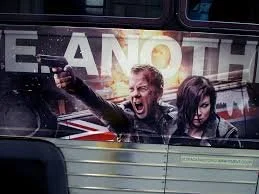
Yes, I want this show guiding the Supreme Court
The hero of 24 was Jack Bauer, an on-again, off-again agent for the U.S. Counter-Terrorism Unit (CTU). Though the show was supposed to take place in a world of our own, Jack had two outlandish, but unacknowledged superpowers: the ability to make anyone do what he wants in the heat of the moment by shouting a command twice ("Drop your weapon! DROP YOUR WEAPON!") and the magical good fortune of owning cell phones that always got perfect reception. He also had an unwavering sense of purpose: if the only way to get the information needed to prevent a terrorist attack was torture, then so be it. Jack and his colleagues repeatedly torture suspects (not all of them guilty), and even are themselves subjected to torture (Jack most of all). While experts generally agree that, aside from the crucial moral questions torture poses, it is also rarely effective at producing reliable intelligence. Yet on 24, this is not the case: again and again, the day is saved thanks to secrets elicited through violence and threats. In 2007, Supreme Court Justice Antonin Scalia cited 24 in justification of so-called "enhanced interrogation":
"Jack Bauer saved Los Angeles. ... He saved hundreds of thousands of lives," Judge Scalia said. Then, recalling Season 2, where the agent's rough interrogation tactics saved California from a terrorist nuke, the Supreme Court judge etched a line in the sand."Are you going to convict Jack Bauer?" Judge Scalia challenged his fellow judges. "Say that criminal law is against him? 'You have the right to a jury trial?' Is any jury going to convict Jack Bauer? I don't think so.
"So the question is really whether we believe in these absolutes. And ought we believe in these absolutes."
Scalia's citation of a fictional television drama to justify his legal opinion was shocking, but the content of his opinion was not: no one really expected Scalia to turn into a defender of individual human rights in relation to the U.S. state security apparatus. Politically, Scalia was 24's ideal viewer, in that he came to the show ready to believe in the efficacy and legitimacy of torture.
But 24 was not just a niche show for neocons; it was a hit with a broad fanbase. What did it mean for liberal viewers to watch 24? The inherent discomfort was not that the show portrayed torture in a positive light, but that, unless the viewers were actively resisting the narrative every step of the way, for the sixty minutes they were watching 24, they were trapped in a compact with Jack Bauer. Because Jack was right, and because torture did work, the only way to enjoy 24 was to assent to the admissibility of torture within the confines of this particular narrative. The problem was not that Antonin Scalia was a fan; the problem was that being a fan meant temporarily being Antonin Scalia. We root for Jack Bauer to torture the perps because we know that this will stop a bomb from going off or a president from being assassinated. In a court of law or a philosophical debate, one can come up with countless scenarios in which a suspect is tortured, and many of them will not lead to torture's justification. But 24 is a fiction whose scenarios are specific, limited, and framed precisely in the best possible terms for making torture acceptable.
This problem is not limited to 24, obviously, but it is firmly connected to questions of genre, and certain adventure genres rely on tropes that lean politically rightward. Is anyone really going to advocate for gun control during a zombie apocalypse, when the people who survive are precisely those who have access to guns? Or for putting Batman in jail when Gotham is overrun by ultraviolent criminals? In stories about heroes fighting crime, the deck is usually stacked in favor of a conventional notion of what, exactly, constitutes a crime and what might be an appropriate punishment. Even when a superhero comic does call into question some of the more dubious aspects of our criminal justice system, or, for that matter, the appropriateness of putting on a mask and taking justice into one's own hands, the readers, creators, and owners of these characters all share a vested interest in seeing their adventures continue. Whatever our personal politics, when we read Batman, we want to see him beating up the bad guy. Even Batman: The Dark Knight Returns, whose future setting frees it from both the confines of continuity and the necessity of leaving open avenues for endless storytelling, only flirts with killing off its main character. It ends with Batman very much alive, and available for more stories in the future.
Next: Destruction of Deconstruction?