Batman: The Dark Knight Returns; or, How I Learned to Stop Worrying and Love Fascism
After his initial run on Daredevil, Frank Miller went to DC to produce (among other things) the four-issue miniseries that would bring him his greatest fame: Batman: The Dark Knight Returns (1986). Written and pencilled by Miller, with inks by Klaus Janson and stunning colors by Lynn Varley, The Dark Knight Returns continues to exert an outsize influence on the superhero genre. Of the big three graphic novels to break into the media spotlight in 1986, this was the only one to focus on a familiar corporate property. Though it was not part of the official DC continuity, it redefined Batman for a generation, giving rise to an in-continuity interpretation of the character as an emotional stunted, misanthropic manipulator who drives everyone away. The aesthetic of the book (combined with the influence of Watchmen) spawned an entire era of "grim and gritty" comics, with little room for anything lighthearted. The Dark Knight Returns has been adapted as an animated film, served as the inspiration for elements of Christopher Nolan's cinematic Batman trilogy, and eventually established an entire Frank Miller subcorner of Batman continuity that included Batman: Year One and multiple unfortunate sequels (Batman: The Dark Knight Strikes Again (2001), Batman: The Dark Knight III - The Master Race (2015), and Batman- The Dark Knight Returns - The Golden Child(2019)), as well as a bizarre, unfinished prequel series drawn by Jim Lee: All-Star Batman & Robin: The Boy Wonder (2005-2008). [1] The world of The Dark Knight Returns has also been established as one of the multiple earths in the recent iterations of the DC Multiverse, appearing in the last issue of the Dark Nights: Metal event (2018) as well as an anniversary issue of the regular Batman comic (Batman vol 3 135; legacy number 900). And on top of all that, it directly inspired a storyline in the 1980s that ended with the death of the second Robin, Jason Todd. [2]
The Dark Knight Returns is also very much a product of its time. On the surface, this is a statement that says nothing: what artistic production is not a product of its time? But Miller's graphic novel was the most successful comic book embodiment of the discourse surrounding urban crime in the 1980s. I am not making the claim that The Dark Knight Returns accurately reflects actual crime during this particular period, but that it is dedicated to reproducing "urban crime" as an idea or story that haunted the American media with only a limited basis in reality. The Dark Knight Returns is not a dystopia, but it is a comic book representation of a then-current understanding of urban life as a dystopia in the making. Watchmen is also invested in the question of crime, but in a manner that allows no one understanding of criminality to dominate (Rorschach, the Comedian, and Captain Metropolis all understand crime differently, while Dr. Manhattan barely understands it at all). Fittingly, it is Rorschach who is the product of a particularly dark understanding of crime and the city; his origin, after all, is rooted in the murder of Kitty Genovese. But as important (and as mythologized) as that murder was, it was not a current event by the time Watchmen was published. The Dark Knight Returns does not bother to go back decades to make its case; the criminal blight in Gotham City is, to borrow the catchphrase of the Law and Order franchise, ripped from the headlines.
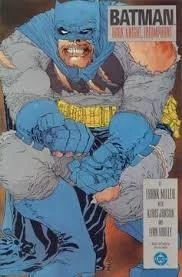
“No thank you, I do not want to dance the Batusi right now”
The Eighties preoccupation with senseless urban violence, feral youth gangs, and lone (white male) citizens taking justice into their own hands also makes it the perfect time for the superhero comic to reconsider its relationship to crime, justice, and vigilantism. Over the course of the character's history, Batman had alternated from grim fighter against street-level crime to sci-fi action hero to wacky camp icon. Starting in the 1970s, multiple creators had begun the job of returning Batman to his less fantastical roots, first Denny O'Neil and Neal Adams (primarily in the main Batman title), then Steve Englehart and Marshall Rogers on their brief, acclaimed Detective Comics run in 1977-1978. Since then, the street-level Batman was the dominant version. But after all this time, what did that mean? When Miller first took over Daredevil, he declared that the action took place in Manhattan's Hell's Kitchen neighborhood, an area first featured as a Marvel crime zone in Steve Gerber and Mary Skrenes's late 1970s series Omega the Unknown. Gerber and Skrenes were quite pointed and specific in the establishment of Hell's Kitchen as a neighborhood worthy of its name, but the kind of crime that took place in Miller's Daredevil was either timeless or deliberately retro (Miller's noir stylings meant that some of the gangs looked like they stepped out of a time machine). Batman: The Dark Knight Returns was the first time that Miller seriously engaged with crime as it was imagined to exist in the 1980s, even if the setting was roughly twenty years in DC's future. [3]
By having Gotham descend into criminal chaos in Batman's years-long absence, Miller is able to use his version of Batman's home town as a crucible both for Eighties notions of criminality and for the question of vigilantism. Establishing where, exactly, the book lands on the vigilante question is a matter of some controversy, partly because of Miller's clever and complex narrative structure. Much of the action is commented on by a running Greek chorus of television screens, featuring experts and ordinary people sounding off on the appropriateness of Batman's actions. The result is a sense of actual dialogism: the vigilante question is engaged from multiple points of view, potentially leaving room for the readers to draw their own conclusions. In the decades since the book's publication, there is a temptation to assign a right-wing argument to The Dark Knight Returns, due to Miller's belligerent, xenophobic turn after 9/11. Such a reading is unfair, in that it assumes a kind of crypto-fascism on Miller's part and does not allow for the possibility that his views have changed over the years.
Notes
[1] All-Star Batman has survived primarily as a meme, thanks to Batman's initial conversation with Dick Grayson in the Batmobile:
Dick: Who the hell are you anyway, giving out orders like this?
Batman: What, are you dense? Are you retarded or something? Who the hell do you think I am? I'm the goddamn Batman.
[2] He got better, but it took a long time.
[3] An exception might be made for the two-part Daredevil story co-written with Roger McKenzie, involving schoolchildren on Angel Dust. But this was just an Eighties variation on a decades-long tradition of scary stories about one demonized drug or another.
Next: The Politics of Reading against Your Own Politics