Secret identities have been willingly and unwillingly revealed in comics for decades, and in nearly all cases (eventually, even Daredevil's), a writer comes along who finds a way to put the genie back in the bottle. But Bendis did something new: not only did he continue to explore the effects of Daredevil's outing throughout his entire run, he even ended it with Matt in prison. Two things made Bendis's approach to the secret identity question unique: first, the development of a real-world media context, and second, an eye towards the legal ramifications of Matt's new status.
When Daredevil's secret identity was leaked to the Kingpin in Born Again, the threat was less to his secret than it was to his ability to function in the world. In classic supervillain fashion, the Kingpin, rather than going public, or simply having Matt Murdock killed, initiated a slow, methodical program for dismantling every aspect of Matt Murdock's life. In the aftermath, the next fifteen years of Daredevil stories would see Murdock and Kingpin in a kind of detente, with the Kingpin keeping Daredevil's secret identity to himself. But Bendis brings a down-to-earth perspective to secrecy that rarely overlaps with the superhero secret identity trope: secrets tend to get out. As reporter Ben Urich, who at times functions as Bendis's authorial mouthpiece, puts it when Daredevil asks, "You think someone knows who I am?": [2]
You mean somebody else? /Other than me? /Oh--and the Kingpin? Foggy? Karen? Spider-Man? Elektra?/../ And every girl you ever make goo-goo eyes at...
<...>
Listen, Matt, my whole career as a reporter is based on one simple principle: people talk./ Maybe the cat's out of the bag. (Daredevil vol.2 30, Bendis with art by Alex Maleev).
Sammy Silke, an upstart in the Kingpin's organization, is livid that Matt Murdock is always off-limits, and even more livid when he realizes that not only is Matt Murdock Daredevil, but a significant number of the Kingpin's men are aware of the fact and refuse to discuss it ("Does this strike anyone else as vaguely insane?" (Daredevil vol.2 30). Silke does eventually out Daredevil, but not as part of a successful scheme; in fact, he shares the information in the aftermath of the total failure of his coup attempt. Apprehended by the FBI, Daredevil's secret identity is the only card he can play. Even then, the FBI leadership declines to go public; another leaker gives the story to The Daily Globe.
Devastated, Matt contemplates admitting the truth, but his partner, Foggy, makes clear exactly what is at stake by framing the question in terms closer to the real-world context of the media and the law:
Foggy: "Oh Matt--
Come clean?
What are you talking about?
Matt Murdock tries cases as a lawyer...
... and as Daredevil, he's a vigilante?
Working either side of the law?
This means Matt Murdock defrauded the American justice system by faking a trial against Daredevil.
And that's just the most recent example.
Matt--you can't.
You can't come clean.
You can't come out.
First? You'll get disbarred.
And then...then you go to jail. (Daredevil vol.2 33)
The initial resolution of this dilemma is a brilliant step forward for superhero comics, complicating the philosophical underpinnings of the genre while simultaneously exposing one of its greatest ethical weaknesses. Foggy explains the plan of action:
We deny! Deny! Deny! 'Til we're blue in the face.
I saw we get up on the highest tree and we scream: Liars!
We sue everyone in sight until their heads spin off the top of their bodies.
We're going to own that dishrag of a paper.
What is this? Is this news? What they did? No.
In resolving to fight the story as lawyers, they undermine the simple dichotomy of truth vs. falsehood. What matters is not simply the truth, but what people believe, and, more important, what the law determines. The courts will adjudicate the veracity of the argument, based not on actual truth (to which they have no direct access) but available evidence combined with a persuasive narrative. Technically, this strategy would only be legal if Foggy didn't know his client was lying, but, again, one would have to prove his prior knowledge in court.
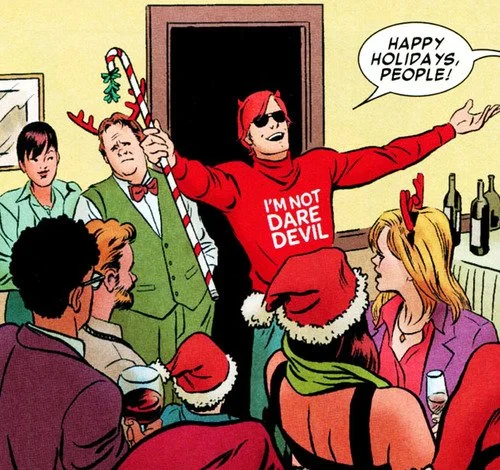
Daredevil or DareTroll?
It's a dirty, compromising set of tactics, one that suggests that the contrast between the ethics of law and the ethics of vigilantism might not be so clear-cut. There is nothing heroic about it. It sullies both the law and superhero vigilantism, because it also reminds the reader of a basic fact about superheroes with secret identities: they are liars, and they are lying constantly. The fact that one of those identities is an attorney only makes matters worse.
For the next several years, Matt Murdock's secret identity as Daredevil will be an open secret, something assumed but never proven, until the police finally get a sample of Daredevil's blood. At that point, Matt Murdock is disbarred and imprisoned, and it will take an improbably set of plot twists for the next writer, Ed Brubaker, to get him out and clear his name, and an even less probable plot twist for Mark Waid to have Daredevil's secret identity forgotten by the entire world. But that is not the point. Just as no dedicated comics reader could really believe that Superman was permanently dead when Doomsday killed him in 1992, few would have expected Daredevil's public identity to be maintained as the status quo (indeed, the most remarkable thing about the Bendis, Brubaker, Diggle, and early Waid runs was that it lasted for fifteen years).
Bendis is the first Daredevil writer to take the law/vigilante question seriously, and he succeeds by letting the two genres intersect in a fashion that makes sense for each. The Law proves more flexible and subject to manipulation than earlier writers had allowed, while the superhero genre learns to function in a gray zone that complicates the usually binary proposition of the secret identity. We still root for Matt; he is the title character, and his glaring character flaws make him appealing to follow. Bendis brings the secret identity drama close to the "real world" than ever before, and the result obliges readers to make the provisional peace with the attenuated morality of both of Matt's professions.
Next: Batman: The Dark Knight Returns; or, How I Learned to Stop Worrying and Love Fascism