When Miller returned to the title nearly three years after completing his initial run, law became important through its near-total absence. Having discovered Daredevil's secret identity, the Kingpin uses every lever available to him to dismantle Matt Murdock's life, piece by piece, including having him disbarred. For the first time in the series' history, Matt is no longer an attorney. He suffers a complete mental breakdown, losing control in both of his identities. Born Again (Miller's second Daredevil run) does not suggest that it is specifically the loss of his license that drives him to the brink (it is only one in a series of humiliations, culminating in the bombing of Matt's brownstone), but it is an appropriate bookend to the story's resolution. Matt's entry into the law was motivated by his father and his father's death; his "rebirth" comes when he is rescued by a nun named Maggie, who turns out to be his previously unmentioned, presumed dead mother. Now we learn that she visited him in the hospital right after his accident, and he felt the cross dangling from her neck. He feels it again at the convent where she revives him from his injuries and illness. Before this point, Matt was never depicted as specifically Catholic, thought his Irish descent made Catholicism a reasonable guess; now, it is his Catholic faith that sustains him. He has moved from the law of the father to the grace of the mother, and no longer needs the legal profession (it will be years before his license and status quo ante are restored).
Karen Page, the former secretary/girlfriend whose addiction-fueled confession of Daredevil's secret identity set the entire process of Born Again in motion, is tormented by guilt while Matt helps her through heroin withdrawal. But Matt, who has already come out on the other side of his life-changing ordeal, does more than forgive her:
--"Nothing," he'd said, Matt did, when she told him what she'd done--
--"I've lost nothing!"Matt said, and laughed like a boy" (Daredevil 232, written by Miller, with art by David Mazzucchelli).
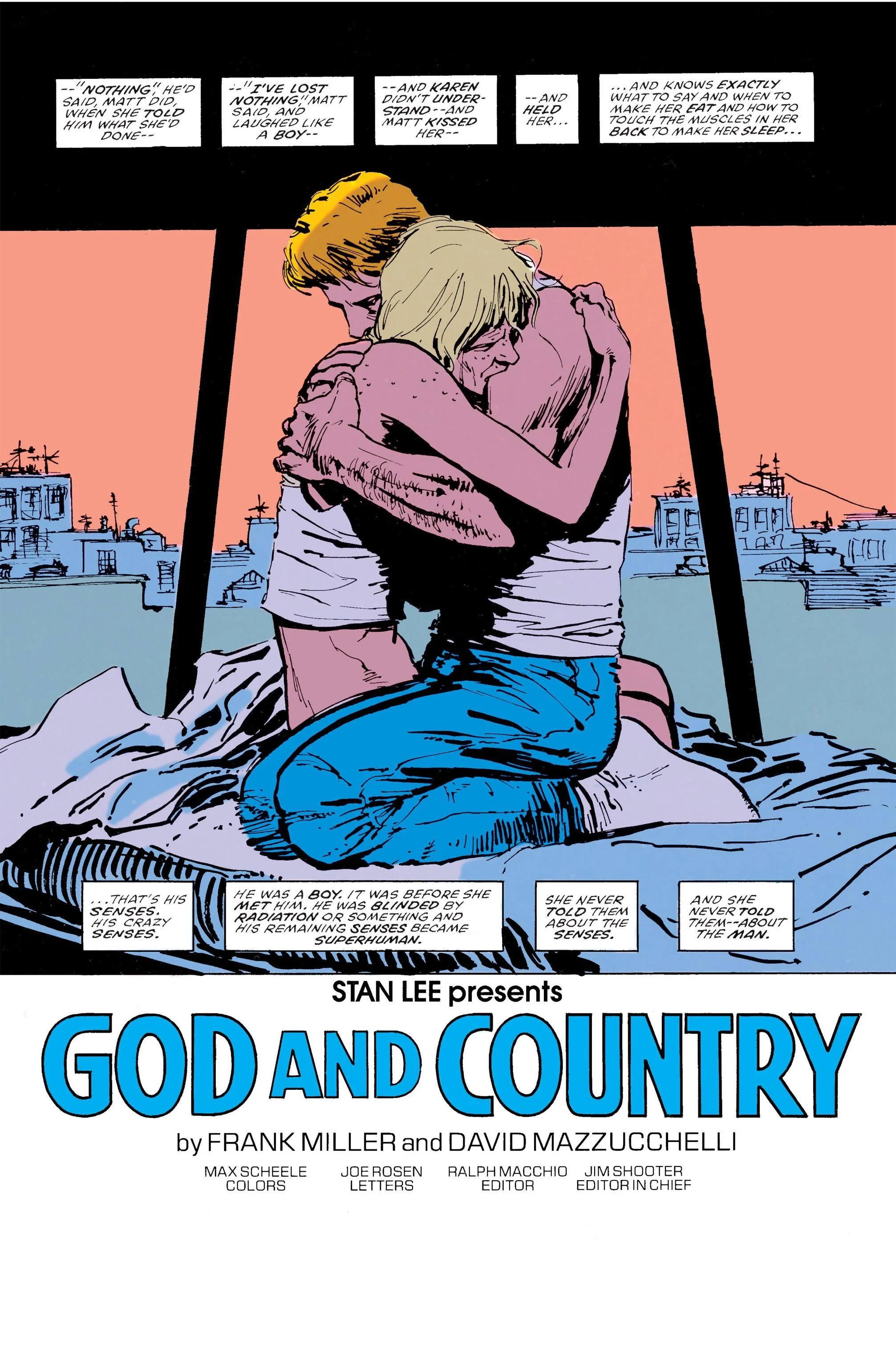
That "nothing" that he has lost includes his career, and by extension, an entire avenue of storytelling that has been a part of Daredevil since the first issue: courtroom drama. Not only will Matt no longer have to balance the competing needs of lawyering and vigilantism, but the comic itself has liberated itself from an ethical minefield based on a generic mismatch. Superhero comics generally do a bad job with courtroom drama (Daredevil included), for a variety of reasons, the most obvious of which is that the creators (and, presumably the readers) don't care as much about it as they do about spandex costume drama. That is just as well, because the two genres are fundamentally at odds: courtroom drama relies on the importance of procedure. This does not meant that the creators or the consumers value legal procedure above all else; the soap opera component of most television law shows makes this proposition laughable. But the law is to courtroom drama what the stanza is to poetry: a set of clear and predictable limitations for creators to rely on, exploit, and use creatively.
The pleasures of the superhero vigilante story come from indulging in the opposite impulse. Vigilantes circumvent the very procedure that can be the object of fascination in the legal drama; they are guided not by the law, but by justice. Each approach has obvious flaws: proceduralism can let the guilty go free, while vigilantism, when taken to its extreme, can become mob justice or even fascism.
Matt can and must appear in a courtroom, but for Daredevil, the courtroom is his kryptonite. Silver Age comics constantly flouted the legal system, with superheroes testifying in their costumed identities, or having shapeshifters pretending to be one of their identities so that they could both appear in the same place at the same time. Small wonder that, when Spider-Man reveals his secret identity to the world during the Civil War crossover, the ramifications are more than personal. As Peter Parker, he has made a living photographing Spider-Man for The Daily Bugle. The newspaper's publisher, J. Jonah Jameson, follows up on his quite reasonable second impulse (his first was to faint from shock): he sues Parker for fraud.
One of the long-term ramifications of Born Again was the tacit understanding that Daredevil the comic is at its best when Matt Murdock is at his worst. After Miller, the best writers to take on the book have responded to the Miller challenge: how can I destroy Matt's life more than Miller did? Not long after Brian Bendis began his run, he found the answer: outing Matt Murdock as Daredevil.
Next: Deny! Deny! Deny!