Punchable Villains and Billable Hours
Early on, Lee and his collaborators establish a pattern for Matt Murdock's double life: in the third issue, "Daredevil Battles the Owl, Ominous Overlord of Crime!" (Lee and Joe Orlando), the Owl contacts Matt to hire him as his attorney; Matt agrees, but investigates and eventually defeats him as Daredevil. For the purposes of this particular story, Matt's double identity is rather typical superhero comic fodder; the contradictions of law and vigilantism never actually materialize. But things get more complex and more interesting in the following issue ("The Unbelievable Purple Man!"), when Lee and Orlando introduce a villain with the power to control people's minds, Zebediah Killgrave. As Lee's description of him indicates ("the most off-beat, far-out, ding-dong , rootin-tootin' crackerjack super-villain you just ever did see"), Killgrave is still a far cry from the terrifying sociopath known to readers of Aliasand viewers of Jessica Jones decades later, but he does pose a set of unique challenges for both Matt and Daredevil. Killgrave is not simply a villain; he is a person who is entirely immune to all rules of human interaction, let alone the law. He robs a bank by simply asking for the money; his powers of persuasion do the rest. When he is arrested, and inevitably hires Matt Murdock (apparently Marvel's only defense attorney) as his lawyer, the judge notes Killgrave's claim that no crime was committed: "The money was freely given to him!"
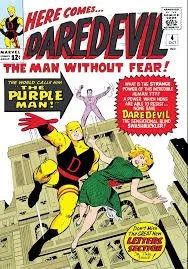
Killgrave, The Purple Man: More proof that even the campiest comics character can eventually be updated and made terrifying
Thus Killgrave is a challenge not just because he can control people's minds, but because the use of his powers makes the law irrelevant--the perfect opponent for a lawyer who puts on a costume in order to skirt the letter of the law he has sworn to uphold. Matt is stymied at every turn; Killgrave's powers mean that his day in court will only happen if he feels like it, and that no one in the legal system could successfully judge his actions. As Daredevil, he is somehow able to resist Killgrave's brainwashing, but is boxed in by Killgrave's habit of throwing innocent, mind-controlled civilians in his way (including his secretary and love interest, Karen Page). The only way Daredevil succeeds is through the combined expertise of both his identities: Matt the lawyer comes up with the idea of secretly recording Killgrave's casual confession of his crimes, but it is Daredevil who is in a position to trick Killgrave into incriminating himself. In addition, his immunity to Killgrave's mind-control makes more sense thematically than it does on the level of plot: a villain whose powers are rooted in his purple skin meets his match in the embodiment of blind justice.
When Frank Miller redefined Daredevil in the early 1980s, he did not put any particular emphasis on Matt Murdock's legal career. In his initial run on the title, Miller treated Matt's work as a function of his secret identity. The contrast between vigilante hero and attorney at law was not of particular interest when the writer/artist was so busy expanding Daredevil's world to include ninjas, the Kingpin, an old mentor (Stick), and a former lover-turned-enemy (Elektra). Miller deepened the character of Matt Murdock significantly, but his focus was on the man's emotional and psychological damage.
The one minor exception was a one-off comedic issue, "Guts" (Daredevil 185, with art by Klaus Janson). The issue starts with Matt breaking the fourth wall, telling the reader that he cannot be Daredevil all the time: "Crimefighting alone won't pay the bills./ Lawyering will, though. So by day, I'm Matt Murdock, attorney at law." This story will be about his law partner Foggy. Fat, clumsy, and silly, Foggy had always been played for comic effect, and here the joke is that Miller is applying his noir aesthetic to the adventures of the least noir character in the Daredevil stable. Foggy is investigating a case of corruption that puts him in danger repeatedly, unaware that each time, Daredevil is saving him from behind the scenes. Again, it works because Foggy is always a figure of fun, but also because it shows the absurdity of placing a lawyer--an ordinary lawyer— in conflict with gun-toting criminals and mammoth-sized Kingpins. None of it makes much sense--the Kingpin somehow doesn't recognize Foggy as an attorney rather than a gun for hire, but that is part of the point. Foggy the lawyer is trying to be the protagonist of the wrong genre.
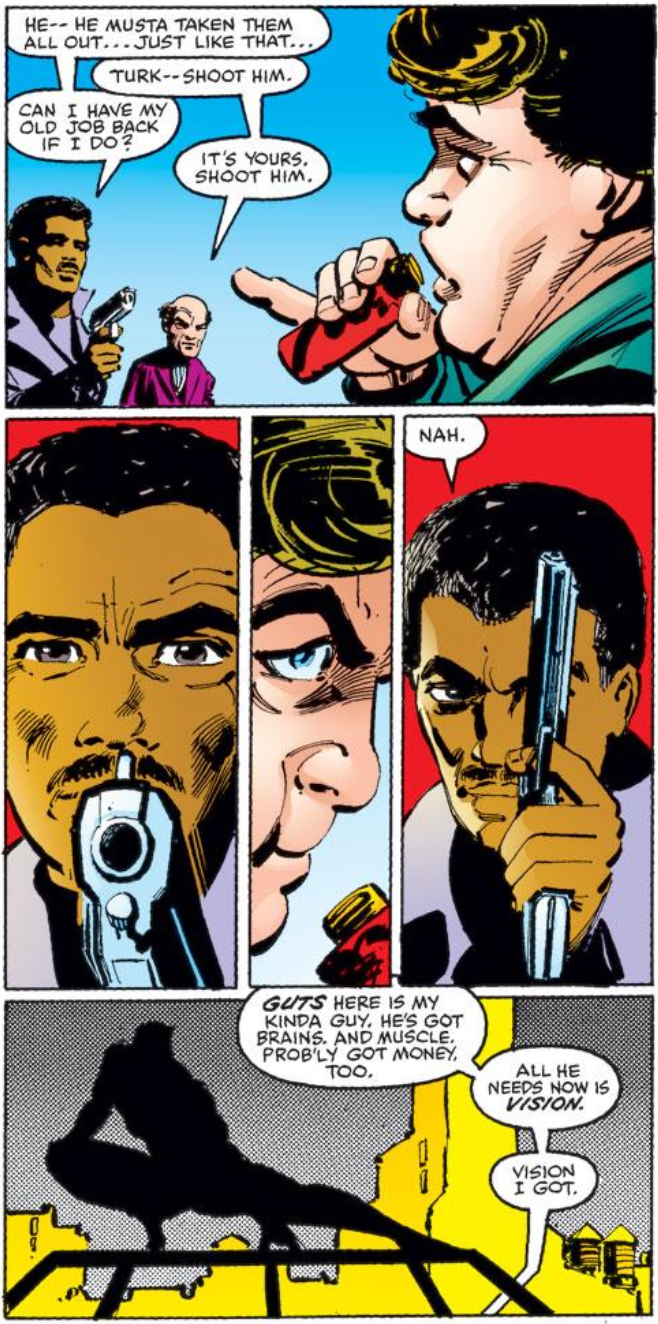
Stupid Humor Rule #113: Fat people always have to be shown eating. Because that’s all they do
Next: Nothing to Lose