Fighting (for) the Law
Chapter 3:
The Law vs. Justice
Fighting (for) the Law
Superheroes with secret identities tend to have day jobs that complement their more unusual activities: reporters, mild-mannered or otherwise, are well-poised to hear about a crime in progress, scientists of all stripes bring useful knowledge and even more useful gadgets to the fight against supervillains, and rich playboys have a great deal of time on their hands (and even greater financial resources to spend on their costumed adventures).
There is, however, a small subset of superheroes whose fight against crime at first glance looks like an extension of their professional work, but actually functions as its antithesis: lawyers and police. Like military service, law enforcement is more likely to be part of a hero's backstory than their present: DC's Guardian and Marvel's Misty Knight are both former cops who are no longer constrained by police regulations. Some superheroes exercise their powers as part of a science fictional law enforcement agency, which also tends to give them more leeway than ordinary earth cops (the various Green Lanterns; some versions of Hawkman, Bishop of the X-Men).
Only a few actually combine ongoing police work with superheroics: Dick Grayson (Nightwing) served in the Bloohdhaven police force for a brief time; Barry Allen (The Flash) is a forensic scientist with the Central City Police Department; various versions of the Spectre (Jim Corrigan) continued their detective work even after becoming the Spirit of Vengeance, and, more recently Renée Montoya has combined her costumed activity as The Question with legitimate police work, even rising to the rank of Gotham City Police Commissioner. It's unsurprising that so few superheroes are in the police force, since the contrast is not particularly exciting: who wants to read a story about a doorman who moonlights as a security guard?
Lawyers are also far from overrepresented among secret identities, but they have had more staying power. At DC, Kate Spencer has alternated between being a district attorney and a defense lawyer while also killing criminals as Manhunter. Image Comics in the 1990s published the adventures of Shadowhawk, who was a lawyer before he put on a costume. At Marvel, Jennifer Walters has been the rare character to maintain both a legal career and a heroic identity (She-Hulk), but this is often in the service of imagining what the practice of law would look like in a world of superheroes (while usually maintaining a much more light-hearted tone than in the standard Marvel fare). The most famous, and enduring, lawyer/superhero combination is Marvel's Daredevil (Matt Murdock), whose legal career has been a defining feature since his introduction in 1964.
Of course, no one was reading Daredevil to learn about the practice of law (or at least, let's hope not). Rather, the law existed as a counterpoint. Though it would take years to be more fully developed, primarily by Brian Bendis, the conflict (or at least, contrast) between the law and vigilantism is a running theme of Daredevil. Initially, it is hampered by Lee's haphazard representation of the legal system. Not only does Matt attend law school as if it were a four-year undergraduate program right after high school, but the issue ends with Matt and his law partner Foggy agreeing that they should not take an accused murderer's case because "from the police report [Foggy} was convinced he's guilty!" (as if guilty defendants did not have the right to counsel).
In addition to being an attorney, Daredevil is also blind. Not the first blind superhero nor the last (DC's Doctor Midnight preceded him by decades), the combination of his disability with his career is a bit too on the nose ("Justice is blind"). He needs both of these details to make him stand out as a new character; the marketing for the first issue is at great pains to compare him to Spider-Man. The cover proclaims: "Remember when we introduced...Spider-Man/ Now we continue the Mighty Marvel Tradition with....Daredevil!!", while the splash page, showing Daredevil leaping against the backdrop of the cityscape, appeals to the instinct of the budding comics collector:
Remember this cover? [over a picture of the first issue of Spider-Man] If you are one of the fortunate few who bought this first copy--you probably wouldn't part with it for anything! / Now we congratulate you for having bought another prized first edition! This magazine is certain to be one of your most valued comic mag possessions in the month to come!"
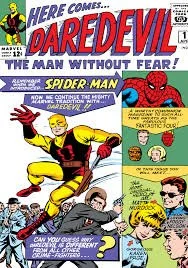
Apparently, justice is also color blind
Daredevil has to be enough like Spider-Man to to capitalize on the wall-crawler's appeal, but also different enough to warrant his own series. Lee and co-creator/illustrator Bill Everett do this not only by making Matt Murdock a blind lawyer, but by giving him an origin story that mirrors Peter Parker's own. Where Peter was an unathletic bookworm, Matt was pushed into serious study by his father, developing his athletic abilities in secret. Uncle Ben was Peter's model for power and responsibility (his costumed career), while Jack Murdock was the driving force behind Matt's civilian identity.
Peter's origin contains three important turning points: gaining his powers, failing to stop a crime (and thereby inadvertently causing his uncle's death), and resolving to use his abilities for the greater good. Matt instinctively acts to prevent a tragedy, pushing a blind man out of the path of a runaway truck and losing his sight to a radioactive cylinder that hits him along the way. Since the radioactivity grants him heightened senses, the origin of his powers overlaps with the demonstration of his refusal to stand by and watch (something he will literally never be able to do again). The determination to be a costumed superhero comes when he loses his father, like Peter's loss of his Uncle Ben, but again with a twist: Peter is honoring Uncle Ben's wishes and memory, while Matt, by resorting to physical violence, is only honoring his father's wishes in the breach.
Matt's entire life is defined by this double bind: his father's injunction to avoid violence in favor of school and, eventually, a middle-class profession, and his lifelong need to act, to intervene, and to set wrongs right. As a result, Daredevil is a walking, swinging, embodiment of Lacanian theory: his actual father's explicit limitations on his individual agency turn into a neurotic manifestation of all that he is supposed to repress (his physicality, his heroism). He dons the original (hideous yellow and red) Daredevil costume in response to his father's murder, and any satisfaction gained by inadvertently causing the death of the man responsible is haunted by the fact that he is doing exactly the opposite of what his father wanted. The irony is intensified by the fact that Jack Murdock's decision not to throw the fight (despite the Fixer's instructions) is motivated by Matt's presence in the audience; Jack had strayed from his own principles, but redeemed himself for the sake of his son. Matt can never be fully redeemed; the double bind imposed by his actual father then gets transferred to his professional life: every night he patrols as Daredevil, he is violating the law he has sworn to uphold (even if it is in the name of the justice to which the law is supposed to aspire). [1]
Note
[1] Miller complicates the scenario in his retelling of Matt Murdock's origin and early years, Daredevil: The Man without Fear (illustrated by John Romita, Jr. 1993-1994). In addition to shoehorning the retcons he made during his first Daredevil run (Elektra, Stick), he includes a scene of domestic violence. Still a little boy, Matt runs home to brag to his father about winning a fight with a bully. Mike smacks him, and Matt runs away. The captions convey his thoughts: "Dad hit me. / It was wrong. / Dad was wrong. / And if even Dad can be wrong, then anybody can do bad things. Anybody at all. / The only way to stop people from being bad is to make rules. Laws. /Somewhere in a long and lonely night the boy's course is set. / He will study the rules. / He will study the laws." The narration of the scene, along with the image of Matt staring out into space, echoes the origin of the other corporate superhero on whom Miller would make his mark: Batman. But it is almost a parody, in that it is the origin not of Daredevil, but of Matt Murdock, attorney-at-law. Where Bruce Wayne swears to uphold justice as a vigilante in response to his parents' deaths, Matt Murdock resolves to study law in response to his father's violence.
Next: Punchable Villains and Billable Hours