It stands to reason that, as superhero comics grew more complex and skewed more adult, their ethical framework would start to wear thin. Developing out of an artistic practice of literal caricature, the early superhero comics were never intended to function as anything like a realistic representation of the world that produced them. Discussing the comics form, Scott McCloud calls cartooning "amplification through simplification," a phrase that could just as well apply to superhero comics' approach to content and theme. The Lee/Kirby/Ditko innovations of 1960s Marvel brought the genre a few steps closer in line to the "real world," but picking up any Marvel comic from, say, 1963, and reading the dialogue aloud would demonstrate that several steps still remained. This may sound like a value judgment, and to some readers and critics, it would be. My point is rather than a growing awareness and dissatisfaction with the disjuncture between the world of Marvel and DC and the proverbial "world outside your window" would push corporate comics in the direction of increased realism and, as we see in the case of the drug-themed comics of the 1970s, "relevance." Yet this "realism" ages just as quickly as do the hairstyles and clothes. An unfriendly reader will find at least as much to mock in an O'Neil/Adams "Hard Travelin' Heroes" Green Lantern / Green Arrow story as in an issue of the Lee/Kirby Fantastic Four. Jumping ahead to the twenty-first century , Brian Bendis's Mamet-inflected, hypernaturalistic dialogue is another likely candidate for retrospective snark.
Certainly, there is no reason to make a fetish of realism, as though verisimilitude were the single determining criterion for assessing or enjoying a work of art. Nor is a fictional world's resemblance to the "real" world essential for making a point about justice, ethics, behavior, or metaphysics, as any number of works of fantasy demonstrate. The problem for superhero comics comes when the gap between the allegorical fantastic and the faithfully representational becomes just narrow enough that the exploration of an ethical problem cannot be satisfying according to the demands of either mode. Superhero comics can fall into the ethical equivalent of the Uncanny Valley. Here, though, the problem is not a visual depiction of something human that is still un-human enough to provoke an uncanny response, but rather a setting or exploration of an ethical problem that is neither fanciful enough to be allegorical or fabulous nor mimetic enough to feel like an adequate vehicle for tackling a significant, real-world question. Mutants can be rounded up in concentration camps in nightmarish dystopian futures as a story about the horrors of genocide, but Dr. Doom cannot stand at the ruins of the Twin Towers and shed a tear through the eye slit of his iron face mask.
As a vehicle for addressing real-world problems, these superhero comics fall into another trap: perhaps less an Uncanny Valley than an Uncanny Foggy Moor. Here the gap is between earnestness and camp. Lex Luthor, Captain America, Ultimate Captain America, Ms. Marvel, John Hawksmoor (of the Authority), Ultimate Thor, the Squadron Supreme's Nighthawk, have all been American presidents in one continuity or another. The Kingpin, Luke Cage, Green Arrow, and Mitchell Hundred (Ex Machina) have all been mayors, Iron Man has been Secretary of State, and the pre-Crisis Batgirl went from librarian to congresswoman practically overnight. Just how seriously are we supposed to take this? Batgirl's 1972 congressional campaign is another patently ridiculous attempt to portray youth culture, but later examples, such as Green Arrow's stewardship of Star City and Luke Cage's time as mayor of New York, make more of an effort at credibility. Grant Morrison's "President Superman" may well be the best compromise: he and those around him take his presidency completely seriously, but, since he comes from an alternate Earth, readers are not expected to follow the month-by-month adventures of a president who repeatedly sneaks out of the Oval Office to repel alien invaders or knock asteroids out of a path towards our planet.
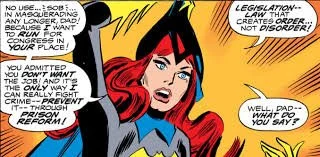
That’s Congresswoman Batgirl to you, sir
When Marvel made New York City the setting for the adventures of Spider-Man, the Fantastic Four, and virtually every other superhero they published, it was an innovation. It made National (DC), with its Metropolis, Gotham City, Central City, and Star City, look staid and old-fashioned for its unwillingness even to pretend to be engaging with our world. Over the years, however, DC's creators and editors leaned in to the advantage of their fictional settings. The familiar adage that Metropolis is New York City by day and Gotham is New York by night made sense for Superman and Batman, and eventually allowed each of the cities to be developed in directions that would have been impossible for a believable, if fictional, New York. For a time, Metropolis was infused with future tech that made it literally the "city of tomorrow," while Gotham suffered a cataclysmic earthquake that cut it off from the rest of the world and turned it into a post-apocalyptic No Man's Land. New York would occasionally be used, but some creators instead took further advantage of the opportunity to create new fantasy cities that would have their own character and facilitate their own particular type of storytelling: when James Robinson and Tony Harris created a new Starman in the aftermath of Zero Hour, they situated him in Opal City, designed to host the mystery and nostalgia that informed the storytelling. At their best, DC's fictional cities facilitate their own chronotopes: a story in Gotham would not unfold the same way in Metropolis.
Here, as in so many other cases, Watchmen shows a possible way forward. Moore and Gibbons positively revel in the derivative nature of the world they created: as a distorted version of a commercially unsuccessful superhero universe (Charlton) that itself could credibly be called a variation on DC core concepts (the street-level hero, the god, the martial arts girl), Watchmen is more of a tertiary than secondary world. The fears that grip the population are the same as those that animated so much of the political discourse of the time: the book was serialized in 1986, the year in which it also took place, and global nuclear war was an ever-present, if low-level, possibility. But Moore and Gibbons allowed their world to be substantively changed by the presence and actions of its protagonists, with American winning the war in Vietnam and Nixon somehow still in office twelve years after his real-world resignation. The themes of Watchmen did not require the readers to accept that it took place in a reasonable facsimile of their world, but the logic behind the plot and the characters' actions did not strain credibility. Though unfolding in the medium of comics and steeped in the lore and traditions of the superhero narrative, Watchmen tapped into the kind of world-building familiar to readers of high-quality science fiction: suspending disbelieve is possible and desirable because, once the reader accepts the novum (i.e., the thing that makes the work science fiction rather than mimetic) the rest of the world falls into place. The superhero comics discussed in this chapter labor under the burden of multiple, proliferating nova, with simply too many fantastic and generally inexplicable elements to make them a believable secondary world.
The odds, then, are stacked against a corporate superhero comic adequately reflecting or representing a "real world" problem. Creators have to reckon with the limits of the permissible, which, depending on the time and circumstances, can be a matter of industry self-regulation, company policy, or the spoken and unspoken expectations about the contents of comics. The seriality of these comics could, at least in theory, work in favor of ethical exploration, but the inevitable changes in creative and editorial teams and the sheer accumulation of detail and lore (continuity) are significant, and almost inevitable, obstacles. Finally, the tension between the fantastic, sometimes campy elements of superhero comics (the costumes, the rhetoric, the tropes) and the seriousness or scale of the chosen problem is a tonal challenge that, if not insurmountable, must at the very least be daunting.
It is a historical accident that most mainstream comics make no use of lower case lettering; when the quality of printing and paper is low, the upper case is a guarantor of legibility. But it is also emblematic of the problem: regardless of subject matter or attempted tone, these comics shout at the reader at the top of their voice. One could say the same about opera--like so many aspects of medium and genre, it is as much a feature to be used as a limitation with which to grapple. Like the borders of a comics panel, the bombastic character of superhero comics is so ubiquitous as to be nearly invisible to the reader, or it can be used more playfully in a manner that one cannot help but notice. And, like the panel border, it can be all the more noticeable in its occasional absence, a reminder of what readers have come to expect without question. The corporate superhero genre functions within the invisible borders that separate it from the world that produced it, with results that are usually appreciated best when the reader has tacitly assented to the creative dissonance on which the comics rely.
Next: Chapter 3: The Law vs. Justice