Invasion of the Capitalist Marketing Machine
Foreignness, hybridity, and the threat to an essential Russian purity are all up for grabs in one of the strangest Russian films of the twenty-first century. Branded, the 2012 film written and directed by Jamie Bradshaw and Aleksandr Dulerain, was a joint Russian-American film productions that appeared at the very end of Medvedev’s presidency. A last gasp of cross-cultural cooperation, Bradshaw and Dulerian’s film proved that when the former adversaries join hands and work together, they can produce truly spectacular crap. If we were to make a word cloud out of the limited number of reviews of this spectacular flop, “worst” would be one of the largest of the bunch. [1]
Released in Russia as Moskva-2017, but renamed in English presumably so the half-dozen people who've read Olga Slavnikova's novel 2017 in translation won't get confused, Branded is a film that defies all attempts as summary. So let me try: Misha Galkin (Ed Stoppard) nearly dies as a boy when a constellation shaped like the head of Elsie the Contented Cow zaps him with lightning. Naturally, when he grows up, he works in marketing, helping Russia learn to love fast food. His boss is a part-time American spy played by Jeffrey Tambor, whose niece Andy (Leelle Sobieski) is in town to produce a reality show about extreme cosmetics and weight-loss surgery. They fall in love, which means they have sex in his car during a traffic jam.
Meanwhile, a cabal of evil white men on a far-off island are plotting to make the world's population want to be fat. They sabotage the reality show, throwing its contestant into a coma. Misha runs away to the countryside, where he spends years herding cattle. Andy comes for him eventually, but he stays with the cattle. One night, he has a vision that one of the cows has turned red, so he builds a special wooden hut/altar, slaughters the cow, burns cow and altar, and pours the resulting ashes all over his naked body.
When Andy brings him back to Moscow, Misha discovers they have a fat, spoiled son, and that Misha now sees the CGI-generated brand creatures that attach themselves to people, growing fatter as their hosts fatten themselves. Strangely, no one believes Misha when he says he sees these things, and Andy and son leave him. Misha throws himself into his new work: conning a Chinese company that wants to bring a chain of vegetarian fast-food outlets to Russia (easily the most improbable part of this whole story). He uses them to finance a media campaign about the dangers of beef, all of which allows the giant CGI monster egg on top of the Chinese company's building to grow and grow, until out hatches…a carnivorous, brand-eating dragon that starts eating the other brand creatures. Misha's efforts lead to a global ban on advertising, and to the return of his estranged wife and son. Even reality show coma girl wakes up, thin and wobbly, but with great hair. In the end, the cow-head constellation looks down from on high, and sees that it is good.
Branded has all the hallmarks of hilariously terrible B-movies, starting with a voice-over narrator providing backstory at every turn. Tambor and Sobieski fulfill the typical role of actors who are too good for this material, while Ed Stoppard is…perfectly at home. Finally, Russia has its very own equivalent to Plan 9 from Outer Space.
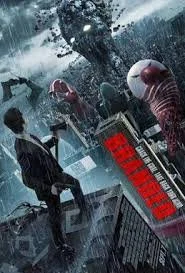
This really needs to become a midnight cult movie
Branded is not exactly an alien invasion movie, but it is not exactly not an alien invasion movie, either. It’s possible that the cow-shaped constellation guiding Misha on his spiritual journey is an alien entity (she is, after all, literally floating in outer space). She might be a primal bovine god; certainly, Misha’s ritual evokes caricatured representations of “primitive” worship, while the red cow could be a reference to the red heifer that some premillenialist Christians believe to be a prerequisite to Christ’s return. None of this adds up to anything coherent, of course, but by this point that should hardly be a surprise.
The message of the movie (that branding and advertising are bad) is not a new one, and it has been delivered much better many times before, including in Russia (both Pelevin's novel Homo Zapiens and its cinematic adaptation). It checks all the boxes for Russian postcommunist anxiety about a degraded, market-based culture in a disordered, agglutinative mess that may as well be a snapshot of a segment of the collective unconscious. It is also a paradox from start to finish. Audre Lord famously proclaimed that "the master's tools will never dismantle the master's house," but the makers of Branded appear to have raided the entire toolshed in the hopes that she was wrong. How do they develop a polemic about the evils of capitalist marketing and brands? By working as a Russian-American writing and directing team and somehow convincing well-known and respectable Western actors to star in it. They have produced a film that tries very hard to look like an American movie of its time, completely with huge swaths of CGI. Perhaps the greatest irony is that, as Charlie Jane Anders writes, they are guilty of false advertising," with trailers that promise a "weird, surrealistic version of They Live " luring moviegoers to dismal and unoriginal treatise about the evils of late capitalism. Branded argues for purity from a place of hybridity. As we shall see, hybridity can be both a boon and a danger in Russian cinema about alien influence, but here it is simply a dead end.
Note
[1] "Branded is a Terrible, Terrible Movie" (reelchanger.net) "Make no mistake about it, this is a horrible movie" (Moviemoses.blog). Jim Batts calls it a "cinematic endurance test."
Next: Sputnik: Beware of Hitchhikers