Late Soviet Death
In the last two Soviet decades, nonconformist and avant-garde creators found that an intense focus on death (as an event, a state of non-being, and as the corpses left behind) was a compelling response to the country's sanitized mass culture, to an ideology that was on life support, and to a succession of gerontocratic leaders who dropped dead, one after the other (Brezhnev in 1982, Andropov in 1984, and Chernenko in 1985). Vladimir Sorokin would turn dismembered corpses into grist for his literary mill, from the transformation of a cliche about a man leaving his heart behind into a girl dropping off a jar containing a human, beating heart at a police station (The Norm , 1983), the murder, dismemberment, and ritual mock consumption of the family patriarch (The Four Hearts, 1991), and cooking and eating a teenager in "Nastya" (2000). Viktor Erofeyev displayed a similar penchant for morbid physicality in stories such as "The Parakeet" (1991), in which a KGB torturer describes to a father the beating, blinding, and castration of his teenage son."
Sorokin and Erofeyev were by no means isolated phenomena. They were accomplishing in prose what a small group of avant-garde artists had been doing in film. The Necrorealists were a Leningrad-based group of young filmmakers who could never hope for official distribution in the Soviet Union. Their films were deliberately crude in every sense: looking as much like home movies as serious cinema, the Necrorealist oeuvre (with names like Urine-Crazed Body Snatchers and Werewolf Orderlies, featured cannibalism, dismemberment, and a plethora of human corpses. Everything about them was an inversion of Soviet mores, from their fundamental nihilism to their substitution of homoeroticism for rugged masculinity.
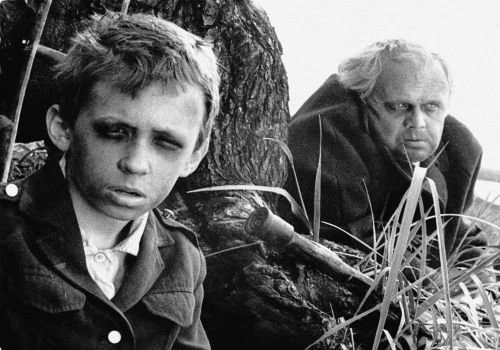
Evgeny Yufit, Transparent Grove
The Necrorealists were the unsung heralds of a phenomenon that would dominate Perestroika culture: the muckraking, pessimistic naturalism known as "chernukha." A slang term for the Russian word for "black," chernukha was initially an elite, high-culture phenomenon that dwelled on bodily functions, loveless sex, abject poverty, miserable families, and sadistic violence. [1] Chernukha purported to reveal the "truth" about Soviet life that had been obscured by decades of propaganda and hypocrisy. Such films as Little Vera, along with the stories of Ludmila Petrushevskaya and the aforementioned Erofeyev, shocked conservatives with their apparent cynicism
The mass appeal of such works would be limited once the shock value wore off, but by the last years of Perestroika, chernukha evolved into a key feature of popular culture, thanks to a a widespread infatuation with true crime and mysteries. The first post-Soviet decade witnesses a concern less with death and dying than with murder and corpses. Violent crime, which had been much less common in Soviet times, became a national preoccupation; meanwhile, the Russian viewing audience, which had been starving for more mystery and crime-based content in the Soviet days, was being fed a steady diet of murder and torture as entertainment. Chernukha was transformed from a niche, avant-garde phenomenon into the defining feature of 1990s mass culture, clogging the best seller list with hitmen, mafiosi, and the occasional vigilante. As the decade was drawing to a close, Aleksei Balabanov's Brother (1997) presented a new kind of hero for an audience that had grown accustomed to violent entertainment: Danila Bagrov, a kind of killer-savant whose affectless, casual violence was offset by his naive love of pop music and his ability to connect with (or feign connection with) anyone he happens to encounter. The movie's climax, in which he kills one bad guy after another like a first-person shooter while reciting a sentimental poem, confronting the main villain with a declaration that strength resides not in money, but in "truth," inadvertently sets the tone for concatenation of violence and moralism that will come to the fore in the 21st century.
Now the logic of chernukha transforms into something that shores up rather than undermines the power and authority of a state operating in the name of Russia. The violent hero who loves his motherland is a violent force for the motherland and for whatever incoherently formulated ideals in which it cloaks itself. The chernukha of the early 1990s made plenty of space for redemptive violence, but the object of its redemption was either the victim or the victim's avenging angel. The individuals involved may well have had a symbolic value related to the nation (indeed, they often did), but Brotherand its successors wed redemptive violence to the state and its mission.
Note
[1] See Chapter Two of my book Overkill for more detail.
Next: I See Dead People