Mbembe's necropolitics is a compelling framework for the postcolonial context, and for examining the state's distribution of lethality along racial and class lines. It forces us to de-naturalize processes and assumptions that have become so normalized as to become invisible (at least to those who are not their primary victims). There are, however, several pitfalls to applying necropolitics to Putin's Russia, or to Russia at all, for that matter. In a (post-) Cold War context, necropolitics could easily reinforce Russophobic stereotypes that verge on Orientalism: In Russia, life has "always" been cheap; Putin's bloodthirsty regime is built on the bodies of the dead (like his native St. Petersburg, a swamp whose reclamation under Peter the Great came at a staggering human cost).
The same sort of reductionism is at work when necropolitics is identified with communism or socialism. In 1977, the right-wing, antisemitic mathematician-turned-dissident Igor Shafevich wrote a tract entitled Socialism as a Phenomenon of World History (published in English as The Socialist Phenomenon) that ran through not only the gamut of socialist theories, but also "Eastern" religions and Freudianism to come to the conclusion that the goal of socialism is nothing less than the death of humanity itself:
in contrast to a religious or a national ideology, which openly proclaims its goals, the "death instinct" that is embodied in socialism appears in the guise of religion, reason, social justice, national endeavors or science, and never shows its true face. Apparently its action is the stronger the more directly it is perceived by the subconscious part of the psyche, but only on condition that consciousness remains unaware (299)
But necropolitics in the Russian context is not meant to essentialize the country's history, politics, and "character;" on the contrary, necropolitics in Russia, as elsewhere, represents a choice made by the powerful in relation to the powerless. It is, however, a choice that has been made more than once, and, more to the point, a choice that has been frequently highlighted by Russian intellectuals as a recurring problem. At times, these intellectuals are themselves engaging in essentialism, but there is no need for us to follow them that far. Instead, we should ask ourselves: what does it mean that necropolitics so frequently becomes identified with "Russianness" by Russian thinkers, and what is the effect of the necropolitical choices made in the twenty-first century Russian federation?
The vast loss of life at key points in Soviet history produced a periodic Soviet (and anti-Soviet) critique of the country's necropolitical regime. In the late 1920s, Andrei Platonov moved from writing utopian science fiction about the communist future to creating some of the most devastating responses to incipient Stalinism and its cavalier treatment of human life. His 1929 masterpiece, Chevengur tells the story of the attempt to build utopian socialism in one town, where death will be conquered and labor provided by the sun itself; nearly five hundred pages later, nearly all the named characters are dead. In 1930, he finished The Foundation Pit, in which emaciated true believers are, at least in theory, building the massive "Protetarian Home" to house poor workers like themselves, but they never get beyond making the hole described in the novel's title, which turns out to be their own mass grave.
By contrast, World War II ("the "Great Patriotic War") would, just one decade later, elevate death and self-sacrifice to the highest ideal. Between the Nazi invasion and the Soviet victory, the losses suffered by the USSR were almost incomprehensibly large. That the military would try to psychologically prepare its men for their possible demise is neither surprising not unusual. What does stand out, however, is a validation of martyrdom that occupies a huge discursive space in postwar Soviet culture.
In her insightful and comprehensive study Making Martyrs: The Language of Sacrifice in Russian Culture from Stalin to Putin, Yuliya Minkova connects the cult of dead World War II heroes to a wide range of cultural phenomena with no immediate connection to the war. She focuses on the Soviet martyr par excellence, the teenage partisan Zoya Kosmodemyanskaya. Arrested for arson attacks on German holdings in 1941, she was brutally tortured, but still refused to talk. With her last breath, she supposedly exhorted her fellow citizens to continue the fight against the Nazi invaders. After an article in Pravda the next year retold her story in exalted tones, she became the subject of an intense propaganda campaign that last decades. It included films, poems, paintings, and sculptures, with Zoya featured as a heroic martyr in a set of posters meant to be displayed in Soviet schools.
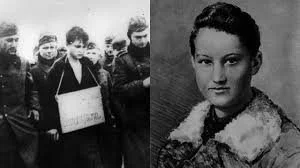
Zoya Kosmodemyanskaya
Minkova notes the ironic displacement at work here, in that Stalinist culture passed over in silence the torture, abuse, and murder of Soviet citizens during the Purges of the 1930s only to describe analogous atrocities committed by the enemy in the following decade. This is not to dismiss the very real crimes committed by the Nazis on Soviet soil, but rather to point out that the status of martyr is not inherent to the abused body; it is up to the state to decide whose life can be considered a true sacrifice.
Minkova argues that the language of martyrdom would survive long past Stalinism, ranging from tales of heroic flight attendants during hijackings to the complex fates of Afghan war veterans, many of whom were "are unable to find a system of reference" that would allow them to blame the power structures that consigned them to pointless war and separate themselves from official discourse. They were caught between the valence of victim and hero, a liminal, contested space that characterized the contradictions of late Soviet culture.
Next: Late Soviet Death