Key challenges to both Russian state authority and the government's ability to protect its citizens came in the form of massive terrorist attacks. Once again, the Chechen Wars were at the heart of the problem, although, unlike the 1999 apartment bombings, there was no reason to assume a false flag. Terrorism had brought the Chechen wars "home" before Putin was in power, most notably in the June 1995 Budyonnovsk crisis, when Chechen forces attacked a hospital in a town bordering on Chechnya, Over 2000 people were held hostage over the course of five days, over 100 of whom were killed during a Russian attempt to retake the hospital on the third day of the crisis. Prime Minister Viktor Chernomyrdin conducted negotiations that led to freeing all the remaining hostages in exchange for meeting the Chechens' demands, This was seen as a humiliating setback (the Duma passed a no confidence vote in its wake), adding to the impression that Chernomyrdin's government (and, by extension, Yeltsin's leadership) was weak and inadequate. When Russia faced similar challenges in the early 2000s, the response was always a show of strength leading to staggering losses.
On October 23 2002, the Dubrovka theater in Moscow was taken over by a group of forty Chechen terrorists during a production of Nord-Ost, a blockbuster musical based on a beloved 1944 Soviet novel (Veniamin Kataev's Two Captains) and even more popular film. Nord-Ost was anything but an ordinary theatrical production. Billed as Russia's answer to Les Mis (an international hit musical that could not have realized it was posing Russia a question), Nord-Ost featured over 400 performers over the course of a single night in a former ball-bearings faculty retrofitted for an audience of more than 1000 people. The terrorists took more than 900 hostages, including both performers and spectators.
Negotiations were conducted over the next three days, leading to the released of more than 200 hostages (primarily women, children and foreign nationals). On the morning of October 26, Russian Special Forces initiated an operation to break the siege, first by pumping a tranquilizing agent into the ventilation system, then through a full-on assault, exchange gunfire with those hostage-takers who remained conscious. A Special Forces officer bragged that "this is our first successful operation in years,” despite the fact that dozens of hostages had died in the crossfire, while others had choked on their own vomit after succumbing the to the gas. The official death toll included 130 hostages, with other estimates reaching as high as 300 (Satter).
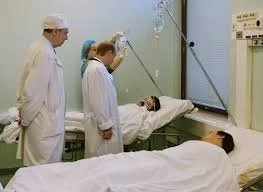
Putin visiting the survivors. Wikimedia
Nonetheless, the Special Forces officer was not alone in his assessment of the raid, whose "success" was praised first by Moscow's mayor, then by Putin himself, who focused on the hostages who survived, as well as on the prestige of the country: the rescue "proved that it is impossible to bring Russia to its knees.” That last statement sums up the necropolitical calculus of the Russian state in the twenty-first century: triple digit fatalities among Russian civilians are a small cost to pay for preserving national pride. The families of the survivors told a very different story--they spent hours demanding information from the authorities after the raid, while their loved ones were either dead or dying from inadequate medical care after their own government poisoned them with a chemical attack. The first responders were not told that the gas was a fentanyl derivative, which meant that they missed the opportunity to treat their patients with an opioid antagonist.
As was the case with the Kursk disaster, Putin's government blamed the Russian media for portraying the hostage crisis in a manner that did not support the official (and continuously evolving) narrative. The NTV channel, a formerly independent channel that had already come under indirect state control in 2001 after airing a talk show about the Ryazan apartment bombings that included the theory of FSB involvement and infuriating the president with satirical talk show that featured an unflattering puppet version of Putin, was now lambasted for its critical coverage of the Dubrovka siege. As part of its takeover by the energy giant Gazprom, NTV had been placed under the directorship of Russian-American businessman Boris Jordan; within a few months of the Nord Ost drama, Jordan was ousted. [1] Once again, the human costs were much less important than the harm to Russia's reputation.
The Nord-Ost hostage drama had a huge symbolic resonance. The Dubrovka was not just any theater; it was a ball-bearings faculty that had been transformed into a massive “culture hall” in order to host this musical extravaganza. Nord-Ost was not just a theatrical adaptation of a beloved Soviet classic, it was also a drama with a broad historical sweep, extending from the October Revolution through the Second World War.
Though some critics derided it as tacky, the production was touted by the Moscow government and praised by such unlikely critics as the liberal Dmitry Bykov, who called it the “pride of Russian culture”: “you will pride yourself on the fact that you were born here and live here, among these joyous and stubborn people” (quoted in Beumers 2004). Georgy Vasiliyev, the impresario behind Nord-Ost , claimed that the musical “was a sort of protest against tarnishing our history, against not believing in your own strength, against all this pervasive, depressing, ugly stuff in mass media” (Baker and Glasser 2005).”
Thus, the Chechens attacked the glitzy, ultra-patriotic, feel-good sensation of the early 2000s. The heady cocktail of spectacle, gigantomania, retro music, and an uplifting message that both sanitized Soviet history and claimed it as Russian was actually a preview of what would become a Putinist hallmark. Patriotic cultural actors were fumbling toward a narrative that could be adopted with pride by the citizens of a country that was both ancient (going back to medieval Kyiv) and new (just approaching its eleventh birthday when the theater was seized).
The irony of patriotic mythmaking about a political entity that is a cross between a nation-state and a multiethnic empire is that the Chechens, who also grew up in the Soviet Union, would have been familiar with the genre. After all, Nord-Ost was based on an undisputed Soviet classic, one which most Chechens of that generation would have known either from their school reading or the film and television adaptations. Their (indisputably criminal) actions disrupt the appropriation of a Soviet patriotic narrative for Russian purposes, doing so from within the narrative itself. These are people who want to fight their way out of the story, and who, perhaps inadvertently, manage to undermine it by provoking the organs of Russian state power to do what they do again and again: quash resistance at the expense of the lives of their own citizens. It’s a powerful counter-narrative, but at a horrific price.
Note
[1] Full disclosure: Boris Jordan is a trustee of New York University. whose donations fund the endowment of the Jordan Center for the Advanced Study of Russia. I edited the Jordan Center's blog from 2012 to 2020.
Next: Life = Cheap?