More Sputnik: Aliens in the Family
Given that the Alien films are the most obvious intertext for Sputnik, the Russian film's deviations from its model stand in stark relief. Ridley Scott's groundbreaking 1979 movie, along with its many subsequent installments, does not hide its obsession with reproduction and (queer) mothering. From the first famous chest -burster during the salad-eating scene, Alien mines parasitism and metaphorical male pregnancy for much of its body horror. The entire franchise is a gift to gender studies scholarship: the tough, androgynous Ripley's "adoption" of little Newt in Aliens (1986), Ripley's own forced "pregnancy" and self-immolation in Alien 3; the bizarre swap of reproductive systems between Ripley's clone and the alien queen in Alien: Resurrection (1997), and the dynamics between baseline biological humans, bodiless AI ("Mother" in the first film), and synthetic humanoids who never had a mother at all (most of the films, including the three twenty-first century installments, plus AppleTV's Alien: Earth (2025-)).[4]
Wrong movie, of course, but just imagine the crossover possibilities
Sputnik follows Ridley Scott's model by featuring a heroine who is neither explicitly maternal or offered up primarily as a sex object, but goes a step further by projecting her androgyny into the past. At various points in the film, we see a disabled child struggle for autonomy in a children's home. The child's head is shaven and the clothes are generic, so there is nothing about this child that is marked as feminine. Yet the end of the film reveals that this child is, in fact, Klimova when she was younger. The matron at the orphanage had been calling him a boy, but now the child says, "I'm not a boy. I'm a girl. And my name is Tanya." At least one trans commentator online saw this as evidence that Sputnikcould be read as a transgender text. The unlikeliness of this being a deliberate choice for a Russian film released in 2020 does not render such a reading invalid; fans (and especially queer fans) have been reading themselves into cisheterosexual texts for at least as long as there has been fandom. Perhaps "genderqueer" would be a more apposite term, given the film's overall approach to gender and sexuality. The characters in Sputnik are always removed from any kind of local or domestic context; they are either in a space capsule, an orphanage, a remote research facility, or the underpopulated desert that surrounds the facility. They have no families, no loved ones, no private lives--they are the desexed subjects of an impersonal late Soviet system. Wherever they go , they are "spam in a can," mystery meat whose gender and sexuality are close to superfluous.
But when it comes to the relationship between the alien and the human, Abramenko immediately moves into territory more familiar from the sequels (particularly Alien: Resurrection and the 2024 Alien: Romulus). In order to explore the ties between reproduction and horror, the Alien films have to maintain the possibility of biological connections between generations. The films need reproduction in order to interrogate it. Sputnik shares the hybridity implied in Invasion (as well as the two aforementioned installments in the Alien franchise) but places it at the film's thematic center.
The fact that the passenger emerges from Vyshnyakov's mouth rather than his chest diminishes the scene's horror when compared to the chest-busters in the Alien franchise, but only by comparison: there is less blood, and the man does not day, but, on its own, it is disturbing visual. The possibility for a male pregnancy metaphor remains, but it is strained by the fact that, every morning, the creature goes back into Vyshnyakov's body the way he came. A less grim version of Sputnik could be playing with the Russian exclamation "Мама, роди меня обратно!" (literally, "Mama, unbirth me!" or "Birth me back in!"), but Sputnik is nothing if not grim. Vyshnyakov is neither mother not father; he is the unwilling host to a parasite that has forced him into a symbiotic relationship that can be ended only by the death of both parties. There can be no cosmonaut without the creature, and no creature without the cosmonaut.
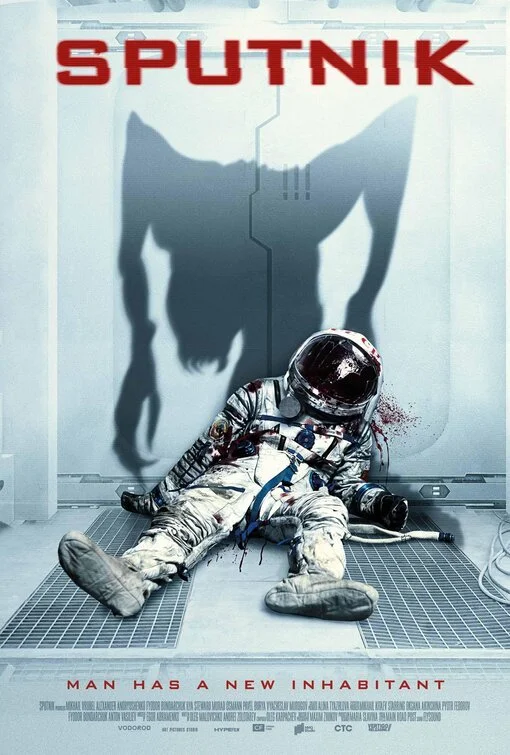
Unlike Alien, then, Sputnik takes its metaphorical power from adoption rather than reproduction, from affiliation rather than filiation. We know from Chapter Three that adoption has been a vexed political question since the Soviet Union's collapse; Sputnik moves all contemporary concerns back to 1983, adoption included. This is not to suggest that Sputnikshould be seen as a commentary on post-Soviet adoption debates, as the connection is much less direct. Rather, in the last years of the USSR, Sputnik shows the weakness of filial ties and the difficult ramifications of adoption both through metaphor (the alien/Vyshnyakov hybrid) and through its parallel tales of absent fathers, abandoned children, and the adults who sometimes step in to fill the void.
The kids are not alright in Sputnik. We know that little Alyosha is being raised in a children's home, and the film repeatedly (and jarringly) switches from the Kazakhstan research facility to the orphanage where a frail, disabled child sits in a wheelchair, wishing for the return of the sneakers that have been taken away from them. The audience has every reason to assume that this is Alyosha, but the last few minutes of the film contain the aforementioned twist that appears to have little to do with the main plot: the child is not Alyosha in the present, but Klimova in the past. The adult Klimova has scars on her back and pain meds in her bag; as a child, she endured multiple operations to treat her scoliosis. In the last moments of the film, Dr. Klimova has come to a different (but nearly identical) orphanage to adopt Alyosha as her own.
Mark Lipovetsky calls this a "self-adoption," since the film takes such paints to confuse Klimova's and Alyosha's identities. Indeed, her adoption of Aloysha is the externalization of her childhood success at self-rescue. This is where the film falls short as a disability text: Klimova overcomes her handicap through the triumph of her will, a move that subsequently becomes her professional calling card. Her near-manslaughter of her patient is the result of her conviction that his epilepsy can be cured through psychological shock, and her treatment of Vyshnyakov is predicated on the idea that this entire horrific situation can be managed if Vyshnyakov can just maintain control. Along with the space program itself, this voluntarism is one of the most Soviet things about Sputnik: biology can be overcome by the disciplined mind.
Next: The Anxiety of Alien Influence