Before leaving Sputnik behind, let us return to the question of timing that began this discussion. It is timing that helps structure the presentation of Soviet culture and its post-Soviet heritage, alien influence, and hybridity. Sputnik is a hybrid film, primarily as a function of its relation to time. For the viewers, the protagonists' unmediated experience is one of inevitable hybridity. Not only are they aware of watching a Russian adaptation of a Western genre set in the late Soviet past, the exigencies of COVID mean that, instead of going to a movie theater or watching the film on broadcast television, Sputnik is that quintessential twenty-first-century media phenomenon: streaming entertainment. And, as an added irony, the very name "sputnik" would soon gain an entirely new connotation. The Russian word simply means "traveling companion"; the Soviet adopted it as the name for both the first satellite in space and the generic term for all such satellites. When Russia developed its own vaccine against COVID-19 just one year after the film's release, they appealed to the glory of past scientific accomplishments by calling it "Sputnik." The film's title is caught in a semantic web that is not entirely in the filmmakers' control.
The choice of 1983 raises the possibility of a cultural and generic purity that would be lost within a few years, even as the film does not engage in the easy nostalgia of other post-Soviet period pieces. It is the rare twenty-first century (re)viewer who discusses Sputnik without reference to Alien. That movie came out in 1983, but would only become a franchise with the sequel in 1986. By the time of Sputnik, Alien is a four-year-old film, but one that would have been unavailable to the film's Soviet characters. There is an innocence here that is difficult to find in the West after decades of meta, self-aware horror films built out of the bones of the self-serious slashers of the 1980s. In just a few years, most Western pop cinema would be easily available to Soviet audiences through VHS tapes and videosalons (which charged a small fee for sitting in a conference room and watching a video on a relatively large screen). 1983 is the last moment when the characters in this particular horror movie could have no preconceptions about the genre: they simply do not know what kind of story they are in.
There is just one problem: the characters may not have seen Alien, but there is no way the same could be said for the filmmakers. Like Veshnaykov and his passenger, Sputnik is a hybrid, the result of the symbiosis between Russian and American cinema that has inevitably characterized contemporary Russian cinema (including films with a straightforward, anti-Western agenda). Most of the genres of popular film that interest the Russian film industry have been defined by Hollywood; while it is true that India, Japan, and Latin America have also had a significant influence, Sputnik's genre, live-action science fiction, has been a primarily American purview. Even though Sputnik was not specifically marketed as "Our Answer to Alien," both the story and the creature itself cannot avoid the appearance that they are in some way derivative. How appropriate, then, that so much of the film is about the inability to prevent contamination, the limits of autonomy, and the entanglement between self and other.
On the surface, Klimova is a paragon of autonomy: after enduring painful surgeries and poor treatment in care facilities, she has become a capable psychiatrist whose (former?) disabilities are visible only to those who can see her scars. Her profession focuses on helping others (her patients), but the lesson she has apparently learned is about constructive trauma and tough love as a method for "overcoming" disability and allowing the disable subject to pass for typical. Yet the scars are important, a reminder that her bodily integrity had been compromised. In this, she is like Vyshnyakov, who is literally the film's poster boy for bodily violation. And, even though I argue that Sputnik departs from Alien's "male pregnancy" metaphor, it is worth noting that the gendered expectations for the two main characters' bodies are reversed: it is Vyshnyakov who is already equipped with an orifice rendering violation possible, while Klimova has to be cut open with a knife.
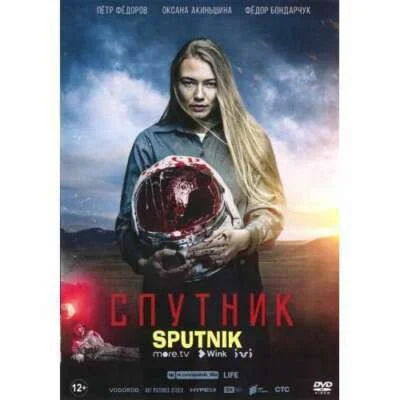
Did somebody lose a helmet?
Ultimately, while showing that complete autonomy is a fantasy, Sputnik rejects hybridity as a path to extinction, at least on the level of the plot. Vyshnyakov shoots himself in the head to prevent the creature's survival through reentry into the cosmonaut's body. Mark Lipovetsky calls his suicide symbolic of the death of the Soviet project, an ideal that cannot be separated from the man or men who embody it. The vaunted Soviet space program nearly destroys the country, and perhaps the human race; Vyshnyakov's sacrifice saves his country's population, even if the country itself is eight years away from its demise. Sputnik is a remarkable case of conflict between form and theme: where the story is an object lesson on the dangers of hybridity and symbiosis, the film itself would be unthinkable as anything other than a rare success in borrowing from Hollywood to make a film that, unlike, say, Attraction, does not feel exactly like a Hollywood blockbuster.
One of the reasons that Sputnik, which is obviously derivative in so many ways, manages to be so different from its Hollywood model is that it is very much a work of melancholy. Humanity survives, but as Station Eleven (and Star Trek: Voyage) tells us, survival is insufficient. There is no joy in surviving Sputnik; the film actually has a limited emotional range. In a move that nicely aligns the movie's plot with its genre, we find out early on that the creature feeds on cortisol, which the human body releases when it is afraid. The creature, like horror in general, lives on fear. But in fear's absence, the film has little affect left to it. The survivors endure, make choices, and move on, as exemplified by Klimova emotionally subdued adoption of Alyosha.
It is a very Soviet kind of survival that nonetheless immediately precedes the Soviet self-destruction: ordinary people have been (literally) chewed up by a pitiless monstrosity, their sacrifice unacknowledged by those who will benefit from it. The greatness of the Soviet Union (its space program) is indifferent to the human costs it has incurred. Lipovetsky calls Vishnyakov's suicide symbolic of both the death of the Soviet project and of the impossibility of completely separating that project from the person or people whose mission is to embody it. Vaingurt argues that the cosmonaut's death is not heroic, but rather the tacit admission that he (and, by extension, "Soviet man" is contingent, dependent, and finite. All such interpretations depend on the multiple time frames in which the film is engaged. Just as the heroes have never seen Alien, they are also in no position to know about the impending Soviet collapse. The film's melancholy is proleptic, at least from an internal perspective, but the viewer, who has probably seen numerous science fiction and body horror films and certainly knows that the Soviet Union is no more, watches Sputnik as a tragedy whose ultimate conclusion is foretold. Sputnik's USSR was in the process of losing itself even before perestroika began.
Next: Thin Skins and Unqualified Immunity