While there is no need to go into detail about Gumilev's ideas, a few key points stand out: first, that he treats the ethnic group like an organism, with a lifecycle from birth to death; second, that the rise of an ethnic group is predicated on the activities of expansionist "passionaries," expansionist leaders who unknowingly harness the energy of the sun; and, third, ethnic groups can be talked about as real, non-contingent entities that bear an intrinsic meaning. Gumilev's theories benefited from the epistemological chaos of the last Soviet years, when intellectuals and ordinary Soviet citizens were particularly receptive to new paradigms to explain the world around them. But they were also conveniently fit with Soviet taxonomies of ethnic identity, or "nationality:" every citizen was born into an ethnic identity, which in turn was a valuable piece of information to be included on identity documents. Ethnic identity was a matter of inheritance: a child could claim the identity of either their father or their mother, but not both.
This Soviet classification system, in turn, reinforced prerevolutionary notions of Russianness. Where before "Russian" had to mean "Russian Orthodox, now it mean, de facto, descendants of people who had once beenRussian Orthodox without belonging to another recognized nationality. Russian Jews, for example, could never be ethnically Russian, because they were ethnically Jewish, even if their entire world and upbringing was rooted in the Russian language and culture. In Soviet times, the potential mismatch between ethnic classification and linguistic and cultural background was mitigated by the fact that all Soviet citizens had a primary identity: whatever else they were, they were Soviet.
The Russian Federation after 1991 was confronted with a gaping semiotic hole left by the disappearance of the Soviet: how would citizens of the Russian Federation who were not ethnic Russians be described? For most of the first thirty years of the post-Soviet period, the old-fashioned adjective "rossiiskii" and noun "rossianin" (from the Russian word for "Russia") were used to distinguish from the "russkii" (ethnic Russian). To non-Russian speakers, this might sound like terminological hair-splitting, but at issue is the very notion of the collective self. Theoretically, if this terminology were applied to the Ukrainian children kidnapped by the Russian state, then we could say that their possible permanent residence in the Russian Federation would render them "rossiane" (Russian citizens), but not "russkie" (ethnic Russians). Indeed, if the internal passport still displayed "nationality," as it did in Soviet times, these children could still be ethnically Ukrainian while no longer holding Ukrainian citizenship.
But one of the things the war has made clear is that the discourse of identity in Russia has now changed drastically. On the one hand, everything Ukrainian is now subject to negation: Ukraine was never a real country, Ukrainian identity is an illusion, and the very "Ukrainian project" is an anti-Russian plot at its core. And 'anti-Russian" here means "russkii," not "rossiiskii." Russophobia, a concept that has become a lynchpin in Russian propaganda, is etymologically related to "russkii." More to the point, the term "russkii" has expanded, and, like an aggressive regime not recognizing the sovereignty of its neighbor, has seriously encroached on "rossiiskii." Russian wartime propaganda overwhelmingly prefers "russkii;" for one thing, it is an everyday term laden with emotion, while "rossiiskii" sounds bureaucratic. For another, the choice of this word also represents an imperial drive whose target is internal: "russikii" can now be capacious enough to encompass ethnic non-Russians who are citizens of the Russian Federation. As Andrei Pertsev (?) persuasively explains , "russkii" is now an identity that can be claimed much more broadly, as well as a declaration of affinity to a particular set of political and nationalist views.
What it means to be "russkii" is a key question now that Russia is bombing its neighbor. On June 22, 2022, a minor rock star perfoming under the name "Shaman" released a clip on YouTube called ""Ia--russkii" (I'm Russian). Standing in a Russian field of wheat like something out of Woody Allen's 1975 Russian-themed comedy Love and Death, Shaman, clad in a stylized version of Russian peasant garb, looks to the skies and sings about his Russianness in vague, nature-inflected quasi poetic terms:
I'm Russian
I inhale this air
The sun looks down on me
The free wind blows above me
It's just like me
For most of the song, being "Russian" is all about romantic tropes sung in his autotuned voice, backed up by soaring instrumentals. The chorus is almost equally vague with one possible exception:
I'm Russia, I go to the end
I'm Russian, my blood is from my father
I'm Russian, and I'm lucky
I'm Russian, despite the whole world
I'm Russian
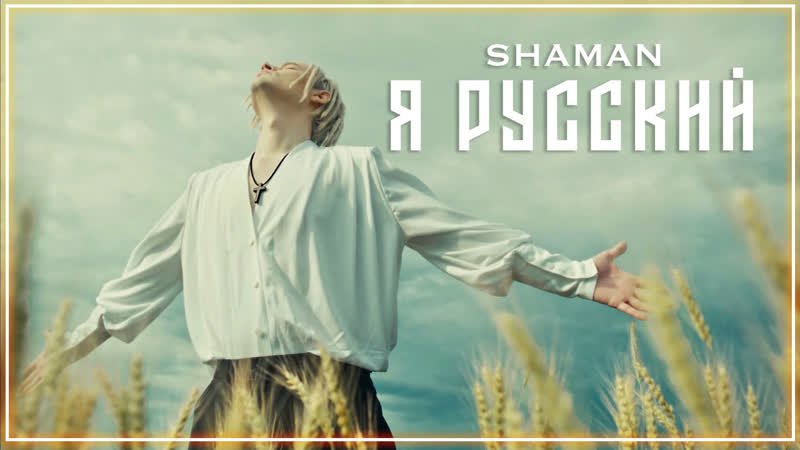
Somehow not a parody
Being Russian is mostly a set of positive tropes that any number of ethnicities could lay claim to, except for the part about the "blood from his father." When asked about this line, Shaman explained that he was not talking about actual biological inheritance, or even actual biological fathers: he was referring to his "heavenly Father." He also deflected criticism that he was defining Russianness in terms of resistance and hostility; the world "despite" here is supposed to mean "no matter what the rest of the world thinks," as opposed to the Russian word's more obvious meaning (out of spite against something).
The vagueness of this patriotism is in perfect sync with wartime Putinism, and, if Shaman is to be believed also helps redefine Russianness as something independent from one's ancestry. People who live on Russian soil and live by Russian value (whatever those are) can be "russkie." [1]
This is the promise implicit in bringing Ukrainian children to Russia. Under the right conditions, they, too, can become Russians, just as the non-ethnic Russian citizens of the RF are now free to identify with a term formerly restricted to a particular ethnic group. Russia is russifying Ukrainian children as part of an effort to Russify itself.
Note
[1} Less than two months later, the humorist Alexander Gudkov released a parody that replaced the word "russkii" with "uzkii" (narrow). The new version is about someone so thin you can use him instead of dental floss, but also has a strong political undercurrent: Gudkov sings that his views are also "narrow."
Next: Kinder, Gentler Kidnapping