By the time Sleepers first aired, Russian audiences were no longer surprised by propaganda-heavy news and talk shows that demonized nearly all oppositional thought. But in the world of entertainment, there could still be a reasonable expectation of at least minimal nuance. In terms of ideological content, scripted television in 2017 was not so dramatically different from from scripted television of 2007: much of it avoided politics entirely, with the "patriotic" quotient slowly increasing in proportion to the topicality of the story. The state-controlled media apparatus was still hesitant to switch from cultivating the population's apolitical cynicism to sustained attempts at widespread political mobilization. This is one of the reasons that Sleepers stood out: viewers would be hard-pressed to avoid a political agenda that is hitting them on the head multiple times each episode.
The other reason is that this propaganda exercise was performed so professionally: well-known actors and directors had signed on to it, a guarantor of quality that seemed at odds with the show's purpose. The show was aimed at a mass audience, but the reviews and the criticism would inevitably come from Russia's intellectuals, who, by and large, saw Sleepers as a betrayal. Sleepers distilled official Kremlin paranoid geopolitics into a brew that liberals found unpalatable.
The hero of Sleepers is FSB Colonel Andrei Rodionov, who, thanks to a spending a decade and a half on assignment in the Middle East, finds the Moscow he returns to in 2013 nearly unrecognizable. Given that the series aired in 2017, the choice of time period is significant, allowing the show's creators to establish its Manichaen worldview without the burden of addressing Russia's (first) invasion of Ukraine. Though the plot's threads lead back to Iraq and Libya, the conflict is between great powers, without proxies to muddle the playing field. As for Rodionov, his absence from Russia between 1998 and 2013 means that he has missed out on Putin-era prosperity and Moscow's transformation into a playground for the wealthy. Rodionov is a sleeper of a different kind. Without every setting foot in a time machine or falling into an explicable coma, Rodionov is a twenty-first century Rip Van Winkle, bemused and appalled by a brave new world.
Unlike his complacent compatriots, however, Rodionov is politically very much awake. Two days before his arrival in Moscow, he survived an assault on the Russian Embassy in Libya, provoked and coordinated by the CIA. In case we might not have noticed just how evil this action was, the camera lingers on an innocent little blonde Russian girl, her brief life snuffed thanks to American perfidy. The attack is a result of the Americans' discovery that Russian and China are about to sign an energy deal that will guarantee Russia a radiant economic future. The Tripoli attack is only the beginning, of course; the CIA has activated its long-dormant "Sleepers" program, calling on a network of stealth agents throughout the Russian Federation to initiate a campaign of propaganda and terror.
Given that Sleepers was intended as a Russian version of The Americans (as confirmed by Michael Idov, who worked for the production company that made the show but refused to be involved in it), the premise itself is not particular surprising. The real bone of contention is the identity of the sleeper agents themselves.
Had they been interested in a more subtle story of spycraft, Bykov and Minaev could have revealed that the sleepers had disguised themselves as loyal true believers in the Putinist order, so that they looked more like Rodionov than like his ideological opponents. Instead, the sleepers are hiding in plane sight: consistent with the media's constant denigration of opposition figures as traitorous hacks bought and paid for by the CIA and George Soros. They all live in luxury and drive fancy cars, gorge themselves on sinister American hamburgers, and ooze disdain for ordinary Russians. There are stand-ins for specific opposition figures (Navalny, murdered journalist Anna Politkovskaya) and representative of generic types (cynical hipsters), and they are all equally odious.
Sleepers is a manifestation of the Putinist imaginary. On the most obvious, superficial level, it is a secondary world of the kind found in so many works of fantasy. But instead of taking place in a realm in which vampires and witches are real, Sleepers takes place in a land in which in all the tropes of Putinist propaganda are true: the U.S. really is behind all manifestations of opposition, the West really is hell-bent on Russia's destruction, and the opponents of the Putin really are self-interested traitors who are only to happy to sell whatever passes for their souls to the highest bidder.
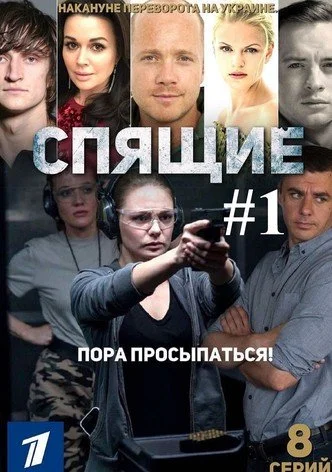
“Time to wake up!”
Or maybe hit the snooze button
But on the other hand, Sleepers is also a case study in the mimetic desire that still animates the post-Soviet entertainment industry. Idov explains this in no uncertain terms, confirming that Sleepers was modeled after The Americans, noting that
such mimicry is common in Russian entertainment. He attributes this to lingering effects of the Soviet period, when Russians had only sporadic exposure to outside pop culture. “Almost no Russian TV series comes into being without a clear American or British inspiration,” he said. Russians are “so insecure about their pop culture that basically they don’t trust their instincts. They were always so proud of their space program and ballet—two things Russia can be rightfully proud of—but they only remembered that they could do space movies after Gravity, and ballet movies after Black Swan.
Sleepers shows exactly how the Russifying of Western examples can go so terribly wrong. It is an uneasy mix of uninspired imitation of American espionage tales and The Americans in particular along with the tropes and cliches of Soviet popular entertainment. The hero is patriotic and upstanding to a fault; patriotism is reinforced by decorating the positive characters' offices with portraits of the country's leader; the hero's failed marriage reinforces the themes of cynicism and betrayal, and every romantic scene is accompanied by the kind of drippy, melodramatic music that was popular in the USSR forty years ago.
Finally, Sleepers is a sign of Russian propaganda's increasingly impoverished imagination when it comes to alterity. A good-faith representation of difference allows for the possibility that those with whom one disagrees might also have a sense of themselves as heroic, correct, or even somewhat justifiable in their otherwise dubious actions. But shows like Sleepers are what we get after years of unrelenting demonization of all opposition: in a world where anyone supporting Ukrainian sovereignty is a Nazi, anyone interested in alternative forms of political-artistic expression are mentally ill, blasphemers, or servants of Satan (Pussy Riot), queer people are victims of the importation of Western immorality, and protesters agitating for freedom of expression or fair elections is a paid agent of the CIA, State Department, or George Soros, the primitive geopolitics of Sleepers makes a sad kind of sense.
Next: Undocumented Aliens