Despite the paranoia about saboteurs and agents of foreign power under Stalin and the frequent charges of "Anti-Soviet activity" leveled against dissidents even decades later, the spy drama occupied a surprisingly limited corner of the Soviet cultural space. As any American instructor who has taught (or tried to teach) a comparative course on Cold War culture knows, English-language films and novels about Soviet and NATO spycraft dwarf their Soviet counterparts in number and significance. Not that the USSR was a passive participant in the Cold War; rhe tensions between the USSR and the NATO bloc featured prominently in propaganda posters and in the news. In the Brezhnev years, Westerners, particularly reporters in the USSR could occasionally find themselves charged with espionage and booted out of the country. But Cold War tradecraft yielded little in the way of Soviet mass entertainment. When James Bond fought Soviet agents in the 1960s and 1970s, it was a one-sided struggle: he had no contemporary counterpart on the Soviet silver screen.
Spymania and paranoia were central to an American Cold War culture that feared the triple threat of ideological subversion ("Is your washroom breeding Bolsheviks?"), geopolitical hegemony (the expansion of the Soviet sphere of influence through diplomacy, international aid, ideological appeal, and possible conquest), and nuclear weapons. The danger to the American psyche played itself out in dramas of communist brainwashing (The Manchurian Candidate) and the flexible metaphors of science fiction (Invasion of the Body Snatchers). Soviet agents abounded in dramas and comedies, becoming so familiar that they could be abstracted into the cartoon Pottsylvanian spies Boris and Natasha in the Rocky and Bullwinkle cartoons.

Only in my Omegaverse fan fiction, TBH
By contrast, the Soviets, as we have already seen, were fighting the influence of Western popular culture rather than inventing a plethora of imaginary Western spies to match wits with chekist heroes. The aforementioned propaganda posters featured Western atrocities in Vietnam and portrayed NATO as an existential threat to the peace-loving USSR. The United States needed to continually remind its population of the "communist threat" to rally political support for military spending and foreign wars; arguably, Hollywood helped this effort by turning the Cold War into entertainment. The Cold War played out in the news, in Soviet policy, and in outright propaganda. There was little need to make the Cold War "fun."
The Soviet Union was never in a position to be able to ignore public opinion or the public mood entirely, but it was not subject to the same sort of electoral pressures that obtained in the West. Moreover, the near absence of market pressures meant that the production of popular entertainment was not necessarily commensurate with popular demand. Filip Kovacevic's 2023 "A List of Soviet Films about Counterintelligence, 1923-1991" tallies 40 movies on this theme in the 1970s alone. But, while many of the Cold War spy stories that did make it to the bookstore, television, or movie theaters are still fondly remembered by readers and viewers who came of age during the late Soviet period, East/West espionage never approached the outsized role of James Bond films or John LeCarre novels from the same period. Venyamin Dorman directed a series of four films about a West German spy who eventually changes sides, beginning with the 1968 The Secret Agent's Blunder and concluding 18 years later with The End of Operation Resident spanned the period from Brezhnev's retrenchment through the beginning of Gorbachev's perestroika. The series, based on a set of popular novellas by two veterans of Soviet state security, was a particularly interesting phenomenon, in that it invited the audience to develop a guarded sympathy with its Western spy protagonist while following him, step by step, as he embraces the Soviet cause.
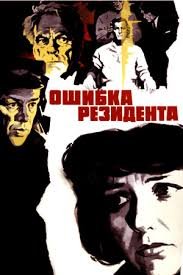
Fortunately, The Resident’s Mistake is not a hospital drama
There were individual spy novelists who wrote popular novels, but not enough for an identifiable genre to appear or sustain itself. Former counterintelligence officer Roman Kim (1899-1967) was one of the few exceptions, writing a number of well-received spy novels. The early part of Kim's fictional output was set in Asia, and almost all of it took place during World War II. Each of these factors (along with the lack of translations of all but one of his novels into any non-Warsaw Pact language) contributed to limiting Kim's role as a creator of Soviet Cold War espionage culture. As Filip Kovacevic argues, Kim himself was vexed by his country's failure to engage with Western spy fiction on its own term. In his 1964 novella "Who Kidnaped Punnakan," an authorial stand-in describes the power of British and American spy thrillers:
Their descriptions of the evil deeds of the Red spies are pushed into the book markets of Europe, Latin America, Asia, Near and Middle East, [and] Africa in an organized manner. And millions of readers of all ages are swallowing them up. [...] They gradually form the images of the intelligence officers from the countries behind the “Iron Curtain” in the readers’ consciousness, convincing them that all that is written in those entertaining books is true and that the countries of the Communist bloc indeed send killers to all corners of the globe, such as Dr. No, Grant, Colonel Vasiliev (as quoted in Kovacevic). [1]
These comments are in service of Kim's larger argument about the value of spy stories, one that is familiar both from internal Soviet debates about mass culture and from the the more general problem of postwar mass consumption: the persistence of the defitsit (shortage). Kim would have preferred to see Soviet writers mobilize as producers of patriotic espionage drama, fighting James Bond on the only front in which he exerted any real power: the imagination. The Soviet culture industry would never quite meet that challenge, generally avoiding the Cold War context in favor of heroes who would fight on the never-ending (fictional) battlegrounds of World War II.
Note
[1] When this post was being drafted, Kovacevic's KGB Literati: Spy Fiction and State Security in the Soviet Union, was still in press. This chapter will subsequently be revised to reflect the new monograph's contributions.
Next: 17000 Moments of Spring