17,000 Moments of Spring
The greatest success story in the world of Soviet espionage entertainment was Yulian Semyonov, whose two novels about KGB Colonel Vitaly Slavin were runaway hits. The first, Tass Is Authorized to Declare was turned into a popular film and translated into multiple languages, including English. Yet the success of the Slavin books was dwarfed by Semyonov's thrillers set decades before the Cold War. His stories about Colonel Maxim Maximovich Isayev, better known by his German alias Max Otto von Stierlitz, remain a fixture of Russian mass culture, in particular thanks to the miniseries Seventeen Moments of Spring. Stirlits, who worked to undermine the Nazis during the Great Patriotic War rather than the West Germans or Americans once the war was over. has remained a hero of Soviet jokelore to this day. At the height of Stielritz' fame, decades had passed since the Soviet victory, but Soviet action heroes were still fighting Nazis on the Eastern Front or behind enemy lines. World War II is a perennial setting for British and American dramas as well, but as only one small part of a larger landscape of espionage and battle as mass entertainment.
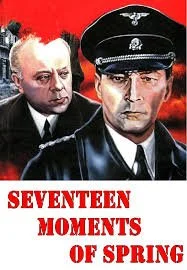
No, this is not Gorbachev checking out a Grindr profile
This (understandable) fixation on World War II held back the development of Cold War spy narratives. Besides Seventeen Moments of Spring, the other signature spy stories of the Brezhnev era focused on the fight against Nazis: Vasily Ardamatsky's Saturn Is Almost Invisible (1963) and the blockbuster novel and film The Sword and the Shield (1965/1968) both take place during the Second World War. Vladimir Putin's decision to join the KGB is widely attributed to his fandom for this particular movie.
By now, no one should be surprised to hear that World War II has continued to play an outsize role in Russian culture. This is not only a matter of the War's function as a moral touchstone for every generation, but also of seven decades of WWI-related cultural production. As I argued in Overkill, the Great Patriotic War was one of the few acceptable settings for the (sometimes graphic) depiction of violence before perestroika. Crime was officially all but non-existent in the USSR, and in any case not a suitable subject for mass entertainment; the television police dramas of the 1970s had such a broad appeal not just because they were well-made, but because they had so little domestic competition. World War II was a cultural safety valve for violent entertainment. As in the West, it usually served as the site of a stark Manichaean conflict between good and evil, while (after 1945) also having the advantage of an eventual foregone conclusion (the Nazi defeat) that could justify the savage fighting and tragic human losses depicted along the way. As a recent historical setting World War II stories could be simultaneously inspiring, horrifying, and exciting in a way that plots centered in the Soviet present could not. The Soviet present was simply not accessible as the grounds for the military or criminal plots that could so easily serve as the grounds for ideological contestation. Spy dramas, along with most opportunities for adventure, were consigned to the safely cordoned off cultural space of the Great Patriotic War.
The end of Soviet censorship (followed shortly thereafter by the end of the Soviet Union) could, at least in theory, have led to an espionage drama renaissance. After all, the pent-up demand for crime fiction was sated by a seemingly endless supply of tales of gangland shootings and mafia wars, not to mention the decade's signal (fictional) professional, the hitman. Science fiction enjoyed a similar, if smaller boom, accompanied by the birth of "Slavic fantasy" (sword-and-sorcery and subpar Tolkien imitations with Russian window dressing). But the 1990s turned out to be a less suitable climate for spy stories. Classic espionage requires actors sneaking around in the interests of a foreign, hostile state. With the Cold War over, what state was that going to be? But it wasn't just about the lack of an obvious foreign enemy; the hostile state is in a symmetrical, almost co-dependent relationship with the "good" state that the heroes call home. When James Bond fights agents of the Soviet Union, he is not a rogue or independent actor (no matter how charming and individualistic he might be); he is operating on behalf of Her Majesty's Secret Service. Obviously, the Russian Federation existed as a state, but it was much less centralized than the regimes that preceded and followed Yeltsin. For the nine years of Yeltsin's presidency, the state did not occupy as large a discursive or cultural role. In its weakened form, Russia in 1990s storytelling was often the hapless victim of malign powers conspiring against it, but these enemies were usually not part of state structures. On the contrary, they were the supranational, conspiratorial forces that manipulated states themselves: Jews, Masons, international capital, and secret societies.
In other words, the enemy in the 1990s was usually some manifestation of globalism, facing a Russian Federation that lacked the will and the resources to effectively fight back. Here the Russian situation made sense within the larger context of ascendant neoliberalism, a free-trade global agenda that downplayed sovereignty, and whatever the chattering classes across the world chose to believe the "end of history" actually was. Just as the West was confronting the increasing threat of international terrorism performed by non-state networks, the Russian Federation faced the threat of separatism (the first Chechen War) and the vague specter of state collapse. Rather than the familiar "spy vs, spy" narrative, Russian entertainment offered variations on a complex, asymmetrical struggle between the patriotic remnants of the Soviet security apparatus (often functioning either as lone wolves or autonomous units), organized crime, corrupt politicians, separatist terrorists or agents of international cabals. The aggressive, anti-Western turn in response to the 1999 NATO bombings of Yugoslavia began the process of restoring a framework in which states were opposing states: the United States and the European Union were, if not enemies, than at the very least rivals, and the Russian Federation would have to retrench and act accordingly.
Next: Twenty-First Century Espionage Man