Putin's ascendency started a process whose side effect would be the revival of the classic espionage pattern. This is not simply because Putin was the product of the KGB, or because he remains a Sword and Shield fanboy well into his Botoxed golden years, nor is it the likely result of a well-formulated plan that began with his installation as president. We should recall that in the early years of the new century, Putin made significant overtures to Western countries (the United States included) with an eye towards international economic cooperation. Rather, it stems from the Putinist determination to centralize power and establish the principle of gosudarstevennost' (statehood/sovereignty) as foundational not only to the Russian Federation, but to all of Russian history. Putinism is the political reincarnation of Soviet gigantomania; where the Soviet aesthetic foregrounded immensity of size as a guiding principle (the biggest statues, the biggest buildings), Putinist geopolitics demonstrates a strong preference for size, scale, and longevity. From its early days, Putinism insist on seeing and thinking like a state; with Putin's return to the presidency in 2012, it broadened to a quasi-Huntingtonian, civilizational discourse. For Putinism, it is the Russian state that is the hero of history. Its only logical interlocutors are other states.
Given the increasing belligerence of Putin's third and subsequent terms, it is somewhat surprising how small a role American and European spies have played in popular entertainment, and how late they have been to make themselves known. Even as real-life American citizens were arrested on trumped-up charges of espionage (Paul Whelan, Evan Gershkovich), they had few fictional counterparts to pave the way. Nor was Russian counter-intelligence a frequent source of twenty-first century heroes. Until recently, both American and Russian spies were easier to find on television in more lighthearted fare rather than outright thrillers. A series called Agent of National Security ran on the TNT network from 1998 through 2004, with a 2019 sequel film, featuring a hero who used his skills as a college theater major to help in the fight against organized crime and separatist elements. Agent did not skimp on the action: evil-doers were defeated, people were threatened and killed, but, like Cops: Broken Street Lights (Menty: ulitsy razbity fonarei), the show on which it was modeled, Agent tried to charm its viewers with its quirky characters and absurd situations in which the hero found himself.
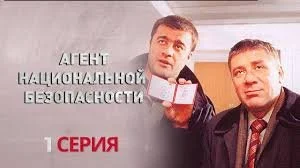
Would you trust your national security to these men>
in 2017, TNT took another stab at the spy genre, this time with an even more pronounced comedic slant: Adaptation,which ran for two seasons and 37 episodes ending two years after its premier. This time the protagonist is Ashton Ivy, an American spy who happens to speak perfect Russian; under the name Oleg Menshov, Ashton has been dispatched to the frigid climes of Noyabrsk, a grim, Siberian oil-producing city. The series is an extended cat-and-mouse game, and much of the humor comes from the multiple ways in which Ashton fails to understand everyday Russian reality while still not actually getting caught. Curiously, Ashton is a sympathetic figure, despite being a foreign agent; indeed, when the show premiered, residents of the town in which it was filmed lodged their objections to being portrayed as drunken, uncouth yokels. It helps that the stakes in this particular infiltration are not quite existential: Ashton is not trying to destroy Russia or weaken its military. Rather, he is sent to Siberia because the U.S. has learned of a new Russian method for obtaining cheap gas. Ashton's mission is in the economic interests of his homeland and against those of his target, but the series manages to keep Ashton's exploits at a distance from the American Russophobic forces that the news media were already warning their viewers about. The poster for the first season shows the Statue of Liberty holding a torch that looks like a cigarette lighter in the shape of a hammer and sickle, with the telling slogan, "An American Spy in Gazprom." It would be naive to pretend that Gazprom is an entity somehow separate from the Russian state, but highlighting Ashton's mission in a company rather than, say, the Kremlin or a military research facility, means refraining from pushing more obvious patriotic buttons.
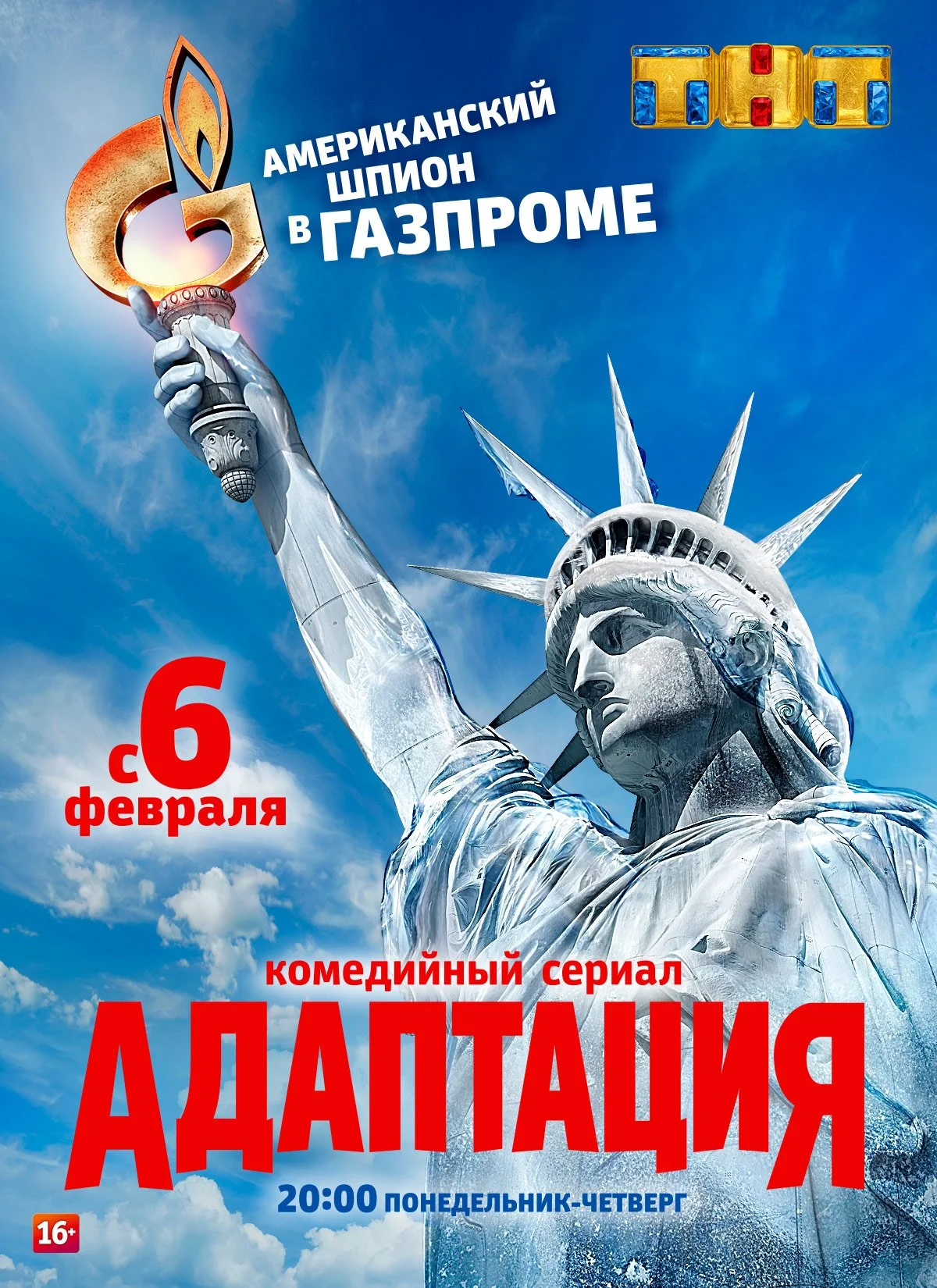
Help! Is there a semiotician in the house?
In Adaptation, Ashton is always on the back foot because he has been sent on assignment to a strange and distant land. His viewers undergo a similar displacement, but in time rather than space: the light comedy and low stakes of Adaptation are curiously out of step three years after the seizure of Crimea, when the news media are devoting more and more time to uncovering the sinister machinations of Russia's enemies (with the United States as enemy number one). Adaptation's geopolitics were so anodyne that liberals didn't even bother to criticize it. And, in any case, the show would be eclipsed by a much more tendentious rival spy drama that appeared at roughly the same time: Sleepers(Spiashchie). With an eight-episode first season that began in October 2017 and a truncated, concluding second season in early 2018, Sleepers was the show that everyone was talking about.
Next: When the Sleeper Wakes