Russian life expectancies plummeted in the 1990s, thanks to sharp economic decline, stress, violence, suicide, alcoholism, and cardiovascular disease (all of which took a greater toll on the male population). The twenty-first century saw a significant turnaround (with the COVID years as an unsurprising exception), although Russian men still cannot expect to live as long as their European counterparts. The war in Ukraine has taken its own toll, in mortality, morbidity, and post-traumatic mental instability, but the statistic are, of course, unreliable. But there is one population whose dramatic losses have become an unexpected signpost of the Putinist necropolitical order: oligarchs and state functionaries.
In what some are facetiously calling "Sudden Russian Death Syndrome," oligarchs and senior officials are dropping like flies. In many cases, the dropping is literal: something about becoming inconvenient to the regime has prompted important men (and the occasional important woman) to be careless around open windows. The headlines in the Western press have the black humor of an Onion story. On February 16, 2023, Newsweek ran a story under the header "Full List of Russians to Fall Out of Windows Since Putin Invaded Ukraine", which was either overpromising or premature. The story listed a meagre three unfortunate souls (Marina Yankina, Pavel Antov, and Ravil Maganov). Antov was the lead fatality in Elaine Godfreys Atlantic Monthly article that brought "Sudden Russian Death Syndrome" to a wider audience. The "Russian sausage tycoon" had spoken against the War in Ukraine over WhatsApp, though he soon retracted his statement and declared his support for Putin. He was celebrating his 65th birthday at a hotel in India when he fell out a window, just two days after one of his traveling companions died at the same hotel. Most of the cases of "Sudden Russian Death Syndrome" are similar mix of odd coincidences and public disagreements with the regime.
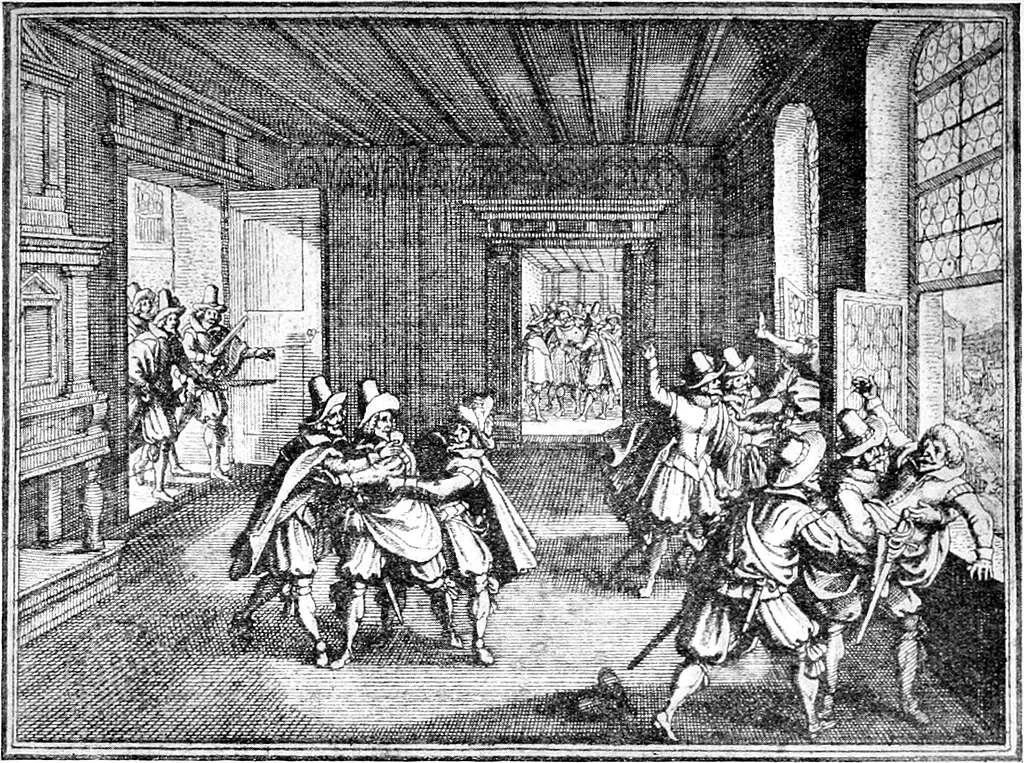
The Czechs did defenestration before it was cool
On September 25, 2025, The Moscow Times published "Death by Falling: A Timeline of Cases Across Russia and Abroad," which listed 18 suspicious deaths over a three-year period. Wikipedia's "Suspicious Russia-related deaths since 2022," by not limiting itself to defenestrations, ends up looking like a morbid summary of a real-life game of Clue (Yuri Voronov, in a swimming pool, with a pistol).
It also recalls a feature from the notorious English-language gonzo tabloid The eXile, which, from 1997 through 2008, satirized the Moscow expat scene, Russian politics, and the Russian media, with a fratboy sense of humor that, while often clever, reeked of misogyny. The paper's writers and editors had a keen eye for the absurd and a love of black humor, all of which were on display in a regular feature called "deathporn." "Deathporn" was a compilation of the past weeks' crime stories, which, when taken together, were mind-numbing in the repetitiveness of their horror. Each brief story was accompanied by a graphic that indicated one of 14 categories: a waffle for "riddled with bullets," a screaming woman for "cries for help ignored," and a butterball for "carved up like a turkey." But now, instead of the ordinary unfortunates who met their demise in "Deathporn," it is the rich, powerful, and well-connected whose lives are cut short in strangely predictable ways (defenestration and suicide). Where "Deathporn" targeted the sensationalism of the Russian media, Sudden Russian Death Syndrome is repetitive and transparent; the flimsy explanations of these deaths appears to be instructive rather than satirical. We are supposed to read between the lines, and come to the appropriate conclusions about what happens to people who overstep them.
There is no proof available that this rash of defenestrations, suicides and apparent poisonings occurred at the behest of the Russian leadership or security services. It's possible that these are dozens of unrelated coincidences, and, as someone who has written skeptically about conspiracy theories, I should be among the first to take this explanation with a grain of salt (while hoping it doesn't turn out to be a grain of ricin). But it is consistent with KGB/FSB practices, going back as far as the infamous assassination of a Bulgarian dissident writer in 1978 (Georgi Markov, on a London street, ricin poisoning via umbrella) and extending into the twenty-first century with the polonium poisoning of Alexander Litvinenko and the novichok poisoning of Alexei Navalny (whose death in a Russian prison camp several years later, while possibly the result of extended ill treatment, fits the pattern). Even in the unlikely scenario that none of the cases of Sudden Russian Death Syndrome are the fault of the Kremlin, they are useful nonetheless. They function as a reminded to the country's elites that, not only are they not immune to the power of Putinist necropolitics, they can easily become its target. The thousands of Russian men who die as cannon fodder in the war in Ukraine are largely anonymous; serious reporting on their deaths could undermine the war effort. But for those who are seen themselves as obstacles to the "Special Military Operation," a public death, complete with a biography, is the sovereign's demonstration of the power over life and death.
It also functions as an odd displacement: while the Russian military death toll is chronically underreported, it is a reality that inevitably surrounds the state-sponsored simulacrum of a resurgent Russian on the move. Information about deaths and death benefits, when combined with a culture of mobilization that trumpets the virtue of sacrificing one's life for the Motherland, haunts a population that does its best not to see the specter of mass mortality. A country whose leaders are obsessed with birth rates and the creation of future generations has been fighting the forces that would depopulate it since the war began: the waves of migration of men avoiding the draft and people of all genders who see no future for themselves in the Russian Federation, and the ever-increasing supply of dead bodies either left on the field of battle or brought back in zinc coffins. The deaths of the well-connected and powerful are, at least numerically, a sideshow. But it is a sideshow that is compelling and instructive.