In Homo Sacer, Giorgio Agamben locates the apotheosis of modern biopolitics in the institution of the concentration camp, whose function is to strip all inmates of the trappings of zoe (social life), leaving only bios (biological bare life), which is then subject to extermination. As a corollary, I would argue that certain subsets of the horror genre can most effectively convey the ramifications of necropolitics, with the various and sundry means of turning bodies into corpses often pointing back to the logic of a state that is less explicit in its necropolitical strategy than the architects of the concentration camp. It is the suspension of the human subject between life and death, as well as the alternation between the fates of individuals and large groups all subject to state power, that bring horror and necropolitics together.
In fact, the horror genre in Russia was thriving in Putinist Russia--certainly, the COVID-19 pandemic gave it relevance and resonance. The genre prospered up until the point of the February 2022 full-scale invasion of Ukraine, at which point it became clear: the imaginative necropolitics of horror could not easily coexist with the actual horror of wartime necropolitics. Witness the career of Dmitry Glukhovsky, whose first novel, Metro 2033, was published in the early Putin years (2002). Metro 2033 was a smash hit, leading to a series of video games, two sequels, and dozens of novels and short stories by other writers published under the umbrella title "The Universe of Metro 2033." The Metro 2033franchise takes place in a post-apocalyptic Moscow, where bands of human survivors have organized fractious societies in various subway stations while warding off attacks from the mysterious, non-human "Dark Ones." Over the next two decades, Glukhovsky developed a large international following and branched out to other genres, subjects, and media. After he declares his opposition to the invasion of Ukraine, Glukkhovsky (who no longer lived in Russia full-time) was declared a foreign agent and sentenced to prison in abstentia.
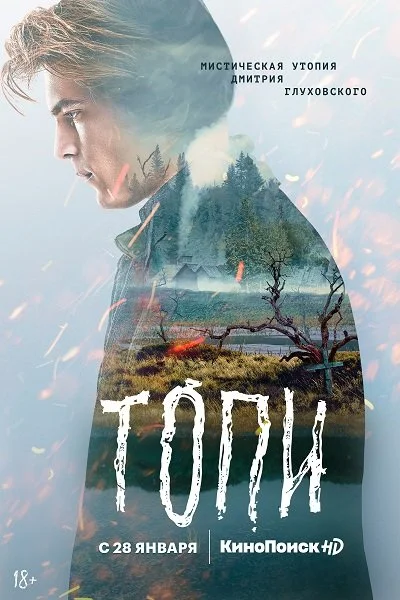
His last project before he became persona non grata was an extended meditation on life, death, and immortality. This was not a new theme for him; his 2013 novel Budushchee (translated as Futu.re) takes place in a dystopian future populated by immortals, who pay for their immortality by refraining to have children. In January 2021, the seven-part series Topi premiered on Kinopoisk a Russian streaming service. Topi tells the story of five young Muscovites who find themselves in the fictional provincial village that gives the series its name. The instigator of this journey is Denis, a tech bro recently diagnosed with a fatal brain tumor. His mother convinces him to go to Topi in order to find a legendary monastery known for healing the sick. He is joined by Katya, who had been contemplating suicide after discovering her boyfriend was cheating on her, Sonya, whose life has fallen apart after the death of her sister, Max, a journalist recently fired from a very Kremlin-friendly media outlet, and Elya, who has just escaped from her harsh, patriarchal family. From the beginning, everything goes wrong: they get into a terrible car accident, discover that the monastery has been abandoned, and spend the next six episodes dealing with the very strange locals who both shelter and torment them.
Sponsored by the Russian Haunted Provincial Tourism Bureau
Topi is a series that refuses to make straightforward sense; it is more evocative than logical. The locals at times seem half-alive, as if they had just woken up from a long nap, or if they were partially-revived corpses. Characters actually do die and come back to life, including, apparently, Sonya's dead sister. The series provides clues pointing in two opposite directions: the first is that the five visitors all died in the car crash, and are now experiencing an uncanny provincial Purgatory, while the second is grounded in less mystical, if no more believable, details. It just so happens that Topi contains more than a monastery: it also is the host to a chemical plant that has been polluting the area with unknown substances. The tea everyone drinks tastes strange-might it be the chemicals? It is possible that the residents of Topi, and now their visitors, have been drugged into an altered state? Perhaps the reviewers who compared Topi to a bad trip were not far off.
Even as he defended the series from accusations that it oversimplified the Russian countryside and indulged in stereotypes about ignorant provincials, Glukhovsky insisted that the series was about 'хтоническая Русь" and "русская хтонь." The Russian word he uses can be literally translated as "chthonic," a Greek term connoting a connection to the underworld. In Russian, it can have the same connotation, referring to the abyss or evil spirits, but it can also function like as one of the many Russian terms of abuse for the uneducated masses who can ruin the political order. Given that the inhabitants of Topi are either drugged, brainwashed, or some form of the unquiet dead, the term seems apt, particularly when we account for the importance of the "Khoziain" (Boss who runs the town. The Boss appears to have magical powers over life and death--he can cure Denis's cancer, but he can just as easily bring it back.
In a supernatural reading of Topi, the Boss is a demonic figure who happens to take on human form. But Topi never settles comfortable in any particularly metaphysical framework, so the Boss is also a familiar type of thuggish bureaucrat who has taken on the trappings of a cult leader. Can he really resurrect the dead and control people's minds, or has he (with the help of the chemicals seeping into the well water) duped people into attributing him a power that he does not actually possess? It is his ambiguous, liminal status that lends Topi so much resonance. It could be the story of literally chthonic forces destroying people's lives, or it could be a cautionary tale about the surrender of authority over one's very existence to a leader whose power lies only in his people's belief in him.
Four of the five visitors are Muscovites; the fifth is Chechen. Taken together, they are the product of what is, on the surface, a very different Russia from that of a small village in the middle of nowhere. Yet they fall under the town's (and the Boss's) spell almost immediately. Glukhovsky said the series is "about the collision of a new type of Russia and the eternal Russia, which always was an always will be." Denis Starostin puts it particularly well:
"Topi" is first and foremost a story of the dead. Not the ones chasing after you to eat your brains, but those who come to us in our dreams as memories of the departed. The longer we live, the more such ghosts gather in our memory. And any village is memory of the past, the history of generations [in a place} where there are a lot more graves in the cemetery than their are living people in the nearby homes."
Starostin's reading locates death and ghosts firmly in the world of the Russian past, a world that, thanks to the country's sociopolitical geography, still freely haunts timeless village life. But, if that is the case, why is it so easy for this past to get a grip on our urban heroes? The two male leads are virtually hipsters, with the entrepreneurial Denis a dead ringer for Internet mogul Pavel Durov, who founded the country's two biggest social media companies (Vkontakte and Telegram) (who left Russia and Vkontakte after refusing to cooperate with a request for data on Ukrainian protesters in 2014). The modern, urban Muscovites only think they have agency, but once they land in Topi, they are trapped. Despite Glukhovsky's protest to the contrary, Topi, magical or not, instantiates the classic Russian understanding of the provinces. By their very nature, the provinces are devoid of meaning. As Anne Lounsbery argues in her excellent book Life Is Elsewhere: Symbolic Geography in the Russian Provinces, 1900-1917, rather than develop a sense of regionalism, Russian culture has traditionally framed the provinces as an undifferentiated space, doomed to wither far away from the real life taking place in the capitals. Lounsbery's title comes from Milan Kundera's novel, and uses the word "life" metaphorically, but in Topi, life is literally absent.
As is Dmitri Glukhovsky from Russia; his life is, quite literally, elsewhere. He had largely been living abroad already, but just a year after Topi's release, his opposition to the invasion of Ukraine would lead to an arrest warrant and the aforementioned eight-year prison sentence in absentia. Political reading of Topi were easy enough to make when the show first aired, but now the series looks like a diagnosis. When the modern, Western-oriented Muscovites end up in a timeless village under the sway of a brutal, charismatic leader who seems to have power over life and death, the visitors are bound to lose. Topi is an oblique comment on Putinist necropolitics, which renders its subject unable to distinguish between the living and the dead.
Next: Sudden Russian Death Syndrome