In Plots Against Russia, I wrote an entire chapter about zombies in postsocialist Russia, arguing that "Russian discourse is less concerned with zombie as thing than it is with zombie as process: not zombies, but zombification" (184). Zombification is the Russian equivalent to "brainwashing," and has played an increasingly prominent role in discussions about religion, ideology, and regional conflict since 1991. Zombies themselves were scarce. But the book came out in 2019, and the zombie landscape has changed since then. COVID-19 drew increased attention to outbreaks of all kinds, while the continuing popularity of such ongoing Western franchises as The Walking Dead and the runaway success of HBO's adaptation of the video game The Last of Us encourage attempts to capitalize on a very lucrative cultural phenomenon.
In addition, my focus was on the zombie as metaphor as a way to talk about propaganda and belief. That is, it was about subjectivity or the lack thereof. Necropolitics demands that I cast my net more widely, to consider the many varieties of unquiet dead who might speak to both necropolitical reality and necropolitical fantasy. It turns out that liminal states between life and death have been playing a broader role in the culture than the relative scarcity of Russian zombies might suggest.
Ludmila Petrushevskaya has earned an international reputation for her dark yet somehow comical stories depicting the miseries of Russian life (past and present). Some of them are unrelentingly naturalistic (the domestic warfare between mother and daughter in The Time: Night; the grim calculation behind "Among Friends"), but she frequently returns to the fairy tale genre even as her settings are almost always rooted in Soviet or post-Soviet reality. In many of these stories, the characters exist in suspension between life and death, without even the comfort of an internally consistent supernatural taxonomy: there are no vampires or zombies in Petrushevskaya, though there are plenty of bloodsuckers and walking dead people. The fairy tale ushers in the possibility of dream logic, where things that don't make sense seem just on the verge of the comprehensible.
In 2009, Keith Gessen and Anna Summers collected and translated a set of Petrushevskaya's stories, finally providing a comprehensive introduction to her shorter workers to an English-speaking audience. The title appears to have been entirely their invention, but it is a faithful reflection of the author's fairy tale style and her unflinching attention to death: There Once Was an Old Woman Who Tried to Kill Her Neighbor’s Baby. Most of the stories follow through on the book's implied promise, and nearly all of them are rooted in the real and metaphorical violence of Soviet and post-Soviet reality. Though it would be a disservice to reduce Petrushevskaya's brilliance to sheer social commentary, there is usually an element that at least gestures in the direction of the political. In particular, her tales of the near-dead or not-quite-alive are usually connected either to Soviet historical trauma or post-Soviet political violence, obscuring not just the boundary between the living and the dead, but the very identities of the people involved. These fairy tale characters become strangely fungible, one mistaken for another.
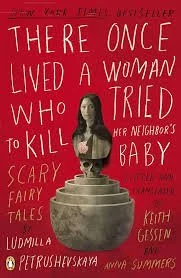
Two stories set during World War II ("The Arm" and "Incident at Sokolniki") treat death and dismemberment as somehow almost reversible, and also as properties that can be passed back and forth among people who either bear an uncanny physical resemblance to each other or occupy complementary roles. "The Arm" seems to realize the metaphor of the "war at home," with casualties migrating back and forth cross both the front and the borderland between dreams and the waking world. A colonel comes home to bury his wife, has a dream that she tells him to dig up her coffin, and then takes a series of increasingly surreal flights with a pilot with one severed burnt arm that he insists on calling his "navigator." Wherever they go, they are surrounded by burnt-out vehicles and the mangled bodies of dead and dying soldiers. He loses consciousness and wakes up in a hospital, informed that he had been found at the cemetery by his wife's grave, with one arm so severely damaged it had to be amputated.
"Incident at Sokolniki" also features death, aviation, and the porous border between this world and the next. A woman finds out her not particularly beloved husband's plane was shot down. Months after the funeral, she meets a man who claims to be her dead husband. They live together for awhile, before he demands that they bury the flight suit he left in the forest. When she finishes the job, her husband vanishes, but returns to her in a dream to thank her for burying him. Both these stories play with the familiar folkloric theme of the unquiet spirit who needs to be put to rest through an extra burial ritual; their placement within the context of the Second World War is reminder of just how close to the surface this traumatic event remains. It is both specific (the particular dead loved one mourned at the beginning of the story) and somehow contagious (the dead continue to multiply through the appearance of apparently living doubles). Death wreaks havoc with the notion of individual identity.
In Petrushevskaya's stories, the fungibility of human identity is felt long before the deaths that are central to the plot. "A Mother's Farewell" (1992) which appears to have a contemporary setting, involves multiple family members--a mother, a father, a wife, a sister, another possible father--but only one named character, Oleg. As the only character with a fixed identity, Oleg is a the center of a network of relationships of family members and putative family members who effectively take turns being dead. This is a family with a severe case of object impermanence and mental illness, complicated by the armed forces that loom over their lives.
Oleg is an orphan who is not quite an orphan: when his mother dies, he goes through her papers and finds love letters from his biological father, who was involved with his mother when she was already married to the man who raised him. Also included are nude photos of his mother, which surprises him less for their content than for the observation that his mother was not as beautiful a young woman as she had been reputed to be.
At 16, Oleg drops out of school, suffering from severe depression. His father dies, his sister moves out, and Oleg, left alone, is soon drafted. While in the army, Oleg encounters his second case of mistaken identity (after his father). As part of a manhunt for an escaped prisoner on a mountain path, he accidentally kills the wrong man. Declared temporarily insane (for the second time--his father had tried to use a schizophrenia diagnosis to keep him out of the army, Oleg is discharged.
Now a wreck of his former self, Oleg is suddenly aided by his sister, who tells him that he shouldn't take the story about their mother's infidelity so seriously. He goes back to the letters, which no longer contain any nude photos, and instead of evidence of an affair, he discovers correspondence between his parents testifying to an enduring and faithful love, along with a discussion of how much Oleg looks like his father. Eventually he marries, has children, and goes to visit his mother's grave. But it turns out that the grave is his sister's, not his mother's, and nothing about Oleg's understanding of the chronology of his own life holds together.
No identity in this story is fixed--not Oleg's father's, because of the confusion about paternity; not his mother's or sister's, because it is not clear who exactly is dead and who is buried where; not that of the man Oleg shot, who is yet another case of mistaken identity; and, by extension, not Oleg's, since he cannot establish a coherent biography. While most of this story looks like a domestic drama, the intrusions of the military are significant. Oleg's first mental breakdown leave him susceptible to the draft; his military service compounds his inability to recognize the fixed identity of those around him, and leads to his next breakdown. And the confusion between his mother and sister is compounded by uncertainly as to the date of his discharge from the military.
Peterushevskaya's most chilling story of confusing between the living and the dead is also the one that has its most explicit necropolitical context: "The Fountain House." Originally published in the year 2000, it takes place in the aftermath of an explosion on a public bus (just a few months after the suspicious apartment bombings). A fifteen-year-old girl is killed, but her parents, who were riding in the seats behind her, survive. Or at least, that is how the story begins. The father is convinced that she is actually still alive, and manages to have her body stolen from the morgue. He drains the family bank account and bribes a doctor who admit her to the ICU, where he is obliged to put on a hospital gown and lie down in the cot next to his daughter's. The doctor works on the daughter's corpse and administer's a sedative to the increasingly unsettled father. The father dreams that he has brought a sandwich to his daughter's summer camp. The sandwich contains a human heart, which he proceeds to eat in her stead. When he wakes up, the doctor is performing a blood transfusion on his daughter using hte father's blood. By the end of the story, both the father and daughter are alive, apparently as a result of the father's actions in his dream. But their status is tenuous, confusing to both the parents and the hospital. The bus explosion, while never explained, is invoked repeatedly throughout the story. Somehow, the bombing seems to have dislodged them from both normal logic and the normal understanding of life and death.
What, precisely, is Petrushevskaya doing in stories such as these? Certainly, they are far from the only examples of the author's use of dream logic, nor are they the only cases of what Farah Mendelsohn calls "liminal fantasy" (stories in which the presence of the fantastic is never entirely settled). Nor are they the only ones that demonstrate a preoccupation with death and morbidity; one of her most famous short stories, "Hygiene," is about a plague that leads to the gruesome deaths of almost every character featured. But in all of the stories discussed here, horrific violence and national upheaval form the backdrop, distorting ordinary human lives and disrupting the boundaries between life and death in a way that is never quite explained. There is nothing explicitly political about these texts, which read as if they are curious anecdotes about, if not someone the Russian reader might know, then about the proverbial friend of a friend of a friend. Yet the inciting incidents are from a realm of events incommensurate with the ordinary and the everyday (war and terror), and the defining feature of all the characters is their utter inability to understand what is happening to them. These are people either without agency (Oleg) or whose agency is circumscribed by their ignorance and confusion (the father in "The Fountain House"). Their world is one in which things happen to them, in which inexplicable violence is always just beyond our vision (and just outside the text); they cannot even be sure whether they are a live or dead.
In "The Fountain House," the father bribes the medical staff not just to save his daughter's life, but to lend their medical authority to his (apparent) delusion that she is not dead. Oleg in "A Mother's Farewell" must appeal to the family's informal archive (fading paper) and the solidity of the gravestone to determine which members of his family are actually dead. Death is not a certainly in and of itself; it requires external confirmation to make it real. The protagonist of Anna Starobinets's 2005 short story "Yasha's Eternity" faces a similar, if even more fantastic conundrum: his heart stops beating, but he continues to function. Is he still alive? In his case, the medical (and, by extension, legal) authorities decide he is not. Though he is not threatened with anything as gruesome as (possibly) premature burial, he is, step by step, deprived of his rights as a citizen. He loses his apartment and his work, becoming completely unmoored from the rhythms of public life. Ironically, once he seems to lose his bios (Agamben's designation for basic, biological life), he is deprived of zoe (existence as a social being). Unable to either live or die, Yasha embodies the necropolitical conundrum hinted at by Petrushevkaya's stories: life and death threaten to exceed the parameters of both biology and the biopolitical regime.
NextL The Provincial Undead