The Death Mask of Vladimir Putin
Chapter 5
The Necropolitics of Putinism
The Death Mask of Vladimir Putin
Within a year of become Acting President of the Russian Federation, Vladimir Putin published a set of conversations with three reporters in order to offer the reading public some insight into a figure who until recently had been relatively unknown. The English edition (marketed as a "self-portrait" rather than as a set of interviews) was called First Person; the original Russian translates as In the First Person. Each of these titles is a play on words: Russian literary scholars use the term "first person" to describe a common type of narrative, as do scholars throughout the world, but the Russian traditions of government also use "first person" as a shorthand for the man in power. Strangely enough, the English title helpfully makes this connection clear by being more vague.
One nuance, however, is inevitably lost. Russian law and bureaucracy, like Russian narrative theory, do not use the neutral word "chelovek" to refer to a "person." Instead, the term is "litso"--literally, "face." "Litso" functions in police reports and legal documents the way "individual" does in their American counterparts (most notably in the phrase "litsa of Caucasian nationality" to refer to individuals from the the Caucasus region).
Literally, Putin's 2000 book is about the "First Face." The new "first face" of the Russian state had only just begun a journey from obscurity to ubiquity, a drama that would be etched on (and erased from) his now-famous physiognomy. The rise of "Putiniana" (using the Russian leader's image to move product, provoke laughter, and inspire patriotism) is now well known. Putin's face is the stuff of memes, from his fabled resemblance to Harry Potter's Dobby the House Elf to the rouged and lipsticked Vladimir Vladimirovich adopted by queer protesters. It is also now the face of a regime that has lasted for the entire first quarter of the twenty-first century.
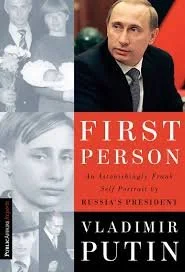
Nobody’s selection for book club
Never particularly expressive, Putin's face has not so much aged as become a mask of itself. Since at least 2011, rumors have circulated in Russia and abroad that the president has undergone plastic surgery and has a distinct fondness for Botox. For a man in his seventies, he has remarkably few wrinkles; on the contrary, some observers point to a relatively new "puffiness" to his cheeks that, in the absence of apparent weight gain, suggests ongoing cosmetological interventions. In and of itself, Putin's alleged concern for retaining a youthful look is not particularly significant, especially against the backdrop of years of increasing political repression at home and war in Ukraine. True, his assumed vanity is a gift to his critics, in that it undermines the stoic, macho image he has cultivated throughout his entire public life. But, after a quarter century of Putinism, I would suggest that Putin's frozen physiognomy has a unique symbolic significance.
A face that does not move is a face that does not age, but it is also a face that barely appears to be alive. Cultivated with the help of Botox, a neurotoxin that, in other contexts, is lethal, Putin's face is a death mask taken from a still-living body. Twenty-first-century Russian political culture has been unable to produce a convincing and viable vision for a post-Putin future, a situation fostered by a system that consistently crushes political opposition. Putin's supporters repeatedly proclaimed that there is "no Russia without Putin," while his opponents chanted the slogan, "Russia without Putin." What better face to represent this political paralysis than one that a neurotoxin has paralyzed?
Putin's living death mask is the locus of a number of powerful metaphorical frameworks for the homology between leader and state: the implications of Russia's personalized leadership by the "first person/first face," to be sure. As Olga Beshlei and Egor Mostovshchikov wrote in one of the earliest articles on the oddities of Putin's appearance (2011): "It has long been said that the face is the reflection of the soul, or, more precisely, what is going on within it. When talking about a politician on whose decisions depend the lives of tens of millions of people, it is impossible to pretend that this question is not worthy of attention." At issue is the older understanding of what Ernst Kantorowicz calls the "king's two bodies," where the monarch's "body natural" is the visible manifestation of the "body politic," as well as the Soviet-era explorations of a collective national body discussed in the introduction. His supporters' dismissal of the very idea of a Putin-less future is manifest in the frozen, undead face of (to borrow the English-language title of Olga Slavnikova's novel) the man who couldn't die. This paralysis is the preemptive denial of melancholia, the dogged insistence that there will be nothing to mourn.
Public mourning under Putin has been quarantined, limited to the commemoration of the long-ago, symbolic sacrifices during the Great Patriotic War. When an opposition figure such as Alexei Navalny dies, citizens attend public memorials at their own risk. The organizations and museums keeping the memory of Stalin's victims alive have either barely managed to function in the face of state persecution or vanished entirely. Even public grief over national tragedies (such a the terrorist assaults on Beslan and the Moscow theatrical Nord-Ost production) cannot be tolerated. Putin himself set the tone in his cold response to Larry King's question about the deaths Russian sailors in a submarine, in a response whose lack of affect rivaled the opening line of Camus' The Stranger ("Mother died today."). King: "What happened to the Kursk?" Putin: "It sank."
This expressionless death mask is entirely appropriate for a man and a regime that are, at best, cavalier about the human costs to the nation's citizens and, at worst, actively creating and deploying systems whose end product is mass mortality. He began his first presidency with an emphasis on consumer comfort and prosperity; over twenty years later, he launched a war whose main strategy seems to be to throw more and more disposable troops at the enemy. The full-scale war in Ukraine is the last (or at least, most recent) action that has stripped away any remaining veneer of humanism, revealing the crude necropolitics of Putinism.
Next: Getting into Death