As elaborated by Achille Mbembe in a 2003 article and 2019 book, necropolitics (which gives each of these works their title) builds on arguments about the relationship between death and sovereignty perviously developed by Friedrich Hegel, Georges Bataille, Giorgio Agamben, and Carl Schmitt, and in Michel Foucault's theory of biopower. Agamben had extended Schmitt's notion of the State of Exception as a way not only to define sovereignty, but to characterize modern biopolitical sovereign regimes, with the German concentration camps as the most visible consequence of a system for which Nazism serves as the most extreme example, rather than an exception in and of itself.
Though he does not use this term, Mbembe's revision of Agamben and Foucault is deconstructive. Foucault puts "life" at the center of his theory of state hegemony (the "bio" in "biopower",) while Agamben argues that the modern state rests on the distinction between "zoe" (social life, a life that is legible and coherent within the reigning sociopolitical system), and "bios" (bare life, an entirely animal phenomenon that strips the subject of social significance, rendering them outside the law). Mbembe's terminology asks: what if we we posit death as the guiding preoccupation of modernity rather than life? "Biopower, he writes, "is insufficient to account for contemporary forms of the subjugation of life to the power of death." The resulting necropolitics does not so much undermine biopolitics as reinscribe it within a broader set of concerns. In Jasbir K. Puar's opinion, necropolitics “foregrounds death decoupled from the project of living—a direct relation to killing that renders impossible any subterfuge in a hallucinating disavowal of death in modernity” (Terrorist Assemblages, 2007, [2018]). Marina Gržinić writes that necropolitics "attaches life to death in a form of life that is subjugated to death, as austerity, immiseration, merciless exploitation of the ecosystem, etc. Biopower, which is centered on the body of a single citizen, is now shifted to a necropower" ("Exclusion and the Dead")
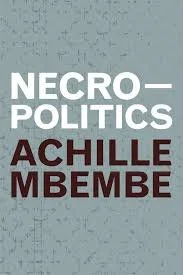
Both Mbembe's original, defining work and the scholarship that has followed in its wake use necropolitics to better understand racist and colonialist state structures, policies, and acts that target specific, "undesirable" populations. These populations include both internal and external enemies, shoring up neoliberal capitalism with the bones of slaughtered subalterns. The necropolitics of Putinism does share some of these elements, as evidenced by the wars in Ukraine. My argument about necropolitics in 21st-century Russia, though, is a bit different. Necropolitics in Russia is more of a process than it is as a stable, defining feature. While Putinism always contained its fair share of necropolitical elements, its early years were more easily understood in terms of a less punitive biopower. It was only after Putin's return to the presidency in 2012 that necropolitics grew to define Putinism itself, though an increasingly cavalier attitude towards the lives and deaths of the country's citizens, its contradictory and devastating policies during the COVID-19 epidemic, the bloody war in Ukraine, and the mass instrumentalization and monetization of the male body that made continuing the war possible.
It would be a mistake to reduce all of Putinism to a necropolitical essence; as I argue in Russian Culture under Putin, the system we call Putinism is not the result of a careful master plan, with fascism as the inevitable endpoint. For years, Putinism had no essence whatsoever, unless that essence was improvisation. Over the years, Putin may have quoted fascist intellectuals such as Ilya Ilyin, or made speeches that appeared to echo the writings of Alexander Dugin. This did not, however, amount to a coherent ideology. Instead, Putin and his team tried out a variety of concepts, retaining the ones that caught on and abandoning those that didn't. Some of his signature repressive policies, such as the "gay propaganda" law of 2013 and its even more draconian successors, were cases of the central state's adoption of initiatives that had initially been put forth on the local level ("gay propaganda" bills were proposed throughout the country before a version of them became national law).
On the other hand, the overall trajectory from a generally permissive culture to authoritarianism will likely make it difficult to see the regime's fascist turn as contingent rather than inevitable. When Sartre famously proclaimed in 1945 that "existence precedes essence," he was talking about the individual human, for whom meaning or purpose is a work in progress, whose "essence" can only be pinned down when existence has finished (i.e, after death). Putinism seems likely to be defined, retroactively by its final form, one that will be "finished" (i.e, perfected) because it has finished (i.e., ended). Rather than a complex historical process with false starts and intermittent successes, Putinism will be read like a novel, with foreshadowing and leitmotifs pointing to a conclusion that seems foretold.
Next: Necropolitics and the War at Home