Historians and journalists who have argued for an authoritarian understanding of Putinism since well before the 2014 invasion of Ukraine have marshaled one set of dramatic and bloody events in support of their argument: a series of bombings in three different Russian cities during September 1999. On September 4, a car bomb killed 64 people in an apartment building in Dagestan. Five days later, another explosion took the lives of 106 people in an apartment building in Moscow. A third bomb yielded the most casualties in another Moscow apartment building on September 13, killing 119 people. The total injured in all three incidents was 582. Other bombing were apparently foiled. The government blamed Chechen rebel leader Shamil Basayev, who had recently invaded Dagestan as part of the latest in a series of incidents following the first Chechen War (1994-1996). Hundreds of Chechens were rounded up as suspects, and dozens were convicted of the crimes.
To this day, the official story of the bombing has not changed, but circumstances have raised doubts about its veracity. American and Russian journalists, and, most notably Alexander Litvinenko, the Russian defector who would die of polonium poisoning in 2010, view the 1999 bombings as a turn-of-the millennium Reichstag Fire, a false flag operation mounted to justify retaliatory violence and make the case for the country's incoming leader. Just weeks before, Putin had become Prime Minister, the fifth man to occupy this position in three years. This was after a year as head of the FSB, the successor to the intelligence organization in which he had made his Soviet-era career. In The Corporation: Russian and the KGB in the Age of President Putin (2009), historians Yuri Felshtinksy and Vladimir Priblyovsky assert that the bombing were the work of the GRU (the Main Directorate of the General Staff of the Armed Forces of the Russian Federation), which allegedly dispatched its officers to Dagestan, and the FSB, which allegedly masterminded the explosions in the other cities. American journalist David Satter testified to the US House of Representatives that the bombings were part of "Operation Succession," a complicated plan to save the Yeltsin clan from future prosecution by driving up Putin's popularity before his appointment as Acting Prime Minister just four months after the attacks. This theory gained its broadest exposure to the American public in M. Gessen's The Man without a Face: The Unlikely Rise of Vladimir Putin (2012).
Was Vladimir Putin behind the 1999 bombings? As a question of legal and moral culpability, the responsibility for the 1999 explosions is undeniably important, especially if the trail leads back to the future president himself. But I am not in a position to say conclusively, nor, for the purposes of this book (and only for the purposes of this book), is there any need to come down on one side or the other. What is important is that this story has been found credible by a significant segment of Putin's opponent (and even, possibly, his supporters). Whether or not he and his security forces are guilty of this crime, Putin came to power in the wake of a series of bloody incidents that many lay at his feet. And even before he became president, as Prime Minister he used the bombing as the pretext for air strikes on Chechnya, followed by the declaration that Chechnya's parliament was illegitimate on October 1 and the dispatch of Russian troops. This was the beginning of the Second Chechen War, a bloody conflict would last until 2009, resulting in a staggering death toll and leaving cities in ruins.
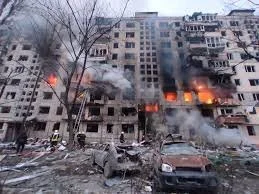
Source: Wikimedia
Even if the FSB was not behind the bombings, it is the case that Putin ascended to the presidency using the war in Chechnya as the latest justification for the importance of a "firm hand" on the levers of federal power. The war itself, though unfolding on Russian territory, could still be experienced by Russian non-combatants as a far-off, necessary crackdown on separatist extremists. Consistent with Mbembe's formulation of necropolitics, this years-long military conflict targeted a group that was easy for both the government and the majority population to consider disposable: estimates of Chechen civilian casualties for both Chechen Wars combined range from 100,000 to 300,000. This reinforces the argument that the Putin regime was built on bloodshed from the very beginning, if one knows where to look.
This in itself would not make the Russian Federation unique; quite to the contrary. This is why it is also an oversimplification. Early Putinism (that is, Putin's first two terms as president along with his sole stint as prime minister) was an attempt at the same kind of necropolitical bargain that has characterized so many modern states since World War II: brutal necropolitics for marginalized, preferably far-off communities facilitates, and is facilitated by, a lighter touch with the majority population. The Chechen Wars were, like so many contemporary wars, televised (selectively, with censorship); the public could simply turn them off. High oil prices raised the standard of living in the urban parts of the country, while the government demanded little of its population besides a tacit commitment to stay out of trouble.
Next: One of Our Submarines (Is Missing)